



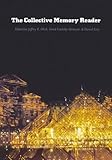
Jeffrey K. Olick, Vered Vinitzky-Seroussi, Daniel Levy, eds. The Collective Memory Reader. New York: Oxford University Press, 2011. xviii + 497 pp. $99.00 (cloth), ISBN 978-0-19-533741-9; $39.95 (paper), ISBN 978-0-19-533742-6.
Reviewed by Cynthia Comacchio (Wilfrid Laurier University)
Published on H-Memory (December, 2011)
Commissioned by Catherine Baker (University of Hull)
[Untitled: Cynthia Comacchio on The Collective Memory Reader]
The editors of this collection are sociologists and respected scholars in the multidisciplinary/interdisciplinary study of collective, or, as they prefer, social memory. Their selection of ninety textual excerpts is culled carefully from the thousand or so that they considered, and includes their own contributions to testify to their participation in memory studies. As they point out, the field's development in the late twentieth century, while clearly related to the "supposed rise of memory" after mid-century, is neither explained entirely by--nor is it "reducible to"--that multifarious cultural and political phenomenon (p. 29). Thematically organized in five sections, the texts that they offer to support this premise range widely, both historically and methodologically. Part 1, "Precursors and Classics," lays out the historical context with a sampling of the more familiar theorists, though perhaps from subject contexts other than memory: Edmund Burke and Alexis de Tocqueville, Ernest Renan, Friedrich Nietzsche, Sigmund Freud, Karl Marx, Walter Benjamin, Theodor Adorno, and Claude Lévi-Strauss, to cite a few. Other selections, such as the important perspectives offered by Egyptologist Jan Assmann (in part 2, "History, Memory, Identity"), cultural theorist Aleida Assmann (in part 4, "Media and Modes of Transmission"), and social psychologists Harald Welzer, Sabine Moller, Karoline Tschuggnal, Olaf Jensen, and Torsten Koch (also part 4), have not been widely available in translation from their original German. The mix of the familiar and the novel is precisely the quality that a thought-provoking anthology should demonstrate.
The jointly written introduction is contextual, expository, and reflexive. The editors consider the contemporary context for the burgeoning of memory studies in the past thirty years, noting the cultural underpinnings of the so-called memory boom, its politicization, and the critiques of what some have seen as the resultant "memory industry".[1] Examples of the latter are also excerpted in this volume.[2] Their express purpose, however, is to trace the antecedents for this recent flurry of interest as it has evolved "since even before its consolidation in scholarly and public discourse in the 1920s and with increasing frequency since the 1980s" (p. 5). Emphasizing the relationship of memory and modernity and the diverse ways in which memory has served the modern nation-state, they focus on the analytical watershed represented by Maurice Halbwachs's 1925 study, Social Frameworks of Memory. This close discussion of Halbwachs's work, which conceptualized collective memory as it has come to be understood, opens into a review of its "complex inheritance" (pp. 22-25); the latter is made evident in references to Halbwachs in any number of the texts that follow. Jeffrey Olick, Vered Vinitzky-Seroussi, and Daniel Levy introduce the major questions, themes, and issues that have arisen within and around the varied disciplinary perspectives on memory, in particular the relationship of memory, war, and the Holocaust. Their consideration of what constitutes memory studies includes a concise outline of sociological, historiographical, psychological, and anthropological perspectives. Expansive, articulate, thorough, and thought-provoking, this introductory essay concludes with an explanation of their selection criteria and the "rigorous editing" process that they employed to "extract the key durable ideas from complex texts" (p. 47) in order to put together a collection that has recognizable "value added" (p. 48). This, to my mind, they have admirably succeeded in doing.
The editors' thoughtful provision of all that might be useful in a reference compendium makes this collection a model in that regard. The preface contains a bibliography of original source information for each excerpt according to its order of appearance in the sections that follow. Their comprehensive introductory essay concludes with fourteen pages of references that trace the relevant scholarship through the twentieth century and into the twenty-first, with particular emphasis on the past thirty years. The opening part, "Precursors and Classics," is followed by an exploration of "History, Memory, and Identity" in part 2. In addition to Jan Assmann's discussion of what he calls "mnemo-history," which posits traditions as "phenomena of collective memory" (p. 210), part 2 includes the co-editor Olick's attempt to breach the "cultural divide" in psychological and sociological approaches to memory and the historian Alan Megill's thoughts on whether "the tension between the historical and the mnemonic can ever be overcome" (p. 197)--and, more to the point, on whether it should be.
Part 3, "Power, Politics, and Contestation," features the omnipresent Michel Foucault, although from an interview on "film in popular memory" rather than the standard works; the renowned British Marxist historians Raphael Samuel and Eric Hobsbawm on the political uses of heritage; and an incisive methodological critique by the U.S. historian Wulf Kansteiner. Part 4, "Media and Modes of Transmission," includes the seminal work of Aleida Assmann, as noted, here discussing "canon and archive" (pp. 334-347) in their roles as technologies of memory; a selection on incorporated and inscribed memory from the British sociologist Paul Connerton's landmark analysis, How Societies Remember (1989); the co-written study, noted above, by Welzer, Moller, Tschuggnal, Jensen, and Koch on family dynamics and the generational transmission of memory; and the U.S. media scholar Barbie Zelizer's critical consideration of the "distant cousin" relationship of memory and journalism (p. 358). This section also presents the co-editor Vinitzky-Seroussi's argument for understanding commemorations of “difficult pasts"--exemplifed in this case by the assassination of Yitzak Rabin--as “fragmented,” rather than by means of the more straightforward, but decidedly less nuanced, category of "dissensual" (pp. 375-377).
The volume wraps up strongly with a section on "Memory, Justice, and the Contemporary Epoch." The editors characterize this section as "the broadest in the entire volume" in its attention to the relational nature of contemporary interest in memory and memory's role in contemporary culture (p. 399). Pierre Nora's inclusion is a given, but, here again, they have chosen from his critical reflections on his own work's contribution to the "memory boom" rather than the inaugural work itself, which is widely known and available. Also stimulating is the argument by the Canadian philosopher of science Ian Hacking that "memoro-politics" emerged with the late nineteenth-century development of a "depth knowledge" of memory as an approach to "the soul" that science could not study (pp. 408-410). This section, and the volume, closes with three studies that raise necessary questions about "the obligations of memory" with respect to transitional justice and "our obligations to it" in ethical terms (p. 400), focusing on the Holocaust (Daniel Levy, one of the co-editors, and Natan Sznaider), mass atrocity and international law (Mark Osiel), ethics (Avishai Margalit), and the politics of forgetting (Marc Augé and Paul Ricoeur).
Each section begins with a concise contextualization of its theme or themes, drawing connections between the pieces as well as between the larger sections and briefly addressing their relevance to memory studies. Each excerpt is prefaced with a contextual note that identifies and situates the writer in the larger subject field and scholarship. Finally, the subject and author entries in the index make for quick and efficient searching. Taken individually, these selections deepen our understanding of memory studies; taken together, they provide a historical grounding that effectively constitutes a collective memory of the subject itself. The editors have deftly arranged the materials in such a manner as to bring out coherence and continuity, the historic threads binding perspectives through and across time, without eliding difference and discontinuity and changes over time. This is the messy work of history and memory. Needless to say, untangling these threads without breakage poses a daunting task for anthologists, but it is masterfully achieved here. Although I have barely touched on the ninety-some entries individually, they are by and large North American and European; it would be interesting and useful to see how cultures outside these geographic bounds, and their scholars, conceptualize memory. Nonetheless, this collection is impressive on so many levels that it is difficult to avoid the pat assessment that this is a “must-have book" for all scholars and students, novice or veteran, interested in the encompassing subject matter.
Notes
[1]. The editors provide a summary of the main points of criticism in their introductory essay (pp. 29-30, 32-33), citing, for example, Charles Maier, "A Surfeit of Memory? Reflections on History, Melancholy and Denial," History and Memory 5, no. 2 (1993): 136-152; Noa Gedi and Yigal Elam, "Collective Memory: What is It?" History and Memory 8, no. 2 (1996): 30-50; Alon Confino, "Collective Memory and Cultural History: Problems of Method," American Historical Review 102, no. 5 (1997): 1386-1403; and Kerwin Lee Klein, "On the Emergence of Memory in Historical Discourse," Representations 69 (2000): 127-150.
[2]. For example, Confino in part 2 (pp. 198-200); Eric Hobsbawm in part 3 (pp. 271-274), Charles Maier in part 5 (pp. 442-445), and Ian Hacking in part 5 (pp. 407-410).
If there is additional discussion of this review, you may access it through the network, at: https://networks.h-net.org/h-memory.
Citation:
Cynthia Comacchio. Review of Olick, Jeffrey K.; Vinitzky-Seroussi, Vered; Levy, Daniel, eds., The Collective Memory Reader.
H-Memory, H-Net Reviews.
December, 2011.
URL: http://www.h-net.org/reviews/showrev.php?id=34417
 | This work is licensed under a Creative Commons Attribution-Noncommercial-No Derivative Works 3.0 United States License. |

