



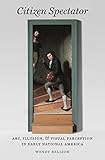
Wendy Bellion. Citizen Spectator: Art, Illusion, and Visual Perception in Early National America. Chapel Hill: University of North Carolina Press, 2011. xviii + 351 pp. $45.00 (cloth), ISBN 978-0-8078-3388-9.
Reviewed by Aaron Wunsch (University of Pennsylvania)
Published on H-SHEAR (August, 2012)
Commissioned by Brian Luskey (West Virginia University)
Seeing Things in the Early Republic
Academicians following the roller coaster removal and reinstatement of University of Virginia president Teresa Sullivan this summer have been left to wonder what to make of these events. According to a recent article in the Washington Post, “One of the first lessons experts draw from the episode is a reminder that there is a greater expectation of transparency from leaders now than in the past.”[1] But which past? The Post itself notes that “Jeffersonian traditions” made such expectations especially keen at UVA. Were the article’s author to read Wendy Bellion’s recent book, Citizen Spectator, she would realize that the ideal of transparency was alive and well in the age of Jefferson, when it was fraught with rich cultural meaning. Perhaps a more apt term, at least in the eyes of UVA faculty, would be “undeceiving,” which Noah Webster defined as liberation from “deception, cheat, fallacy, or mistake” (p. 14).
An art historian by training, Bellion has used visual metaphors in a host of media to tease out new meanings from old images. Nor does her project end there. While paintings by the Peale family and engravings by the father-son duo of William and Thomas Birch provide the book’s center of gravity, Bellion takes her readers on a wide-ranging romp through early national politics, society, and technology, encompassing the solar microscope, magic lantern shows, Democratic-Republican clubs, the pantograph, counterfeit cash, and the Invisible Lady. And while, subtitle notwithstanding, the book focuses on Philadelphia, Bellion’s awareness of American and European context is a safeguard against provincialism. Philadelphia was itself the most cosmopolitan and optically advanced city in the new republic, even after it ceased serving as the capital. As such, it functions less as a representative sample (and where would one find that?) than as a glittering achievement--albeit one plagued by disease and noxious odors.
One tension that animates Citizen Spectator is “a cultural dialectic of deceit and discernment” that Bellion discovers at work in the new nation’s artistic production and political discourse (p. 5). Preoccupied with vision and the devices that manipulated it, Americans were vigilant, even paranoid, about the presence of forces that might abridge their liberties, conceal the mechanisms of power, or cloud their judgment. (The latter term’s dual relevance to aesthetics and everyday life, where the consequences of duping could be dire, is itself a key thread in Bellion’s argument). In light of all this--and there is no escaping Enlightenment metaphors--it should come as no surprise that trompe l’oeil pictures were a particular source of fascination to early museum-goers. They loved the trick almost as much as they loved undoing it, or believing they had done so, or telling stories about themselves or others being fooled. In an age of rationalism and empiricism, testing the limits of knowledge acquired through the senses measured everything from one’s “taste” in art to one’s qualifications for republican citizenship.
Bellion has divided her study into six chapters. Of these, the second, third, and last are arguably the most strictly art-historical. Focusing respectively on Charles Willson Peale’s Staircase Group (1795), the prints comprising William and Thomas Birch’s The City of Philadelphia, a.k.a. Birch’s Views (1798-1800), and illusionistic painting’s broad shift from a vehicle of self-awareness to one of nostalgia and escapism in the 1820s, these essays deal extensively with the form, light, and the circumstances of composition and display. Perspective is analyzed with special acuity in the work of the Birches. Yet even in these chapters, Bellion is careful to take her readers further afield, emphasizing, for instance, the role of Jay’s Treaty in heightening fears of deception in the 1790s or the ways Philadelphia’s grid conditioned the Birches’ experience and depiction of their chosen subjects.
Other chapters venture still further afield. The first is an instructive tour of the kinds of optical instruments that fascinated the Peales and their audiences, and also of the kinds of spaces and theories of perception that made these tools function as they did. Nor were such encounters exclusively ocular and cerebral. In this chapter and others, Bellion is at pains to demonstrate the ways in which concerted viewing, both in and out of doors, was also an act of “bodily engagement.” Chapter 5 confronts us instead with bodily displacement. Debuting in Paris but coming quickly to Philadelphia, a contraption known as the Invisible Lady offered audiences the disembodied voice of a woman who could see them but could not herself be seen. Bellion interprets this novelty as simultaneously broaching and containing the possibility of contemporary women’s participation in the public sphere.
Not all of Bellion’s arguments are equally persuasive. After a fascinating piece of detective work revealing the Staircase Group’s original location in Independence Hall, she shows us how subject (Charles Willson Peale’s sons, Titian and Raphaelle), pose, and accompanying props all point to the presence of Peale’s Museum in nearby Philosophical Hall. But were the sons in this setting also meant to be read as allegories of Theory and Practice? And did this pairing, in turn, assert the republicanism of the elder Peale’s favored art academy against the alleged monarchism of its challenger? Readers’ answers to these questions may depend on their own standards of evidence or those of their respective disciplines.
A similarly accretive line of reasoning attends the explanation of the multiple (and thus contradictory) vanishing points found in Birch’s Views. That this lack of consistency, too easily dismissed as a lack of skill, in fact betokens a more somatic, less rationalistic, approach to the cityscape seems plausible. That it also “manifests the spatial dislocations that Philadelphia underwent during the late 1700s” is more of a stretch (p. 152). No matter. Even when Citizen Spectator is less than convincing, it is still suggestive, insightful, and provocative.
Perhaps a more serious quibble involves uneven recourse to related scholarship. The book’s primary-source research is strong, especially in the realm of newspapers and pamphlets. Secondary sources on art and vision (notably the work of Jonathan Crary), on the Peales, and on trompe l’oeil are amply cited too. But why do relevant books like Dell Upton’s Another City (2008) or Jane Kamensky’s The Exchange Artist (2008) escape mention? The answer may lie in their relatively recent publication date and the time it takes to get a manuscript to press. Likewise, we may forgive Citizen Spectator’s omission of a bibliography--presumably a publisher’s decision and one mostly for made up for through detailed and instructive footnotes.
All in all, Citizen Spectator is an excellent and useful book. Exemplifying her field’s recent willingness to explore material culture, geography, and bodily experience, Bellion’s work will be of interest not only to art historians but also to historians of the early republic and, indeed, to general readers. Specialists in Philadelphia, the Peales and their institutions, and the history of optics will be especially gratified. And for scholars who are more familiar with the literature on illusion, deception, and social anxiety in the mid and late nineteenth century (think Barnum, confidence men, and painted women), this book serves as reminder that such phenomena, too, had a prologue.
Note
[1]. Susan Svrluga, “Higher-education Experts Draw Lessons from Crisis,” Washington Post, June 27, 2012.
If there is additional discussion of this review, you may access it through the network, at: https://networks.h-net.org/h-shear/.
Citation:
Aaron Wunsch. Review of Bellion, Wendy, Citizen Spectator: Art, Illusion, and Visual Perception in Early National America.
H-SHEAR, H-Net Reviews.
August, 2012.
URL: http://www.h-net.org/reviews/showrev.php?id=34370
 | This work is licensed under a Creative Commons Attribution-Noncommercial-No Derivative Works 3.0 United States License. |

