



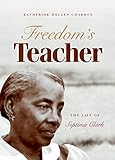
Katherine Mellen Charron. Freedom's Teacher: The Life of Septima Clark. Chapel Hill: University of North Carolina Press, 2009. xvi + 462 pp. $35.00 (cloth), ISBN 978-0-8078-3332-2.
Reviewed by Edward A. Janak (Department of Educational Studies, University of Wyoming)
Published on H-Education (February, 2012)
Commissioned by Jonathan Anuik (University of Alberta)
Uncovering “The Figure under the Carpet”
Visitors new to the Lowcountry of South Carolina who travel outside the historic downtown district might, if they are paying attention, notice a trend: there are lots of things named after Septima Clark. For example, there is the emerging Septima Clark Parkway, a road that reunifies neighborhoods formerly divided by the Crosstown Expressway and joins the Cooper River and Ashley River bridges; and the Septima Clark Corporate Academy, a magnet school located on James Island, offering credit recovery opportunities to struggling high school students from across the city of Charleston. Visitors might, upon reflection, wonder who Clark was, a woman so deserving of multiple honors.
Katherine Mellen Charron answers that question in her excellent book Freedom’s Teacher. The work is fascinating in that each chapter begins with commonly held assumptions about the life and context of the educator and civil rights pioneer, then takes the reader on a detailed, elaborately written narrative that is anything but common. Through her clear and deft writing style, Charron allows the subtle nuances of Clark’s life to refute what needs refutation and reinforce what needs reinforcing, while never getting bogged down in heady prose or lofty approbations. Indeed, when presenting the life of a subject as highly regarded as Clark, it would be easy to fall into hagiography, a trap Charron deftly avoids. In doing so, Charron grounds the life of Clark in the greater context of the experiences of African American women in the South.
As a work of biography, Charron’s book is excellent. A purpose of crafting biography is to uncover what biographer Leon Edel refers to as “the figure under the carpet, the evidence in the reverse of the tapestry, the life-myth of a given mask.”[1] In this task, Charron succeeds fully, giving the reader not just a series of events in the life of the remarkable educator but also a glimpse as to why and how young Septima Poinsette became “THE Septima Clark.”
Charron’s efforts at pulling back the carpet begin in chapter 1, “Home Lessons,” which summarizes Clark’s family background, early life, and education. This chapter begins by demonstrating Charron’s skill in detailing the complexity of the times in which Clark was coming of age. Particularly notable are the explanations of the multivariate black social structure, the differing purposes of both black and white schools, and the conflict between racism and the memorialization of public spaces at the time. This chapter begins by portraying the ongoing resistance Clark was exposed to her whole life, experiences that would shape her into the civil rights leader she would become later.
Chapter 2, “Taking up the Work,” explores Clark’s first teaching position on Johns Island, South Carolina. Since African Americans were legally banned from teaching in the city schools, Clark had to leave the city of her birth and travel to the rural location, then only accessible by water. Providing an interesting view of rural teaching at the time, this chapter continues painting a nuanced portrait of the seminal experiences that helped shape Clark, including students who spent more time in the fields than in the classroom, a lack of textbooks and classroom supplies, and the prospect of beginning a career completely devoid of any support. Indeed, Clark’s first classroom was a textbook example of why segregation was so horrible. In Charron’s words: “separate and unequal education targeted children, whose value the white state measured only by the economic potential of their labor. It was an insidious evil, sustaining itself throughout the twentieth century. But the denial of educational opportunity did not look evil at all. On the contrary, it appeared as normal as the noonday sun.” These experiences, coupled with unfathomable levels of adult illiteracy, instilled in her a desire to find ways to “confront ordinary evil when neither flight nor fright was an option and progress was a necessary mandate” that relied on both northern philanthropy and the support of local black communities (p. 53).
Chapter 3, “Singing the Blues in the New Reconstruction,” examines Clark’s transition from teaching on Johns Island to teaching at the private Avery Academy, her alma mater, in Charleston, to teaching in Hickory, North Carolina, against the backdrop of the expansion of Jim Crow laws. This chapter also marks the launching of Clark’s explicit political activism. A charter member of the Charleston National Association for the Advancement of Colored People (NAACP), Clark met W. E. B. DuBois, a meeting that served as a wake-up call of sorts for the already activist-minded Clark and her colleagues. Charron is up front in sharing the mixed blessings that arose from these struggles; for example, while the group managed to get a law passed banning white teachers from black schools and allowing black teachers into the city of Charleston for the first time, it also codified and legalized segregated schooling statewide. This mixed reward carried through with Clark’s personal life, marked in this period by marriage, children, and the deaths of a child and her husband.
The following chapter, “Political Training Grounds,” explores Clark’s return to Charleston, teaching at the Promise Land School she had left on Johns Island, and eventual relocation to the state capital to teach at the much lauded Booker T. Washington School. There, Clark became professionally involved with Wil Lou Gray and the adult education movement in the state. She continued her education, earning a degree from Benedict College, and worked with a variety of political reform movements related to education. These experiences provided her with much of the raw material from which she would build her career fighting for civil rights.
In chapter 5, “The Battle Transformed,” Charron focuses on how Clark fell in with the national post-World War II movements to fight for racial equality. While many teachers chose to remain mum during the time, Clark broke with her long-joined union to fight for higher teacher salaries for black teachers. Stemming from those efforts, Clark moved from a rank-and-file NAACP member in Columbia to a leader in Charleston, upon her moving home once again.
Charron demonstrates her thorough understanding of the unique mélange of sociopolitical flavors that make up Charleston in chapter 6, “Crossing Broad.” It was during her activist years, in this period, that Clark had a profound influence on legal history, as black and white citizens began to work together in the name of racial justice. While blacks during the period were effectively disenfranchised with the increase of more racist and draconian Jim Crow laws throughout the American South, it fell to white citizens, such as South Carolina federal Justice J. Waties Waring, the judge whose increasingly progressive rulings would eventually form the legal framework of the U.S. Supreme Court’s Brown v. Board of Education of Topeka (1954) decision, to continue the battle. Charron effectively explores the complex, sometimes tenuous intertwining of the white and black societies of Charleston, and Clark’s place navigating both worlds.
Beginning in the Highlander Folk School of Tennessee, chapter 7, “Bridging Past and Future,” explores the next step in Clark’s evolution from teacher-activist to civil rights icon. While Clark had been active in a variety of civil rights campaigns in the Carolinas, it was at Highlander that she truly came to terms with her commitment to social and political activism beyond her classroom and profession, as well as came to learn that true reform must be from the grass roots, not the elite. It was through Highlander that Clark learned the model for the Citizenship Schools, first as a pilot program to increase voter registration back on Johns Island, then increasing literacy and voter registration on a more regional scale. Combining what she had learned in adult education with her background in activism, Charron argues that it was Clark, “not [Highlander School founder Myles] Horton,” who “recognized practical literacy as a key to political liberation for the black grassroots” (p. 217).
Chapter 8, “A Fight for Respect,” details how Clark’s efforts were shaped by, and came to shape, distinctions within the African American community generally and black women specifically. Charron includes comparisons to the work of Ella Baker. Clark and Baker were two women who were similar in that they were “interested in the potential of grassroots people” who shared ideas on how the movement should be organized, and who shared “tribulations as black women working for men who disregarded their opinions” (p. 266). Beyond the support of Horton at Highlander and such activists as Baker, it was in this period, roughly 1956 to 1961, that Clark was jailed for the first time, at the age of sixty-one. This arrest caused the Citizenship Schools to be transferred to the Southern Christian Leadership Conference (SCLC), a move Charron argues was necessary but that caused enormous friction between Clark and the SCLC, as well as with Horton. The schools began to teach people to exercise the legal rights that were being won for them; however, Charron argues that Clark’s voice was becoming increasingly marginalized. She was a woman working in a man’s movement.
Charron contextualizes Clark’s work against the broader civil rights efforts of the time in chapter 9, “Similar and Yet Different.” In it, Charron argues how the Citizenship Schools became a necessary part of greater efforts; “people do not decide to risk their lives and livelihoods because an organizer talks them into it” but rather because “something inside of them changes” (p. 303). For thousands of African Americans, it was Clark’s efforts that led to this transformation. By chapter’s end, Charron explains how the work of Clark and her peers did not end with the passage of the Voting Rights Act of 1965 or the tragedy of Dr. Martin Luther King’s assassination in 1968. Instead, their efforts became embedded in U.S. society, as evinced by the emergence of African American studies programs on campuses nationwide and the emergence of African American women as teachers within such programs as Head Start.
Charron details Clark’s retirement and legacy in the epilogue, “A Right to the Tree of Life.” Most telling is the list featured on page 353, a list of issues Clark identified upon her retirement from the SCLC in 1970. Sadly, as Charron notes, the fact that all items on it “could still apply to the twenty-first century--perhaps suggesting that such problems have only become more entrenched in the ensuing decades--is sobering” (p. 353). However, rather than dwelling on the negative aspects, Charron concludes the work by comparing Clark to the Angel Oak, a tree reputed to be well over 1,400 years old. It is a tree that has survived hurricanes, drought, and property ownership transfers. Charron explains: “it carries scars on its bark and ancient memories in its knobby creases. Some say this Quercus virginiana recalls the Old South. Island women weave sea grass baskets under its canopy. Elderly island people--grandmothers and grandfathers--take youngsters to stand beside Angel Oak, not so they will feel small but so they might imagine, staring up and out as far as they can see, how deep its roots go” (pp. 354-355).
Charron’s book is admirable in its extensive use of primary sources. She allows the voices of the participants in Clark’s life (particularly that of Clark) to speak in an unmediated fashion, a trend sadly lacking in a lot of scholarly work that examines African American lives in the twentieth century. However, if, as Edel argues, the biographer is “a specialized kind of historian,” it must be noted that however strong the use of primary sources and subject’s voices, historiographically, the work is critically lacking.[2] Most notably, any writer covering events from South Carolina’s history must examine the scholarly work of Walter Edgar, the Palmetto State’s historian. Writing on South Carolina history without even a casual reference to the extensive South Carolina: A History (1998) is a significant gap.[3] For example, there are two figures who, while downplayed in the text, were extremely significant contextually in Clark’s life: Governor Coleman Blease and State Superintendent of Education John Swearingen. Blease, one of the most notoriously racist governors in the state’s history, was a man who ran on platforms announcing his policy of pardoning any white man convicted of lynching and perpetuating segregation in the state’s prison systems. While describing him as “rabidly racist” at one point, Charron gives him but three brief mentions (p. 93). Such superficial coverage is unfortunate, considering Blease was the embodiment of everything Clark worked against in her life.
Similarly, Charron presents Swearingen as a figure opposed to federal intervention in education, presenting evidence from a letter he wrote to alert “his U.S. senators to key provisions he found objectionable” (p. 61). Charron missed a few notable facts on Swearingen: firstly, the senators to whom he wrote included his uncle, Benjamin “Pitchfork Ben” Tillman. Secondly, Charron does not mention that Swearingen wrote extensively throughout his career, arguing for the equalization of funding for black and white schools in South Carolina, positioning himself in opposition to his uncle’s politics. Thirdly, while a page later Charron begins presenting an accurately critical portrayal of the racist politics behind northern philanthropic funding, she overlooks Swearingen’s oppositional efforts to these patterns.[4]
It is clear to anyone familiar with South Carolina’s history that while Charron is admirably and intimately familiar with all aspects of Clark’s life, the same cannot be said for the history of the state. This historiographical gap is by no means significant enough to detract from the overall work. What she lacks in state history, she more than compensates with her full understanding and detailed explanation of the incredibly complex sociocultural dynamics that make up Charleston and the Lowcountry. Charron’s stunning, eminently readable writing style pulls the reader in from the outset with opening lines that approach synesthesia. “It is night. A lone black woman walks through a cornfield in South Carolina. The stars wink above her. Crickets and cicadas grow quiet as she passes and then resume their orchestral humming, now punctuated by the sound of rustling leaves a little farther off. She moves toward an unpainted one-room building.... A group of African-American adults will be waiting, eager to learn what has come to teach them. It could be 1863 or 1916 or 1933.... Instead, it is 1964, and she is a Citizenship School teacher” (p. 1).
Any biographers would find this work amazing and a worthy addition to their libraries. Any historian of the civil rights movement would be well suited to pick this up as background and context for understanding a leader and pioneer. A general reader would not be put off by academic prose or overreliance on either citations or notations. Clark’s life is well worthy of such a detailed and nuanced overview; Charron’s book adds to the field appreciatively.
Notes
[1]. Leon Edel, “The Figure under the Carpet,” Biography as High Adventure: Life Writers Speak on their Art, ed. Stephen B. Oates (Amherst: University of Massachusetts Press, 1986), 24.
[2]. Ibid., 20.
[3]. Another of Walter Edgar’s books that would have helped provide some of the missing context is The South Carolina Encyclopedia (Columbia: University of South Carolina Press, 2006).
[4]. For example, when discussing opposition to the General Education Board (GEB), historian Charles Biebel only mentions one state superintendent who actively opposed GEB involvement in a state: John Swearingen. See Charles D. Biebel, “Private Foundations and Public Policy: The Case of Secondary Education during the Great Depression,” History of Education Quarterly 16, no. 1 (1976): 33-34.
If there is additional discussion of this review, you may access it through the network, at: https://networks.h-net.org/h-education.
Citation:
Edward A. Janak. Review of Charron, Katherine Mellen, Freedom's Teacher: The Life of Septima Clark.
H-Education, H-Net Reviews.
February, 2012.
URL: http://www.h-net.org/reviews/showrev.php?id=34367
 | This work is licensed under a Creative Commons Attribution-Noncommercial-No Derivative Works 3.0 United States License. |

