



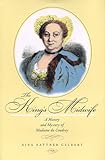
Nina Rattner Gelbart. The King's Midwife: A History and Mystery of Madame du Coudray. Berkeley, Los Angeles, London: University of California Press, 1998. xi + 347 pp. $35.00 (cloth), ISBN 978-0-520-21036-3.
Reviewed by Carolyn Lougee Chappell (Stanford University)
Published on H-France (September, 1999)
Madame Du Coudray (d. 1794) was a mistress matron midwife in Paris who, in 1759, requested and received Louis XV's endorsement of her plan to travel about France instructing local practitioners in the art of delivering babies. The facts of her life--those that form the core of the typical biography--are largely unknown: her family and place of origin, her date of birth, social status, her name itself could not be discovered even by the exhaustive research undertaken by Nina Rattner Gelbart for her unconventional biography The King's Midwife. How Gelbart resolves a double challenge--the lack of crucial information and her own desire to write biography in a new key--provides much of the interest and most of the controversy which this eagerly awaited work will provoke.
From her first teaching stint in the Auvergne in 1751 until her retirement in 1783, Madame Du Coudray crisscrossed France, teaching groups of country midwives and surgeons from every region but the outlying reaches of Brittany, the South, and Alsace. In more than forty cities, perhaps as many as 10,000 women received up to three months of her instruction. Du Coudray earned the title Gelbart bestows upon her--"the national midwife of France" (p. 3)--not only because she was commissioned by the king and given a nationwide mandate by him but because in the course of her originally humanitarian work she reframed her "obstetrical mobilization of the country" (p. 75) in the discourse of national repopulation.
Breveted and funded by the king, she created and shrewdly exploited extraordinary networks: she was an object of solicitude from intendants, a subject in their correspondence with the crown and with each other, a protege of the controller-general Laverdy and ministers like Emmanuel d'Aiguillon and Jacques Necker, of the famed medical monk Frere Come, of the royal first surgeon La Martiniere and the naval surgeons at Rochefort. Buffeted by crises in royal finance, local resentments against an outsider, male aversion to a pushy woman, and the rises and falls in the monarchy's popularity, she ingratiated with her skill even as she offended with her vanity, her undeferential brashness, her self-promoting flaunting of the royal endorsement, and her dismissal of any gender limits on her field of operation. She was a paradox: a teacher ever in search of her next class, a spinster and childless madame with a "niece", and an independent businesswoman always short of funds. She hawked her wares like an itinerant peddler: her lessons, her life-sized obstetrical mannequin, which could simulate various difficulties in delivery, and successive editions of her how-to birthing manual.
Gelbart credits to Du Coudray's work with contributing to the drop decline in infant mortality that made the French population rise in the second half of the eighteenth century. She maintains that Du Courdary's activities also contributed to the survival of midwifery into the nineteenth century despite the male medical establishment's efforts to supplant it. And through it all, Gelbart concludes, Du Coudray showed that women in the eighteenth century could "secure a privileged professional niche for themselves" (p. 280). At least, they could if they were determined, brash, and willing to "scramble cultural expectations" (p. 280), and if they were savvy enough to conciliate the patriarchy by obeying the Church, political authorities, and the medical establishment. It was not an easy task, for women had to persevere through harassment, disapproval, and physical and emotional hardships.
Gelbart presents Du Coudray's story with as much immediacy as an innovative style can muster. She personally retraced the midwife's steps around France, tapping the holdings of several dozen Archives departementales, especially Du Coudray's own letters and the intendants' correspondence with the controller-general. She organizes the narrative in sixty-three date-line entries corresponding to the retrievable episodes in Du Coudray's itinerary. To recapture the way Du Coudray experienced them and to draw herself and her reader inside the itinerary, Gelbart uses the present tense throughout and raises at each juncture the issues she imagines the mistress midwife might have pondered: "Will the new ministers in power, whoever they are, regard her mission favorably and continue to facilitate things for her?" (p. 105) Maps in which Gelbart reconstructs the itineraries, illustrations from Du Coudray's book, and reproductions of a variety of personal documents further enliven the narrative.
Gelbart is very skilled in analyzing texts and superbly embeds Du Coudray in context with a number of rich vignettes. For example, she paints a gripping and graphic composite scene of a childbirth synthesized from knowledge about eighteenth-century midwifery practices and modern medicine as well as from the empathy born of personal experience. There is also a wonderful evocation of Paris in May 1745 when a group of midwives including Du Coudray petitioned for instruction from the Faculty of Medicine. The author also provides a description of the seasonal round of tasks and responsibilities into which rural women had to insert the midwifery course; descriptions of each city Du Coudray visited and the rigors of travel between them; and a restaging of the lessons as they could be extrapolated from the midwife's own manual.
Two fundamental dimensions of the study are, however, contestable: Gelbart's too ready assumption of Du Coudray's historical importance and her overly engaged mode of biography. Gelbart's project itself, her vaunting of Du Coudray as a heroine or "secular saint" (p. 20), her righteous evocation of the injustices Du Coudray endured as well as her ascription to Du Coudray's work of an impact on national death rates and the survival of midwifery rest upon an entirely unsubstantiated assumption about the effectiveness of her methods.
How did Du Coudray's work compare to that of her numerous rivals, some of whose even larger books were also sponsored by the crown and distributed at government expense, or to the mannequins of competing makers, or to the courses lauded by such prominent medical reformers as Tissot and Alphonse Le Roy as well as by the Gazette de santé? Did reformers ignore or denigrate her only because she represented a "threat to their entrenched birthright of power" (p. 203)? Was the substance of her lessons (in print and in person) sound by the light of modern medicine? Superior to contemporary practices? As good as or better than that of her rivals? By how much? It counts for something that so many respondents to the 1786 survey by the Royal Society of Medicine and to Felix Vicq d'Azyr's 1790 investigation of rural medical practice testified to Du Coudray's influence, but that is still far from establishing the effects of her activities.
This is the vindication Du Coudray may have wanted: an appraisal and appreciation of her work, to which she assiduously drew attention, bypassing her interior life, which she did everything she could to keep hidden--as do many women who close up because they have been buffeted, determined to hang on at least to themselves. "She is as unconfessional as they come" (p. 12), says the author. In this respect, Du Coudray's first biographer is certain not to be the one she would have wanted, for Gelbart sets out to expose "the woman behind the mask" (p. 281), to get to "the feminine core of her being... her feelings" (p. 9). Readers will respond variously to the way Gelbart is led in this pursuit to adopt a certain breeziness of tone, an intrusive omniscience, and an identification between author and subject that collapse the distance between past and present.
The breezy style might be lamented as anachronistic or praised as engaging. Gelbart has the village matron, on whose monopoly Du Coudray's new pupils infringe, complain of the "big-shot" (p. 80) and her "new-fangled" (p.79) methods. Du Coudray she calls "a national star" (p. 95), her stay in Châlons (where she has "fans") a "huge hit" (p. 164). Intendant Le Nain is "smitten" with her (p. 100). It is, perhaps, less benign when motives and styles of thinking get imputed to Du Coudray: "If the surgeons think she will be cowed by their snub, waiting submissively for the affair to blow over, her activism for the petition shows otherwise. What satisfaction there would be in turning the tables on them some day!" (p. 44). Later, "she is less inclined than ever to look back with nostalgia. Her aim is to move ahead" (p. 57); "that she experienced again and again the wonder of it I feel certain" (p. 282); "she believes she holds the upper hand"; "she no doubt wished...." (p. 282). Such projection invents an interior life on which the sources are silent; the historian, deeply involved with the subject, comes to feel confident reading her own ways of thinking and feeling into Du Coudray's past: "I think I came to understand why she did as she did." (p. 281). In the end, Gelbart confesses to being happy that Du Coudray's "desire for concealment prevailed" (p. 281), for then she can, in filling in, "assert my needs also" (p. 283).
From the opening lines of the book, Gelbart puts herself squarely in the story: flauntingly, openly inserting herself with Du Coudray as the axis of the study. "We were in a struggle, she and I" (p. 9); I "thought of her as mine" (p. 6); "I am spellbound" (p. 3). The project is an encounter between two personalities, a self-indulgence for the historian, a new romanticism revelling in the particularity of the viewer, to which all historians are fated, but which some struggle to counter. Gelbart, finding that "distance is hard to keep" (p. 11), offers a truly marvellous description of the "intense, reciprocal relationship" (p. 11) between biographer and subject, the two of whom at once collude and compete: "a 'catalytic conjunction' occurs here; writer and subject are in this together, and the interaction is complicated. Explicitly acknowledging this negotiation is not perverse, and can yield surprises" (p. 11).
Yet is the historian justified in moving into the empty spaces of the historical record to make it her own ego-document? Is the subject really, as Gelbart says, "my midwife" (p. 6)? Should the reader hear Gelbart's voice in Du Coudray's words and see Gelbart's face in the story's mirror? To re-cast the portrait encounter with which Gelbart opens the book, does not Du Coudray's gaze fix not on Gelbart alone, but on all the unknown and undifferentiated strangers who will intersect the trajectory of that gaze, none of whom can appropriate it as her own, each of whom is obliged to try to express as much as possible of the viewpoint of the many who pass through? Or must Du Coudray be prey to reconstruction by everyone's private sensibility?
The King's Midwife is an important work that deserves the attention it will receive. In the end, it is perhaps in being controversial that it is truest to its subject. Gelbart, like Du Coudray, determined, in hopes of being a pioneer, to set out on a risky road. In this respect, would Du Coudray have had it any other way?
Copyright 1999 by H-Net, all rights reserved. This work may be copied for non-profit educational use if proper credit is given to the author and the H-France list. For other permission, please contact H-Net@h-net.msu.edu.
If there is additional discussion of this review, you may access it through the network, at: http://www.uakron.edu/hfrance/.
Citation:
Carolyn Lougee Chappell. Review of Gelbart, Nina Rattner, The King's Midwife: A History and Mystery of Madame du Coudray.
H-France, H-Net Reviews.
September, 1999.
URL: http://www.h-net.org/reviews/showrev.php?id=3424
Copyright © 1999 by H-Net, all rights reserved. H-Net permits the redistribution and reprinting of this work for nonprofit, educational purposes, with full and accurate attribution to the author, web location, date of publication, originating list, and H-Net: Humanities & Social Sciences Online. For any other proposed use, contact the Reviews editorial staff at hbooks@mail.h-net.org.

