



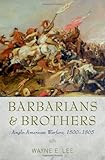
Wayne E. Lee. Barbarians and Brothers: Anglo-American Warfare, 1500-1865. Oxford: Oxford University Press, 2011. ix + 340 pp. $34.95 (cloth), ISBN 978-0-19-973791-8.
Reviewed by Guy Chet (University of North Texas)
Published on H-War (December, 2011)
Commissioned by Margaret Sankey (Air University)
Grammars of Violence and Restraint in War
Wayne E. Lee’s Barbarians and Brothers approaches war as a cultural interaction between societies. In eight chapters, Lee examines eight early modern campaigns--drawn from the Anglo-Irish wars, the English Civil War, Anglo-Indian warfare, the War of American Independence, and, by way of conclusion, the American Civil War--in which English or American troops faced “brothers” or “barbarians.” Situating these case studies within a broad historical context and an anthropological framework, Lee argues that martial conduct is a means by which warring parties communicate with one another. A common grammar of violence enables combatant “brothers” to reliably convey intent and infer meaning. In wars against “barbarians,” perceiving and comprehending enemy violence, as well as martial restraint, requires conscious efforts of cultural translation.
In the introduction, Lee identifies four categories with which to analyze the administration of military forces: capacity, control, calculation, and culture. In the chapters, which offer detailed narrative accounts of tactical engagements and campaigns, Lee relies on these categories to explain instances of extreme violence (“frightfulness”) and restraint, in wars against both brothers and barbarians. The analysis provided in the chapters presents solid “real world” evidence--accounts of expeditions, soldiers, commanders, and governments--which substantiates the theoretical model proposed in the introduction. These case studies illustrate that combatants approached hostilities with a default mind-set of restraint (even in wars against barbarians, the hope of incorporating these indigenous communities as subjects engendered restraint on the intensity of violence applied to them). Restraints--at the level of governments, commanders, or individual soldiers--could break down during the course of conflicts with both brothers and barbarians, often due to cultural shock (at enemy practices) and martial reciprocity. When this happened, the extent and intensity of violence escalated; in Lee’s usage, violence became “frightful.” It was frightful, indeed, not only to those receiving it, but also to those inflicting it, as it starkly transgressed their own martial and ethical conventions hitherto.
Although the book’s main contribution is in its theoretical analysis of the understanding of war as a cultural interaction, readers will find plenty of fascinating data and insights in the episodic narratives of battles and expeditions. In the account of William Waller’s 1644 campaign, for example, Charles Carlton’s statistical findings (in Going to the Wars: The Experience of the British Civil Wars, 1638-1651 [1992]) lend credence to Lee’s contention regarding the experience of combat against brothers or barbarians. Part 3 offers revealing illustrations of cultural similarities and miscues between Indians and Englishmen--acts of ritualized or restrained violence, designed to reform behavior, rather than unleash mayhem, were not perceived as such. Furthermore, Lee traces the effects of Native belief systems and social arrangements on martial conduct (for example, how European contact affected the role of women within Native societies and in intertribal and Anglo-Indian diplomacy).
Lee’s easy transition between the British Isles and North America provides a useful corrective to an impression of American military establishments operating according to a distinctly American martial code. Lee points to the persistence and influence of Old World attitudes and conventions in British North America to explain the emergence of an American martial mentality--the four wars covered in this volume shaped Americans’ “grammar of violence” and their patterns of frightfulness and restraint. All of these formative wars were contests fought against either brothers or barbarians. These wars were extraordinary in this respect; consequently, “Americans have tended to think of all wars as extraordinary and even absolute” (p. 243).
A book about martial conduct and etiquette, in combat and on campaign, is timely for military historians, as it is for cultural historians and lay readers. The cultural, intellectual, and legal implications that Lee draws from the battles and expeditions covered in Barbarians and Brothers are truly original and thought provoking, especially when considered in the context of ongoing American conflicts around the globe, with their messy and inconsistent efforts to determine whether enemies are potential brothers or barbarians. Lee’s research and insight indicate that challenges facing present-day soldiers, commanders, and policy makers are not as novel or modern as some claim.
Finally, Lee has done a great service to readers in devoting significant portions of his narrative to marching and camping. The traditional focus of military histories on combat (and, to a lesser degree, sieges) obscures the true experience of military life. Narratives of camp life and expeditions risk being as tedious as a long march, but Lee’s mix of anecdote, observation, storytelling, and analysis keeps readers engaged, gives them a true sense of soldiers’ wartime experiences, and draws them toward the book’s central argument.
If there is additional discussion of this review, you may access it through the network, at: https://networks.h-net.org/h-war.
Citation:
Guy Chet. Review of Lee, Wayne E., Barbarians and Brothers: Anglo-American Warfare, 1500-1865.
H-War, H-Net Reviews.
December, 2011.
URL: http://www.h-net.org/reviews/showrev.php?id=34234
 | This work is licensed under a Creative Commons Attribution-Noncommercial-No Derivative Works 3.0 United States License. |

