



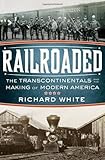
Richard White. Railroaded: The Transcontinentals and the Making of Modern America. New York: W.W. Norton, 2011. xxxix + 660 pp. $35.00 (cloth), ISBN 978-0-393-06126-0.
Reviewed by Cole Harris (University of British Columbia)
Published on H-HistGeog (October, 2011)
Commissioned by Robert M. Wilson (Syracuse University)
Railroads, History, and Geography
After completing The Middle Ground: Indians, Empires, and Republics in the Great Lakes Region, 1650-1815 (1991) and “Its Your Misfortune and None of My Own”: A New History of the American West (1991), Richard White vowed that, henceforth, he would write short books. For a time he did. The Organic Machine: The Remaking of the Columbia River (1995) and Remembering Ahanagran: Storytelling in a Family’s Past (1998) were each of reasonable length. Now he has lapsed, his economical intentions apparently forgotten. Railroaded: The Transcontinentals and the Making of Modern America is a huge book. But its subject is huge, and Railroaded, a good dozen years in the making, is a strikingly original tour de force, one, moreover, that is committed to social change, brilliantly written, full of arresting metaphors, and often surprisingly funny.
White’s central thesis is that the transcontinentals did not have to be built when, where, or in the number they were. There were other options. Late nineteenth-century corporate capitalism did not have a unique face; it was not in western North America what it was in western Europe. Its western North American version was a sprawling, untidy mess riven by corruption and miscalculation. It made vast personal fortunes, ruined companies, destabilized government finances, exploited labor, depleted environments, encouraged lobbying, and drew business and government into unsavory alliances. To the retort that if it did many of these things, it also brought railroads and with them the modern infrastructure that developed the West, White responds that the costs were too high. Railroads would come, but if later and fewer the West would have developed more gently and with far less personal and environmental damage. There were always other options. It was cheaper to send goods by sea from San Francisco to the East Coast--until railway interests subsidized the shipping companies and controlled their rates.
Behind White’s case are years spent in railroad and other archives. He has particularly immersed himself in the railroad barons’ correspondence. Indeed, much of the book is business history written from that vantage point. The railroads, it seems, made little money by marketing transportation. They hardly knew what it cost to move the goods they carried. Rather, money was made by securing government subsidies and from stock manipulations, insider trading, leveraged financial deals, and real estate speculation. From all these operations, companies benefited far less than those who ran them; taken as a group, these men were brazen, manipulative, and corrupt, and they seem, fairly consistently, to have ruined companies while amassing fortunes. Even Charles Francis Adams, descendent of two American presidents, who became president of the Union Pacific Railroad in 1884 and was probably (and certainly thought himself) the most patrician and principled of the railway barons, could be, as business required, as corrupt as the rest.
Beyond such business histories, and of more immediate relevance to historical geographers, are two chapters given to the railroads’ spatial and environmental impacts. In the span of a few decades, White suggests, the railroads effectively reorganized and politicized space, in so doing reworking much of the human geography of the West. They brought towns into existence, relegated others into insignificance, and created new regional economies. The result, however, was always fluid and shifting, particularly as new railroads and changing freight rates altered spatial relationships. Because towns grew nearer or farther apart and economies prospered or withered as freight rates were adjusted and railroads proliferated, the politics of railroads was always intensely contested and intrinsically spatial. In White’s words: “As the railroads made and remade space in the late nineteenth century, they pulled cars as full of politics, ideology, and social relationships as of lumber, wheat, and coal” (p. 178).
Primarily commodity railroads, the transcontinentals crossed vast reaches of sparsely occupied land, their fixed costs were high, and their challenge, always, was to find cargo. Access to the public domain was virtually free, and the railroads sought to turn as much of it as possible into commodities. This they did, in the process, White argues, encouraging “dumb” growth and environmental catastrophes. They promoted agricultural settlement both where it was feasible and where it was not. On arid margins, families struggled and failed. Bison were virtually wiped out, and the Lakota’s economy collapsed. Soon replacing bison on the high plains was a surplus of cattle and, accompanying them, severely degraded rangeland. Cattlemen, writes White, had “expropriated the public domain to produce poor beef and environmental damage” (p. 480). Silver was overproduced as rich deposits were worked out at low prices. Overall the transcontinentals enabled far more production of cattle, wheat, and silver than the world needed.
Much of this will be argued of course. Some will say that given the expansive energy and speculative enthusiasm embedded in late eighteenth- and nineteenth-century American society, White is too optimistic in positing the existence of a real alternative to the pace of western American railroading. Some will say that what, for him, is overproduction is, for others, the welcome availability of cheap goods. A geographer might say that space is always politicized, and that railroads did no more than politicize it in particular ways. But almost everyone, I think, will agree that Richard White has written a brilliant book, one that will generate a long and fruitful conversation.
As a historical geographer, I must admit to reading this remarkable book with a certain wistfulness. Historians have discovered the environment and have written about it exceedingly well. Now, more explicitly than heretofore, they are discovering space. Richard White is an advocate of spatial history, and although Railroaded contains a large measure of business history and too few maps, it is, fundamentally, an account of the social production of space. What is happening is that geography, as a discipline, is paying less attention to the past while, for their part, excellent historians are giving more attention to historical geography’s traditional subject matter.
Perhaps this is as it should be. Disciplinary boundaries should be porous. Good work is far more important than its location. Yet I have always felt that a broadly based geography department is an attractive location for the type of study in which historical geographers engage, partly because good natural scientists, spatial theorists, cartographers, and GIS specialists are at hand, as they would not be in a history department. It has also seemed to me that a geography department serves, as it were, to decenter one’s view of the past, in so doing detaching it, in potentially productive ways, from the historiographic mainstream. More generally, I have thought that a broadly humanistic human geography required the past. But against all of this is the question of critical mass. There are not many historical geographers. Were one of them to write on the Greece of Socrates’ day or on China at the dawn of the Han dynasty, or, for that matter, on the shaping of western North America by late nineteenth-century railroads, few if any other geographers would be able to offer an informed critique. Richard White says he is not interested in universal laws. Nor are historical geographers. Like historians, we are users rather than generators of theory, and our use thereof is to bring complex particular places into better focus. Essentially we, like historians, are contextualizing synthesizers, and this means that if one is really to engage a colleague’s work one has to know a good deal about it. In no more than suggestive preliminary ways can we fall back on common theoretical frameworks. Richard White is in exactly this position. He seeks to understand elements of the late nineteenth-century North American West and, perhaps, something of the American cast of early corporate capitalism, not more. But in his case, his writings on these matters will engage large groups of historians: almost all of those working on the American West, almost all of those working on the genesis of modern American capitalism. Were a historical geographer to write a book of equivalent merit on a similar topic it too would engage a wide, critical readership almost all of which would be outside the discipline of geography. This is a telling difference.
One can only applaud and be exhilarated by the quality of a book like Railroaded. It is a model of outstanding scholarship and a reminder of what can be possible when people and place or, if you will, society and space, are critically and comprehensively examined together. Yet given my background, I can only hold it for the best if this terrain is not entirely relinquished to historians. My preferred model of scholarship, like historical geography itself, is decentered.
If there is additional discussion of this review, you may access it through the network, at: https://networks.h-net.org/h-histgeog.
Citation:
Cole Harris. Review of White, Richard, Railroaded: The Transcontinentals and the Making of Modern America.
H-HistGeog, H-Net Reviews.
October, 2011.
URL: http://www.h-net.org/reviews/showrev.php?id=34120
 | This work is licensed under a Creative Commons Attribution-Noncommercial-No Derivative Works 3.0 United States License. |

