



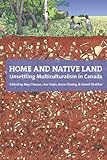
May Chazan, Lisa Helps, Anna Stanley, Sonali Thakkar, eds. Home and Native Land: Unsettling Multiculturalism in Canada. Toronto: Between the Lines, 2011. 256 pp. $29.95 (paper), ISBN 978-1-897071-61-8.
Reviewed by Christopher Taylor (University of Western Ontario)
Published on H-Canada (November, 2011)
Commissioned by Stephanie Bangarth (King's University College, UWO)
The Power to Define: A New Multiculturalism Debate
May Chazan, Lisa Helps, Anna Stanley, and Sonali Thakkar’s edited book, Home and Native Land: Multiculturalism in Canada, takes a new, innovative, and intriguing approach to multiculturalism discourse in Canada. The diverse, insightful, and most notably thought-provoking collection of essays is a refreshing and current analysis of the Canadian reified ideology of multiculturalism and its many contentious symbiotic derivatives. These include issues of race and racism, belonging, hegemonic power, colonization, and immigration. The key to this edited work is the complete paradigm shift in the way that the literature on multiculturalism policy and ideology is studied, viewed, and structured in Canadian scholarship. This is not a revisionist work, but the creation of a new multiculturalism narrative.
The editors’ objective is to make the reader feel “unsettled”--having “both a desire to achieve consensus, thereby settling the debate and fixing meaning, as well as [an awareness of] the difficulty of doing so”--as they navigate the many views contained in the book (p. 1). Chazan et al. state that “one of our ambitions for this volume is that it should unsettle multiculturalism while simultaneously showing how multiculturalism is continuously being unsettled,” contending that “multiculturalism has remained unsettled because different groups and interests have taken advantage of its fluidity to make a variety of claims that aim to settle identities and arrangements” (pp. 1-2).
The ambiguous and undefined nature of multiculturalism creates politicized, racialized, and discriminatory hegemonic power relations and realities. The book is not only an attempt at educating and informing, but is also a political call for changing the ways in which Canadian society obfuscates benevolence through inherently racist and exclusionary institutional practices. The many pieces and articles in the book follow the common theme of displacing, or unsettling, pro- and anti-multiculturalism views which have come to the forefront of Canadian and Western societies following September 11, 2001.
Home and Native Land: Multiculturalism in Canada’s effectiveness lies in the diversity of its pieces which nevertheless share the common framework of hegemonic power under the guise of multiculturalism. Chazan et al. organize the book using the themes of labors, lands, and bodies. They state that the “contributors examine multiculturalism obliquely, assessing how multiculturalism’s wavering reflection appears in and inflects discussion about labour migration, the historical settlement of land, and the racialization of poverty” (p. 3). This edited work is distinct from previous scholarship on multiculturalism in that it incorporates new language and issues, including colonization and Aboriginal rights and land claims, into a discourse that traditionally focuses on visible minorities and new immigrants.
The three themes come together to “illustrate the continued power, limitations and, at times, destructiveness of multiculturalism, both as a policy and as a discourse” (p. 11). As Nandita Sharma argues in her article, “Canadian multiculturalism and its nationalisms” through an examination of the little known Non-Immigrant Employment Authorization Program (NIEAP) implemented six years following the Points System in 1967, multiculturalism and immigration policies and ideologies are in fact complementary racialized tools designed to exclude non-white immigrants and marginalize non-white citizens. One area in which this book excels is in highlighting lesser known stories such as the case of the NIEAP. Other lesser known aspects include Brian Egan’s examination of liberal multiculturalism and the “Indian land question,” and bringing Aboriginal identity into the multicultural ideological rubric; Emile Cameron’s interpretation of literal and metaphorical Indigenous ghost stories; and Laurie K. Bertram’s research on Icelandic-Canadian and Indigenous relations in Manitoba. The book carefully highlights the continued marginalization and colonization of Aboriginal peoples and their respective histories through multiculturalism and hegemonic rhetoric. Chazan et al. highlight how Aboriginal rights in Canada are undermined by multiculturalism policy and ideology.
Readers unfamiliar with the political nuances of multiculturalism and immigration policies may argue that this book is an unfair and unwarranted attack on the Canadian state’s most internationally recognizable attribute. While some pieces, including Sharma’s, critique the state’s apparatus and its racialized motives, George Elliott Clarke’s brilliant work, “For a Multicultural, Multi-faith, Multiracial Canada: A Manifesto,” eschews the theoretical obfuscated dogma in which ideology functions best, and offers a practical solution to Canada’s multicultural “problem.”
He argues that following his seven practical measures, “Canada will begin to look visibly more inclusive (egalitarian in opportunity and power-sharing), from the monarch on down” (p. 56). Legislating and respecting hybridity or “métissage--the intermingling and intermarrying of peoples of many different cultures and backgrounds”; diversifying the Supreme Court of Canada, the Senate, boards, agencies, and commissions to make them “look like Canada itself”; secularizing public schools; apologizing for African-Canadian slavery; and assigning 1 percent of all property taxes collected to First Nations peoples’ respective governments, are all practical measures proposed by Clarke that will allow Canadians to finally achieve a “truly multicultural, multi-faith, and multiracial Canada” (pp. 51-57). Home and Native Land: Multiculturalism in Canada is more than a scholarly collection of conference papers, but a political call to action for meaningful change in Canadian society.
The implicit political tone of the book may discourage some readers from appreciating its content. The editors cleverly organized the book in such a way that Uzma Shakir’s “The Colour of Poverty,” with its cathartic prose and explicitly political mandate, is the concluding chapter. If the piece were near the beginning of the book the reader would dismiss the edited work as a polemic rant. However, taken as a whole, and given the diversity in each writer’s distinctive literary style and analysis, the book reads as a microcosm of how Canadian multiculturalism should work. It is an honest reflection of the shortcomings of Canadian society, but it offers solutions and most importantly it calls on the audience it is specifically geared towards--scholars and academics--to use their positions and influence to foster change outside of the ivory tower. The audience is narrow, but the book is not meant to inform the casual reader or undergraduate student. Chazan et al. have created a treatise that forces readers to “unsettle” their sedimented views on multiculturalism in Canada.
If there is additional discussion of this review, you may access it through the network, at: https://networks.h-net.org/h-canada.
Citation:
Christopher Taylor. Review of Chazan, May; Helps, Lisa; Stanley, Anna; Thakkar, Sonali, eds., Home and Native Land: Unsettling Multiculturalism in Canada.
H-Canada, H-Net Reviews.
November, 2011.
URL: http://www.h-net.org/reviews/showrev.php?id=34105
 | This work is licensed under a Creative Commons Attribution-Noncommercial-No Derivative Works 3.0 United States License. |

