



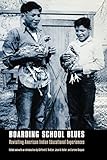
Clifford E. Trafzer, Jean A. Keller, Lorene Sisquoc, eds. Boarding School Blues: Revisiting American Indian Educational Experiences. Lincoln: University of Nebraska Press, 2006. Illustrations. xiii + 256 pp. $45.00 (cloth), ISBN 978-0-8032-4446-7; $20.00 (paper), ISBN 978-0-8032-9463-9.
Reviewed by John J. Laukaitis (Department of Education, Elmhurst College)
Published on H-Education (May, 2012)
Commissioned by Jonathan Anuik (University of Alberta)
The complexity of the American Indian boarding school experience stands prominently in the foreground of Boarding School Blues. For the editors of the work and the authors of the ten essays, boarding schools possess layers of meanings that cannot simply be characterized through the familiar historical framework of assimilation and cultural loss. The history of boarding schools remains as diverse as the students, families, and tribes affected by the institutions. Boarding School Blues presents the history of boarding schools as "one we are only beginning to unravel, discuss, and interpret" (p. 28). In doing so, it establishes a discourse that, on one level, offers new insights into the history of boarding school experiences and, on another level, promotes a direction for future research that gives specific attention to contexts, personal perspectives, and constructs of American Indian agency.
Clifford E. Trafzer, Jean A. Keller, and Lorene Sisquoc make clear in their preface that the boarding school experience remains complex, and "no single interpretation of this experience exists today or ever will" (p. xi). They forewarn against taking any boarding school history as a definitive one and inferring that any particular boarding school experience represents others. With this said, the historical analyses presented in Boarding School Blues do illustrate, on many levels, certain patterns. One such pattern is that American Indians did not passively accept the ultimate aim of the federal boarding school system. As a system designed to extinguish Indian cultures, boarding schools met various forms of resistance,including, for example, students continuing to speak their tribal languages and practice their traditions even at the risk of punishment and their adoption of new knowledge that contributed "to the well-being of their families, communities, and tribes" (p. 4). Another pattern that emerges throughout the essays, as in David Wallace Adams's "Beyond Bleakness," is that histories of boarding school hardships, such as "heartbreaking loneliness, substandard diets, humiliating punishments, life-threatening diseases, and the unrelenting assault on their cultural and psychological selves," while accurate for many, do not acknowledge the history of those who enjoyed and benefited from their boarding school experiences (p. 36). With these patterns and others, this collection of essays challenges static accounts that do not recognize the multifaceted dimensions of the relationship between American Indians and boarding schools.
New comparative approaches contained in Boarding School Blues will be of particular interest to historians of education. Margaret Connell Szasz's comparative analysis of the boarding school systems of England and Scotland and those of the five Southeast nations (i.e., Cherokee, Choctaw, Chickasaw, Creek, and Seminole) stands as a prominent essay in the collection. In "Through a Wide-Angle Lens," she documents how the Southeast nations used boarding schools as a training ground for future leaders much in the same way they were used in England and Scotland. The Southeast nations, according to Szasz, selected students to become "cultural intermediaries, bridging the gap between the old ways and the changes taught at the school" (p. 196). In drawing parallels between seemingly unrelated boarding school systems, Szasz demonstrates how boarding schools functioned as spheres of power within their respective contexts. Another noteworthy essay is Margaret D. Jacobs's "Indian Boarding Schools in Comparative Perspective." As part of her comparative analysis, Jacobs examines how the Australian government "removed indigenous children not simply as a means to assimilate them but also as an official strategy of colonial control and subjugation" (p. 204). In putting boarding schools within a comparative framework, Jacobs sheds light on the similarities that existed between the government policies of Australia and the United States. At the heart of her essay is the argument that both countries disguised the concept of the boarding school as "a kind and benevolent policy designed to rescue and protect indigenous children" but in reality, they established them as a means of control (p. 206). In this way, Jacobs argues, both governments used assimilation as a justification when the apparent purpose was the subordination of indigenous populations.
As a whole, the essays in Boarding School Blues contain solid historical research and analysis. One essay, however, relies more on Foucauldian theory than historical evidence to support its claim. Jacqueline Fear-Segal's "The Man on the Bandstand at Carlisle Indian Industrial School" puts forward the argument that the then anonymous editor (i.e., the Man on the Bandstand) of Carlisle's student newspaper was able to "control, intimidate, and manipulate the children" through the power of perceived surveillance (p. 104). For Fear-Segal, the Man on the Bandstand--a woman really named Marianna Burgess who ran the print shop--symbolizes Jeremy Bentham's panopticon, and her analysis largely depends on Michel Foucault's theories of discipline and punishment. "Regrettably," Fear-Segal writes, "we have yet to discover a comparable record that tells us directly how the Carlisle children reacted to Burgess when she spoke to them through the Man on the Bandstand" (p. 119). This, however, does not prevent her from claiming that the essay will "deepen our understanding of the children's responses" (p. 101). Without any student responses to the Man on the Bandstand and the feelings he evoked, Fear-Segal presumes far more than the historical record is able to reveal.
Boarding School Blues is a welcome addition to the history of American Indian education. The book's focused studies of the Rapid City Indian School in Rapid City, South Dakota, and St. Boniface Indian School, in Banning, California, provide carefully researched examinations of two lesser-known institutions. Archived records and oral history interviews used by many of the authors strengthen the work, and the collection of essays is more than a synthesis of previously published accounts. With its concise introduction and scope of schools and topics, the book would make a worthy addition to a number of undergraduate and graduate courses in history of education and cultural foundations of education.
If there is additional discussion of this review, you may access it through the network, at: https://networks.h-net.org/h-education.
Citation:
John J. Laukaitis. Review of Trafzer, Clifford E.; Keller, Jean A.; Sisquoc, Lorene, eds., Boarding School Blues: Revisiting American Indian Educational Experiences.
H-Education, H-Net Reviews.
May, 2012.
URL: http://www.h-net.org/reviews/showrev.php?id=34056
 | This work is licensed under a Creative Commons Attribution-Noncommercial-No Derivative Works 3.0 United States License. |

