



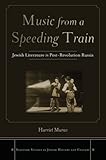
Harriet Murav. Music from a Speeding Train: Jewish Literature in Post-Revolution Russia. Stanford: Stanford University Press, 2011. 416 pp. $65.00 (cloth), ISBN 978-0-8047-7443-7.
Reviewed by Jarrod Tanny (University of North Carolina at Wilmington)
Published on H-Judaic (March, 2012)
Commissioned by Jason Kalman (Hebrew Union College - Jewish Institute of Religion)
The (Soviet) People of the (Soviet) Book
The field of Russian Jewish studies has witnessed a veritable explosion of innovative scholarship in recent years. While this is due in part to the diminution of Cold War-era constraints on research, it is equally a product of our changing notions of what constitutes “authentic” Jewish culture. Harriet Murav’s Music from a Speeding Train: Jewish Literature in Post-Revolution Russia is a welcome addition to this body of work. Murav eschews what were for long the dominant paradigms and the accepted historical narrative of Russia’s Soviet century, challenging her readers to consider the Soviet Jewish experience in a different light, one that reveals persistent creativity, a commitment to the Jewish past, and a cautious yet willing engagement with the construction of communism and all it entailed. Looking beyond the standard “image of the Jew as outsider, other, and pariah,” she demonstrates “what Jews as insiders” were able to create within the framework of Soviet culture, an inhibited but hardly monolithic artistic space (p. 15).
Music from a Speeding Train consists of two parts, subdivided into eight chapters. Organized chronologically, part 1 covers the revolutionary era and the cultural experimentation of the 1920s (chapter 1), the emergence of socialist realism and the triumph of Stalinism (chapter 2), and the cataclysmic impact of the Great Patriotic War and the Holocaust (chapters 3 and 4). In part 2 Murav dispenses with her chronological framework “in order to avoid the well-worn narrative of Soviet Jewish oppression, national reawakening, and redemption via immigration” (p. 17). By approaching the postwar era thematically Murav uncovers significant continuities in Soviet Jewish literature, which despite the trauma of the 1940s experienced a renewed vitality after Stalin’s death. Her final chapter examines Jewish literature in Russian after the Soviet Union’s collapse, which has been characterized by an open reflection on the Jewish role in the (now discarded) enterprise of communist construction. In each chapter, Murav links well-chosen examples with her central thesis: Jewish literature in Russia persisted through the twentieth century and it must be evaluated on its own terms, not against a set of expectations defined by Western standards and Cold War exigencies.
Although it is well known that Soviet Jewish writers wrote prolifically in both Russian and Yiddish until the late 1940s, Music from a Speeding Train is the first integrative study on the “rich cross-fertilization” (p. 2) that took place across linguistic boundaries. Russian Jewish writers like Isaac Babel and Yiddish writers like Perets Markish betray similar themes, aspirations, and style in their works and, of no less significance, many of these writers read, quoted, and translated each other. But the Kremlin’s self-professed right to define who constituted a nation and what constituted a national culture inhibited a comprehensive inquiry into Soviet Jewish literature, perhaps to a greater extent than it impeded the production of Soviet Jewish literature itself. The government decreed that every Soviet nation had its own language and thus required a literary canon in its national language. For the Jews, this meant the promotion and state sponsorship of Yiddish literature. Jews who wrote about Jews in Russian were an aberration insofar as they defied this rigid system of ethno-linguistic classification. “It is as if Babel, Markish, and [Dovid] Bergelson lived on different planets” (p. 2), writes Murav, a statement that characterizes the theoretical underpinnings of Soviet nationality policy as much as it describes scholarship abroad. With Stalin’s imposition of socialist realism in the 1930s, Soviet culture’s official governing template became the inexorable march toward a bright communist future. Many Western observers wrote off Soviet Jewish literature as little more than enforced communist ideology packaged in superficial (and hence meaningless) markers of Jewishness. Those who had talent were either silenced, shot, or conscripted into the service of Stalinist proletarian culture.
Murav challenges this delegitimization of Soviet Jewish literature, contending that “assumptions about Jewishness must be suspended in order to discover the meanings and associations of this term in Russia and elsewhere” (p. 11). Stalinism did not homogenize Soviet Jewish writers into mimetic conveyers of communist claptrap. Rather, it imposed a framework that was sufficiently malleable to allow for an imaginative engagement with Soviet modernity and traditional Jewish writings, “including the Hebrew Bible, liturgy, and classic rabbinic texts” (p. 3). The resultant corpus of literature was at once Soviet and Jewish, two poles of identity that were neither incompatible nor in perfect harmony with one another. Such fluidity crystallized into a codependency fraught with tension, which waxed and waned as the twentieth century unfolded.
Murav’s thesis is especially illuminating in her chapters on the Great Patriotic War and the Nazi genocide, which was never called “the Holocaust” in official Soviet discourse. “During the war,” writes Murav, “Jews were particularly good Soviets, because they were Jews, because they were doubly the target for annihilation in Hitler’s war against ‘Judeo-Bolshevism’” (pp. 112-113). Although a Russocentric chauvinism began to rear its ugly head during the war, replete with traditional antisemitic stereotypes of the cowardly parasitic Jew, Soviet Jewish writers such as Il’ia Erenburg, Itsik Fefer, and Perets Markish combated this image through “the literature of mobilization,” portraying “Jews as super soldiers motivated by hatred of the enemy and a desire for revenge” (p. 142). Yet this did not preclude lamentations on carnage, loss, and obliteration in a more traditional Jewish key, a mode of writing framed by “a backward-glancing Jewish temporality” (p. 3), a lens of Jewish trauma that linked 70 AD, the Khmel’nitskii massacres, Petliura’s pogroms, and Babi Yar in a succession of victimhood, seemingly endless and cyclical. “There indeed was a Holocaust in Soviet Russia,” Murav concludes, but it looks different from the more familiar Western representations of the Shoah: “the perspectives of Jewish victims, Jewish avengers, and Jewish victors overlap” in texts written in both Russian and Yiddish, further substantiating her claim that Soviet Jewish literature transcended the prescribed boundaries of nationality policy and socialist realism (pp. 153-154).
Music from a Speeding Train’s most important contribution to Russian Jewish studies are the two chapters dealing with postwar literature. Stalin’s anti-cosmopolitan campaign (1948-53) resulted in a sweeping purge of the Jews from the Soviet elite, the execution of prominent Yiddish writers, and the imposition of informal antisemitic policies that were eased but not eliminated after Stalin’s death. Most scholars have argued that Soviet Jewish life never recovered from the double blow of the Holocaust and late Stalinism; the so-called Jews of silence lived, worked, and could even thrive in the USSR as loyal citizens, but not as Jews. The revival of Yiddish literature in the 1950s was a hollow victory, so the argument runs, given the demise of the Yiddish-speaking world through urbanization, assimilation, and the violent decimation of the shtetl. But in an admirable act of literary excavation, Murav brings to light previously ignored Soviet Jewish writers who “remained true to the shtetl,” where “things are done in a Jewish way; time unfolds in an orderly alternation of holidays and weekdays; cataclysmic events intrude, but do not destroy it” (p. 283).
Some of Murav’s readers will undoubtedly question the historical significance of these cultural artifacts from an era known for its stagnation, ossification, and ideological bankruptcy. Her postwar cast of characters--Itsik Kipnis, Grigorii Kanovich, Shire Gorshman, and others--did not have the eminence of Isaac Babel and Dovid Bergelson, and one must wonder how many people actually read their works. But that’s not the point. Murav demonstrates that Soviet Jewish literature after the Holocaust is not the one-dimensional martyrology of annihilation one might expect to see. “For these authors,” writes Murav, “the Jewish home is found in the former Pale of Settlement, where it is neither a wasteland nor the site of full plenitude and unbroken tradition, but rather something in between” (p. 248). From a literary perspective, the rhythm of Soviet Jewish life survived (and transcended) the ravines of Babi Yar and the gas chambers of Birkenau.
Throughout the book, Murav does a commendable job in handling the slippery question of what makes a particular text “Jewish.” Students of Soviet history, much like the Soviet state, have tended to use biological descent and public identity as their starting point for defining the Jew, followed by the appraisal of their subjects’ biographies and cultural products in search of Jewish content. Murav rejects this approach, insisting that neither blood nor obvious markers of Jewishness--physiognomy, clothing, commitment to Judaic ritual--are satisfactory in the Russian context. For Murav, “the text has to be understood in its own terms, according to its own internal logic” (p. 4), a logic that, paradoxically, links such texts to other texts: the insertion of quotations from Jewish literature of earlier times; references without elaboration to places of significance in Jewish history; the structuring of time according to the tempo of the Jewish calendar. Even omissions--disjunctures in the narrative where the Jewish past intrudes through an uncanny silence--have functioned as telling signposts in Soviet Jewish literature.
Music from a Speeding Train is a necessary corrective to the dominant approach in Russian Jewish studies. Through the judicious use of her sources, Murav proves that neither the officially delineated ethno-linguistic boundaries of the state’s nationality policy nor the constraints of socialist realism prevented the creation of a vibrant Soviet Jewish literary tradition, one that followed a different trajectory from its Western and Israeli counterparts. Murav challenges her readers to abandon their preconceived ideas of what constitutes authentic Jewish culture. And once the reader has done so, it becomes clear that the Jews of Russia persisted in their ancestors’ historic role as the People of the Book.
If there is additional discussion of this review, you may access it through the network, at: https://networks.h-net.org/h-judaic.
Citation:
Jarrod Tanny. Review of Murav, Harriet, Music from a Speeding Train: Jewish Literature in Post-Revolution Russia.
H-Judaic, H-Net Reviews.
March, 2012.
URL: http://www.h-net.org/reviews/showrev.php?id=33981
 | This work is licensed under a Creative Commons Attribution-Noncommercial-No Derivative Works 3.0 United States License. |

