



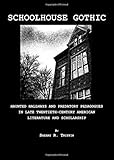
Sherry R. Truffin. Schoolhouse Gothic: Haunted Hallways and Predatory Pedagogues in Late Twentieth-Century American Literature and Scholarship. Newcastle: Cambridge Scholars, 2008. viii + 182 pp. $59.99 (cloth), ISBN 978-1-84718-993-6.
Reviewed by Katherine Ashley
Published on H-Education (January, 2012)
Commissioned by Jonathan Anuik (University of Alberta)
The Curse of Education
Confined spaces, ancient superstitions, and an “obsession with the past, with archaic beliefs and power structures” are all features of gothic fiction, which is characterized by Sherry R. Truffin in Schoolhouse Gothic as a post-Enlightenment reaction to rationalism, empiricism, and progress (p. 6). While the classic novels of gothic fiction were written in the eighteenth and early nineteenth centuries--Horace Walpole’s The Castle of Otranto (1764) and Charles Maturin’s Melmoth the Wanderer (1820) are notable examples--the gothic mode has endured and flourished. The twentieth century gave rise to the southern gothic in American literature, and elements of the gothic are still very much in evidence today in the works of authors like Stephen King and Anne Rice. The way that the gothic is expressed in fiction has evolved, however, and been consistently reconfigured to reflect specific social, political, and cultural contexts. Truffin’s Schoolhouse Gothic studies one of the current incarnations of gothic fiction by focusing on manifestations of gothicism in the academic milieu. The term “Schoolhouse Gothic” is Truffin’s own and it designates not so much a genre or subgenre. Instead, it is used as a metaphor for the way in which the academy--academic institutions, schoolteachers and professors, and the curriculum itself--confines and limits students in various ways.
One of the primary merits of Truffin’s study is that it moves the discussion of fictional representations of academic life away from analyses of the largely comedic campus novel genre and instead explores texts belonging to a variety of genres. At the same time, it also moves the discussion of gothicism away from the horror genre with which it is traditionally associated. Truffin takes in popular writers like King as well as Nobel Prize-winning authors like Toni Morrison and includes chapters on Flannery O’Connor, Joyce Carol Oates, and David Mamet. Although the analytical framework is loose at times, it is useful because it gives a good idea of how authors with dramatically different preoccupations, styles, and philosophies--and dramatically different audiences--conceptualize contemporary American education. The very fact that authors as dissimilar as King, Morrison, and Mamet choose to explore some of the more sinister aspects of the educational system suggests that all is not well in the academy.
What precisely makes a text representative of schoolhouse gothic? Truffin pinpoints several features: curses, traps, paranoia, violence, and monstrosity. Curses take two forms, the first hinges on the concept of “enlightenment.” On the one hand, there is the notion of the Enlightenment and its legacy of rationalism as a curse; on the other, there is the notion of enlightenment--that is to say, knowledge--as a curse, because in the works Truffin studies, knowledge is rarely synonymous with freedom, be it intellectual or physical. Indeed, drawing (sometimes too heavily) on Marxist literary theory and the work of Michel Foucault, particularly in her analysis of O’Connor, Truffin argues that the academy is the “site of institutional surveillance and normalizing disciplinary power” (p. 10). Surveillance and discipline lead to the second type of curse encountered in schoolhouse gothic fiction, the notion of the academic hierarchy as a curse. Truffin contends that academic “neutrality hides the ways in which the academy functions to reproduce the values and hierarchies of the larger culture” (p. 14). Insofar as this is the case, intellectual objectivity becomes a trap. These curses and traps in turn result in the paranoia that the closed educational system (and the closed physical environment of the school) elicits in its student-victims. The two final products of this system are identified as violence (both physical and epistemic) and monstrosity. The concept of violence is self-explanatory, but monstrosity holds a special meaning here, for it is “linked in scholarly renderings of the Schoolhouse Gothic to a key product of academic labor: discourse” (p. 24). In other words, academic discourse transforms students and teachers into monsters.
How, then, does schoolhouse gothic manifest itself in the works of King, O’Connor, Morrison, Oates, and Mamet? The chapter on King underscores how he “characteriz[es] teaching as abuse”; likens schools to prisons and mental institutions; and compares “modern education to everything from bad parenting to rape, capitalist brainwashing, and monster-making” (p. 34). Like King, O’Connor, a devout Catholic frequently associated with the southern gothic mode, can be clearly situated within the enlightenment-as-curse framework because she rejects “post-Enlightenment conceptions of reason” in favor of the liberating forces of faith (p. 61). In her studies of both of these authors, Truffin emphasizes the power invested in teachers at the expense of students--surveillance, discipline, testing, and the keeping of student records are means of subjugating rather than educating students, and these tools of the teacher’s trade reinforce the powerlessness of students vis-à-vis the educational system.
The powerlessness of students is even more apparent in the chapters devoted to Morrison, Oates, and Mamet, focusing as they do on issues of race, gender, and class. Truffin’s analysis of Morrison’s Beloved (1987), for example, centers on the conjunction between “power [physical, social, pedagogical] and knowledge,” as embodied in the role of the slavemaster/schoolmaster (p. 82). Although it builds on previous chapters and makes a solid case for education as a means of perpetuating racist beliefs and behaviors, this particular chapter is somewhat marred by the fact that the schoolhouse gothic net is cast rather wide. On the one hand, Beloved, which deals primarily with racism and slavery, is not even set in a school. Oates’s Beasts (1975), on the other hand, is set in a university and “focuses less on race than on gender, portraying misogyny as a curse that haunts the academy” (p. 105). This misogyny gives academics intellectual, pedagogical, and, ultimately, sexual control over their students. Finally, if racial and gender prejudice function as curses in Beloved and Beasts, then the curse in Mamet’s play Oleanna (1992) is class related. Carol, the student protagonist, feels alienated from the university system that John, a professor on the brink of tenure, criticizes from his (soon-to-be) secure position within the intellectual establishment. For Truffin, Oleanna is an important work of schoolhouse gothic literature because it “critiques both the traditional academy--with its tendency to wreak epistemic violence on students and others by shaming and defining them--and the narcissism of contemporary academics whose disavowals of power have led not to reform but rather to new kinds of violence” (p. 142, emphasis in original).
There are predatory pedagogues to spare in the texts that Truffin studies, but one is hard-pressed to pinpoint any “haunted hallways,” at least in a literal sense (there are no ghostly students or teachers); rather, the pupils in these contemporary American texts are figuratively “haunted” by their educational experience, just as the contemporary American academy is “haunted” by its “shared history of class, race, and gender exploitation” (p. 17). In this respect, Truffin uses the term “gothic” in its broadest sense. This does not entirely detract from the author-specific case studies that are presented. Even though the fiction of King, O’Connor, Morrison, Oates, and Mamet deals with extreme cases, the issues their works are concerned with are real and in need of reform. Thus, despite an inconsistent tone that ranges from the highly theoretical (chapter 3) to the cutesy (personal musings on senior year songs), Schoolhouse Gothic does an effective job of moving the discussion of representations of American schooling in the twentieth century away from the feel-good, Hollywood-influenced vision offered in films like Mr. Holland’s Opus (1995) and Dangerous Minds (1995) toward the more challenging, yet ultimately more intellectually productive, picture offered in fiction.
If there is additional discussion of this review, you may access it through the network, at: https://networks.h-net.org/h-education.
Citation:
Katherine Ashley. Review of Truffin, Sherry R., Schoolhouse Gothic: Haunted Hallways and Predatory Pedagogues in Late Twentieth-Century American Literature and Scholarship.
H-Education, H-Net Reviews.
January, 2012.
URL: http://www.h-net.org/reviews/showrev.php?id=33951
 | This work is licensed under a Creative Commons Attribution-Noncommercial-No Derivative Works 3.0 United States License. |

