



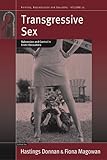
Hastings Donnan, Fiona Magowan, eds. Transgressive Sex: Subversion and Control in Erotic Encounters. New York: Berghahn Books, 2009. vi + 280 pp. $75.00 (cloth), ISBN 978-1-84545-539-2.
Reviewed by Chris Bobel (UMass Boston)
Published on H-Histsex (May, 2012)
Commissioned by Timothy W. Jones (University of South Wales, & La Trobe University)
Seeing Power and Resistance through Nonconformity
As I read Transgressive Sex: Subversion and Control in Erotic Encounters on the subway, in the library, and in other public spaces, I wondered what others thought of the plainly provocative title and arresting cover image. For those us who study the social constructions of taboos, book titles and covers are hardly trivial. To wit, I recall my editor’s subtly censoring directive regarding the cover image for my book on menstrual activism: “It needs to be something a student can carry under their arm while walking across campus.” I have no doubt that Transgressive Sex’s co-editors, Hastings Donnan and Fiona Magowan, are similarly challenged by the ironic meta-reality attached to even talking about talking about taboo. How do we “keep it (not too) real”? In the end, we sometimes lose sight of the actual people at the core of our inquiries. In Transgressive Sex, a collection indisputably rich and a powerful boon to the field of sexuality studies, this seems the case once we delve into the book’s contents. Here, the narratives of real people living their lives are often obscured. This collection of ethnographic research is, oddly, often quite detached from the actual informants under study. I longed to hear the voices of informants intertwined with the astute analyses that distinguish this collection.
What this remarkable book does offer is a set of consistently powerful interrogations. The text moves from the structural to the individual and back again in an impressive number of diverse contexts that span the globe. Readers will appreciate the many multilayered, often counterintuitive analyses which encourage cross-cultural knowledge production and serious methodological and theoretical considerations.
The unassuming organization of the book is sly. The book flows from sophisticated scrutiny of moral panics through engagement with nuanced issues of identity and representation to sticky tensions between formal and informal interventions with sexual transgression. The singular theoretical piece is well situated at midpoint, pausing to reassess the literatures often (mis)used in sexuality studies, and the concluding chapter on methods entertains issues often neglected.
In the elegantly synthetic introduction, Donnan and Magowan frame transgressive sex as “an enticing and hazardous proposition for reorganizing human agency, perception and action as its inherent sense of crossing limits, amplifying margins and repositioning power can extend and transform the boundaries of the social body, social order and the self” (p. 3). The hegemony of sexuality--a construct shaped and maintained by the usual suspects: class privilege, racialization, heteronormativity, and the gender binary--thus gets a workout when the normative is violated.
In chapter 1, Marie Rosenkrantz Lindegaard and Ann-Karina Henriksen demonstrate how, in Cape Flats, South Africa, a community where teen pregnancy and violence are common, girls’ gendered burden to maintain respectability through virginity carries tragic consequences that put the girls at risk.
In chapter 2, Suzanne Clisby similarly exposes a tension in the lives of youth. She studied the thrice-marginalized: young, working-class girls in the carvinalesque English seaside. The girls’ so-called hedonism is met with much hand-wringing and tsk-tsking by middle-class actors who, Clisby reveals, actually exploit the construction of these marginalized actors as “the problem” instead of the culpability of men and the entertainment industry itself.
Like Clisby, Rosellen Roche boldly digs beneath the surface of another contemporary moral panic. “Free houses” in Northern Ireland (unsupervised homes where teens gather to party and have sex) are not so free after all, she finds, but constrained by conservative ideologies of the wider society.
Rebecca Cassidy’s dispassionate study of zoosex asserts that the truly authentic transgression is not the treatment of animals as sexual partners (or victims), “but the elevation of this activity to the arena of identity formation, a definitively human zone” (p. 108). Cassidy’s locus is unsettling when so much seems unresolved regarding issues of consent, but I applaud her thoughtful engagement with perhaps one of the most freighted of sexual taboos.
Kalissa Alexeyeff, too, creates a disruption when she surfaces the “real” taboo in her study of cross-dressing men or laelae in the Cook Islands. Hers is a compelling dramatization of the what’s at stake when the well-policed public/private boundary is crossed.
The politics of same-sex organizing in today’s Poland, where homosexuality is decriminalized but still deeply deviant, serves as a potent contrast to the Cook Islander experience. Here, Monika Baer parses a familiar tension--disparate objectives and the split between academics and activists over questions of identities, exposures, and tactics.
Gay sex in the public sphere--this time quite literally--captures the attention of Laurent Gaissad, who studied gay men’s “cruising” parks in the south of France. Gaissand shows how “hidden forms of sexuality between men persist and expand both temporally and geographically in the midst of ordinary, everyday life” (p. 152).
Next, Mark Johnson thoughtfully reflects on the anthropological treatment of and sexual and gender diversity in the West over the last one hundred years. His aim is an important one--to recuperate the oft-overlooked contributions of key works, such as Krafft-Ebing’s work on the medicalization of sexual “deviants.”
Heather Montgomery similarly arrests the dominant narrative by squarely placing the practice of child prostitution in Thailand in a wider East-West context. She illuminates the most exploited children (those in brothels used by local men), because, “it is harder to stand up to the enemy within” (p. 205). Montgomery is no apologist for Western men’s bad doing, but rather, an agitator enabling a more comprehensive set of interventions.
The penultimate chapter by co-editor Fiona Magowan presents the interplay between legal and traditional responses to a disturbing trend--a dramatic increase of sexual and domestic violence among Aboriginal people in the Northern Territory of Australia. Her analysis shows “kinship is central to the control of sexual transgression, as sexual practices are regulated through communal surveillance by the social body over sexual bodies in family and ritual contexts” (p. 211).
The book closes with a rare reflection on the researcher-researched relation. While collecting data in the South Pacific island of Vanuatu, Ingvill Kristiansen learned the rules and risks associated with being an unmarried woman in public space at her personal peril. Kristiansen shows how “the fieldworker’s dependency on good relations with ‘the locals’ leaves her (or him) in a vulnerable position which automatically fosters a much greater tolerance toward others’ behaviour” (p. 243). While I find her analysis overly accommodating of men’s entitlement, her exposure of the real but often neglected material implications of cross-cultural research is invaluable.
Considered together, the contributions to Transgressive Sex articulate the many ways embodied sexual transgression is interactional, contextual, contingent, and at times, ironically a reification of the status quo. And while readers may, like me, long to see and hear more from the informants who animate these studies, they will surely appreciate the compelling demonstrations of both the durability of normativity and privilege, and more hopefully, the possibilities of something beyond.
If there is additional discussion of this review, you may access it through the network, at: https://networks.h-net.org/h-histsex.
Citation:
Chris Bobel. Review of Donnan, Hastings; Magowan, Fiona, eds., Transgressive Sex: Subversion and Control in Erotic Encounters.
H-Histsex, H-Net Reviews.
May, 2012.
URL: http://www.h-net.org/reviews/showrev.php?id=33939
 | This work is licensed under a Creative Commons Attribution-Noncommercial-No Derivative Works 3.0 United States License. |

