

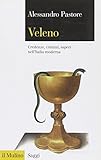
Alessandro Pastore. Veleno: Credenze, crimini, saperi nell'Italia moderna. Italy: Il Mulino, 2010. (paper), ISBN 978-88-15-13873-6.
Reviewed by Thomas Cohen
Published on H-Italy (June, 2014)
Commissioned by Monica Calabritto (Hunter College, CUNY)
Here we have a lively book with a deadly subject, treating of poisons and poisoners in Italy, with an occasional northward glance across the Alps. Its subject is wide: the substances themselves, the methods and practices of poisoners, the attempts by institutions to regulate their actions, the responses of the medical profession, and the effect, on Italy's reputation, of the peninsula's alleged and true predisposition to resort to poison. Accordingly, this is a history at once technical, social, legal, and cultural. The book is marked by wide reading and lively erudition. It is profoundly interesting but, for lack of shapely paragraphs and pointed chapters, harder to consult or paraphrase than a scholar might desire. The book is quicker to evoke and illustrate than to draw conclusions, and shies away from systematic overview. I end this review with a list of fascinating questions the book provokes and illuminates in interesting ways but does not answer in firm or systematic fashion.
There are five chapters. The first treats of poisoning itself, as activity and source for Italy's dire reputation, perhaps half-merited, as poison's homeland. The second takes up the statutes' strictures and jurists' distinctions. The third scours the records of the courts, doing social history of crime, showing by grim example who killed whom, how, for what reasons, and then, what fate befell suspected culprits if they were caught. The fourth chapter deals with medical opinion and lays out how learned commentators inserted poison into their profession's doctrines about health and illness. The fifth and final chapter explores how professionals and laity tested poisons on assorted unlucky animals and, occasionally, on pathetic fellow humans.
In the first chapter, we see a great variety of tales of poison. There was a poison complex in the culture, so poisonings did happen, be they political or familial. Servants killed cruel masters; appalling Strozzi really did poison a rebellious daughter who balked their marriage plans; spouses killed for revenge, grudge, despair, or liberty to love. But, in this poison-besotted culture, rumor and innuendo reigned. Poison was hard to prove and diagnose and many a famous or puzzling death, like that of Alexander VI, especially if sudden, awakened suspicions of foul deeds. Meanwhile, the main machinery of inquiry was a judicial system so oppressive that, thanks to torture, confessions leave us real doubts about what ever happened.
The second chapter surveys the laws and punishments. Poisoning could invite a cruel contrapasso, in Dante's sense, poetic justice. Cut off the offending hand and then brand and sever the offending head that compassed the vile deed. The chapter surveys the law, from ancient Rome across Baldus and others down to the first glimmer of the Enlightenment. The author notes that early modern laws on poison might blend with those against love potions or magic, as all three devices mingled natural and occult powers. How to rule, then, if a person were to die of a love potion? Or of well-meant medication, for that matter! Gradually, with the progress of the natural sciences, the law came to distinguish among magic, potions, and poison much more clearly. Meanwhile, the stealth of poisoning persuaded authoritative late sixteenth-/early seventeenth-century jurists, Tiberio Deciani and Prospero Farinacci, for instance, that the charge justified vigorous, protracted torture. Later in the seventeenth century, however, with astute Paolo Zacchia, circumspect empirical caution became the rule.
The meat of the third chapter, long and abrim with gruesome deeds, is a reading of the dossiers of tribunals. There, as the author readily acknowledges, we confront the usual confusion rife in records from the courts. As historians know well, whatever men and women said, and what magistrates concluded, might fit tightly, loosely, or little at all what really ever happened. Trials are thus a deeply ambiguous source as to actual crimes, but a splendid clue as to what people believed or how they chose to tell their stories, especially in a judicial forum. So trials become a fine source for the history of lying, too, but it is often hard for historians to tell a deliberate lie from honest mistaken belief or perspicacious semi-simple truth. Pastore's solution to this familiar dilemma is to tell the stories as the trials recount them, without offering much judgment of his own as to what he and we ought to believe. He seldom weighs the testimony and tests the motives of the witnesses. A history more micro in its habits might take us further, helping to sift the stories for the motives of the tellers, and to extract the beliefs and cognitive habits that gave them shape. At any rate, the general picture that emerges from Pastore's catalog of cases reveals less high politics and strategic cunning than the general banality of evil poisonings, be they noble or plebeian; squalid tales, true, half-true, or false, of overweening parents and jealous or desperate spouses. We see allegations: a prior has killed his predecessor to take his job; a husband wiped out a wife who has, he thought, contracted syphilis in another's bed. In some such tales, greedy kinfolk surface, eager to disqualify and dislodge a rival heir by charging complicity in a lucrative death. These trial stories abound in tales of rival diagnoses and earnest medical discussions of how to read the external blotches and internal lesions of a corpse. The chapter uses abundant trials from Rome and Bologna, and, for Venice, where trials are lacking, it exploits diaries and other sources abrim with rumors. Venice is of particular interest, as with its artisanal sciences it figured as a magnet for chemical experiments, real, intended, and alleged. A Bologna trial brings us the copious life story of a wandering hermit who roamed the Latin Mediterranean but gravitated to Murano, where he claimed to brew a poison so strong that the merest touch would kill. His target, says the trial, was the pope. Trials show the variety of materials and the dodges of the poisoners. To strike the victim, where did one slip the poison? Again and again, in the wine or the minestra, but, by the eighteenth century, chocolate and coffee, bitter drinks, had joined the roster of delivery vehicles.
The fourth chapter treats of the ambivalence of the physicians. How to tell a poison from a cure? Mercury, for instance, was both at once, as were opiates. Paracelsus noted sagely: if you consume too much of it, anything may poison you. But medicine had three chief interests: diagnosis, antidote, and cure. Diagnosis was hard; only in the nineteenth century did chemists learn to detect arsenic in a corpse. So diagnosis leaned on reading signs, external and internal, so that much post-mortem cutting out of organs happened. A hole in the gut was a fine sign, they believed, of arsenic. As for antidotes, the search was eternally ardent but largely futile. Bezoar stone, theriac, ground horn of unicorn did no good at all, but science, and society, kept up the search. The only antidotes that helped at all were induced vomiting, purging, and washing out the innards with copious food and drink.
In the fifth and final chapter we find the suffering animals: dogs and cats, especially, plus some swine and apes. Laity and men of science were quick to try any suspicious substance on these forerunners of the guinea pig. They plied our fellow creatures with powders, and fluids, with suspect vomit, with snake venom. Some of this they did to assay the lethal substances, and some to test the wished-for antidotes. We have here a mixture of pragmatic social custom (when in doubt feed it to a cat), time-tried legal praxis, and scientific empiricism, sometimes methodical, but seldom very systematic in its measurements or controls. At the end of the chapter we see the gruesome treatment of convicted criminals offered up to test poisons and remedies, most of them unwitting and or unwilling, but also a few who took the poison as a patent wager to cheat the gibbet and sometimes, if seldom, did win the bet.
All of this is fascinating and instructive. A reader is left with many questions. First of all, was there a large poison story, and, if so, what was its shape? Did poison and poisoning change, in its techniques, its social functions, its legal status, in the half-millennium or so the book surveys? Second, was there a cultural history of poison? Do the trials, diaries, poems, and other sources allow us to reconstruct the language, values, and practices that shaped the use of poison or the response of family, friends, and neighbors to the knowledge, belief, suspicion, or fear that poison was at hand? For instance, how did poison figure in honor culture? Was a poisoning a fitting revenge suitable to feud, or was it vile, because cowardly and stealthy? And what of legal thinking: is poisoning just one more assault on the body or is it sui generis, and, if so, how and precisely why? And what of regulation: how do corporate bodies--guilds of pharmacists, for instance, and city councils--try to regulate dangerous substances like rat poison, for instance, that might lend themselves to evil ends? And, to return to natural sciences and the physicians, a topic the book does treat, how did early modern thinkers fit, or neglect to fit, poisons into their larger scheme of the world? Was poison a mere accident, or an essence? Did it set a thing aside? Did it violate in some way the good order of nature and the benignity of the divine order of the cosmos, or did it, rather, in some way, enhance nature's mystery and power? And how much, if at all, did the evolving methodology for testing poison, a product of the empiricism of the law and the natural sciences, contribute to the genre of methodical description of testing materials and their effects? How did the complex dialogue between jurisprudence and natural science shape the evolution of the slowly emergent laboratory report? In short, this is a very interesting and learned book, but it leaves the reader hungry, and thirsty, for more systematic exposition and for more explication of the subject's connections to ambient conditions, beliefs, values, mental schemes and social or political practices.
If there is additional discussion of this review, you may access it through the network, at: https://networks.h-net.org/h-italy.
Citation:
Thomas Cohen. Review of Pastore, Alessandro, Veleno: Credenze, crimini, saperi nell'Italia moderna.
H-Italy, H-Net Reviews.
June, 2014.
URL: http://www.h-net.org/reviews/showrev.php?id=33920
 | This work is licensed under a Creative Commons Attribution-Noncommercial-No Derivative Works 3.0 United States License. |

