



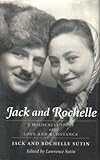
Jack Sutin, Rochelle Sutin. Jack and Rochelle: A Holocaust Story of Love and Resistance. Minneapolis, Minn.: Greywolf Press, 1995. 225 pp. $13.95 (paper), ISBN 978-1-55597-224-0.
Reviewed by Robert C. Doyle (Independent Scholar)
Published on H-PCAACA (March, 1996)
Jack and Rochelle: A Holocaust Story of Love and Resistance is a powerful two-person captivity, escape, and resistance narrative of two teenagers on the run who fell in love during World War II. For these middle-class, Polish Jews caught in eastern Poland during the Red Army's onslaught in 1939, then again during the German invasion of the Soviet Union in 1941, the world came to an end.
Jack and Rochelle found themselves in an hostile world--surrounded, hunted, and betrayed by three deadly enemies: Polish police who assisted the Red Army to disenfranchise Jewish homes and businesses and who later helped the SS to wipe out Poland's Jews systematically; bands of Russian partisans who considered Jews the enemy every bit as much as the Nazis; and the Nazi exterminators themselves. Soon after the SS arrived, Jews were collected and concentrated into ghettos where even minor offenses brought immediate execution. They created the Judenrat, an advisory committee of prominent Jewish leaders who carried out the SS orders quickly and efficiently. As a result, in the early days of the Nazi occupation, many leading Jewish citizens were executed hastily and secretly outside their homes. Jack's family, with the exception of his father Julius, was caught and murdered; Rochelle lost everyone except for an uncle. Jack and Rochelle came to the conclusion that they had to escape--Jack because he sought revenge against his tormentors; Rochelle because she refused to die like a lamb.
After their escape, Jack and Rochelle found and joined small atrads, partisan, marooned communities in Nalibocka, the forest not far from their homes. They armed themselves and conducted food raids against Polish farms and small military raids against German supply lines. With few allies among other Jews, they learned that personal determination, luck, planning, vigilance, and mutual reliance were the keys to survival. (This is not to say that this narrative has an anti-Polish or anti-German polemical intent. Not at all. They tell it as it was for them.) Revenge was an ever-present motive, especially against the SS and Gestapo who murdered millions during the occupation. Rochelle noted that these feelings subsided in time and evolved into acts of feelingless avoidance as time began to heal the wounds of war.
Being a Jew remained dangerous in Poland after "liberation" by the Red Army in 1944. Rochelle came from Stolpce; Jack came from Mia. They attempted to return, but discovered that no one wanted them back. There was no home, only a devastated ruin. After digging up small treasures of Russian gold coins hidden by their parents at the beginning of the war, Jack and Rochelle realized that, if they moved to West Berlin, the closest place where Americans tended to Jewish and other Displaced Persons, they could emigrate to America.
The book is a unique love story about two people who developed an inseparable human relationship amid the horrors of war; between the lines, there is a powerful lesson in the sanctity of life itself. Wartime, as Jack and Rochelle explain, is never the best time to form meaningful or long-lasting relationships. Any sense of future is stymied by the realities of the present. Deep feelings give way to fear and uncertainty; thoughts of establishing lasting partnerships give way to enjoying only the pleasures offered by the moment.
The narrators recall their experiences together, and readers get the feeling that they are sitting down in the Sutin living room for an extended conversation with two very honest people. Nearly every chapter features Jack and Rochelle Sutin trading interpretations of events, as they discuss not only what happened to them, but also why they did what they did. Essentially, there are three voices at work in this narrative: Jack's, Rochelle's, and a joint historical voice that synthesizes both into a third as they find their common ground together.
No, it is not a definitive historical work about the Holocaust. Yet readers familiar with Holocaust narratives will find it an interesting first-person glimpse into the experience of growing up Jewish in prewar Poland and being part of the events that structured the rest of the twentieth century. It chronicles the activities of a small group of Jewish partisans in Poland, an issue that needs more attention from Holocaust historians. Being able to leap through a world of wartime frustration and uncertainty to a world of profound human commitment and hope makes this book different and refreshing. It provides some light of humanity for one of the darkest of human experiences.
If there is additional discussion of this review, you may access it through the network, at: https://networks.h-net.org/h-pcaaca.
Citation:
Robert C. Doyle. Review of Sutin, Jack; Sutin, Rochelle, Jack and Rochelle: A Holocaust Story of Love and Resistance.
H-PCAACA, H-Net Reviews.
March, 1996.
URL: http://www.h-net.org/reviews/showrev.php?id=339
Copyright © 1996 by H-Net and the Popular Culture and the American Culture Associations, all rights reserved. H-Net permits the redistribution and reprinting of this work for nonprofit, educational purposes, with full and accurate attribution to the author, web location, date of publication, originating list, and H-Net: Humanities & Social Sciences Online. For any other proposed use, contact P.C. Rollins at Rollins@osuunx.ucc.okstate.edu or the Reviews editorial staff at hbooks@mail.h-net.org.

