



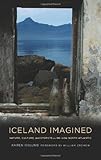
Karen Oslund. Iceland Imagined: Nature, Culture, and Storytelling in the North Atlantic. Seattle: University of Washington Press, 2011. xvi + 260 pp. $35.00 (cloth), ISBN 978-0-295-99083-5.
Reviewed by Helga Ögmundardóttir (University of Iceland)
Published on H-Environment (April, 2012)
Commissioned by Dolly Jørgensen (University of Stavanger)
In her book, Iceland Imagined: Nature, Culture, and Storytelling in the North Atlantic, the historian Karen Oslund traces the story of how the nature and human inhabitants of the North Atlantic, especially Iceland, the Faroe Islands, and Greenland, have been imagined and presented in European texts. Her focus is on writings by travelers who visited the region’s islands for various reasons from the eighteenth century to the latter half of the twentieth. The picture that emerges is one of complex and often contradictory historical imagination, sometimes more shaped by the preconceived ideas the travelers had when they arrived and preferences from their native cultures than by any unprejudiced scrutiny of what they saw and heard. The book is well written and detailed, and yet short and concise, as the author doesn’t spend unnecessary space on each part but allows the reader to get to know many different aspects of her field of interest. The topic benefits from this wide range of examples of how both the nature and peoples of the North Atlantic region were portrayed, whereas too few and overly detailed descriptions would have made it hard for the reader to build up her own imaginative map of how the region was perceived by these travelers of the past. The outcome is a mental journey in the vast and varying region of the North Atlantic, which brings forward surprisingly many details, even for someone raised and living in Iceland.
In the introductory chapter, the author puts forward several statements about the purpose of the work, as well as some key questions she wants to answer. These give a good overview of what the book covers and indicate what might be seen as missing, or at least pointed out as interesting for further investigation. The author calls the book “a cultural history of the North Atlantic as a European periphery” (p. 7), as well as a study of how the region has been envisioned from the outside by observers. This very ambitious statement is not quite met in the subsequent text, and no wonder, for that would require a much more thorough and longer piece of work, especially when it comes to the histories of Greenland and the Faroe Islands, which receive much less space than that of Iceland. But the book is very usable as a first mapping and research of what such a cultural history might look like. Touching on the history of nature, nationalism, technology, and language, the text invites the reader to enter the world of culture and nature of the three islands in focus (especially Iceland) through fields of investigation which are revealing, although rather conventional, in a historical text. Her main threads do overlook some central cultural history themes. For example, a description of the history of gender and women’s positions as told in both travelers’ and natives’ writings would have added a new and deepening dimension, not least in the light of gender roles and women’s behavior among the peoples of the North Atlantic often being seen as different and ambiguous, compared with what the travelers were used to at home, in both the past and present. As Oslund says: “Iceland Imagined takes as its point of departure the sense of confusion and difficulty travelers had in locating, measuring, and understanding this territory” (p. 22). Even if she doesn’t step much out of the conventional frame of historical research, she manages to convince the reader how profoundly confused the foreigners became when trying to fit the people and nature they met in the region into their preconceived categories.
Another issue stated as one of the book’s points of inquiry is the “hierarchy of civilization” (p. 17)--that is, how the representatives of European power centers in Denmark, Great Britain, Sweden, France, and Germany organized the peoples they observed in these marginal areas of Europe, both in relation to each other and to their own homelands. Oslund states that her text “shows how both the big and the little brothers were active, if not equal, partners in shaping this relationship” (p. 23). The book surely draws a vivid picture of these politics of images and power, where stated and hidden interests of the travelers played a major role in what they told about in their texts when they came back home, as well as how they did it, but whether they were “equal partners” is entirely dependent on who is speaking and from which point of view in the complex mosaic of power relations that prevailed in those times. Even if today’s researchers pay equal attention to the many texts produced both by the visitors and the visited and give both equal space in their presentation of this long-passed past, it is very doubtful that there was any balance in who shaped the images of nature and people in the North Atlantic. In fact, it seems that the persistence of ambiguous and mystical images of northern natures and cultures in the minds of tourists and travelers to the region can be interpreted as precisely the product of a much stronger southern view of them than vice versa. As for today’s cultural and political play of images, now that tourism has become such a strong field of interaction and mediation between people from different regions, it is clear that the story of the mythical and ambiguous north is one of the grand brands of countries like Iceland, and the natives there are not necessarily willing to tell the truth about their Western way of life and indifference towards their past. If their cultural past and mythical nature are what the hundreds of thousands of tourists come to see, then that is what they put in the forefront as the most important parts of their self-image, even if they generally have superficial knowledge of and little respect for this very past and constantly destroy that very nature for modern industrial development and capitalist economic growth.
To end this brief overview of a fine book, I want to point out some minor issues which, it has to be stressed here, do not alter my general satisfaction with this work. One is that the spelling of Icelandic words and names is too often wrong, which for such a thorough and detailed historical text, is an unnecessary flaw. Another is the discussion about the company deCODE and its biobank project in Iceland in the 90s (see the epilogue, “Whales and Men”), where Oslund traces the arguments that were voiced for and against building up a database where the genetic information of all Icelanders was to be stored for medical research. To make a long story short, she is right on all the points she covers, but forgets one of the main critiques many had against such a project. The company is a private one, operated to make a profit for its owners; to give away one’s own, and especially one’s children’s, often sensitive genetic information to a private company was in the eyes of many people not only ideologically repulsive but a breach of trust between generations. They had no guarantee of the company not selling medical information to insurance companies, for example, and cases of such things happening are not at all unknown. A third, and last, issue to take up here is that in a few cases it is not always clear who is speaking in the text: is one reading an opinion of the author herself or is she quoting someone else? This applies especially to statements which are neither facts nor universally accepted (if such a statement exists at all!), but rather which beg to be questioned and scrutinized, as they are indeed images and symbols and crowded with possibilities of different interpretations. An example is the statement on page 54 that “Icelandic nature is extreme, unpredictable, and even wild, but people live within this wilderness, and their character has been formed by the struggle with its nature”--isn’t such a view of the country’s nature and people precisely the type that should be questioned, discussed, and put into the same historical context as all the other images Oslund deals with? And why is it “an ironic result” that “in establishing themselves as the special authorities about nature in Iceland, native Icelanders ended up transforming their country in European eyes into a more “ordinary and less exotic place” (p. 81)? In whose eyes is this ironic, and how? Its alleged exoticism exists above all in the mind of the visitors and couldn’t it be seen as a normal consequence of modernization, globalization, and ever increasing tourism that a place is transformed from mythical and sublime to familiar and even rather unexciting?
The politics of images and who defines whom has been and will be, probably for as long as there are curious and creative researchers, an ongoing process and a topic of many more books such as Iceland Imagined. Oslund’s work fits into a broad trend of examining Iceland’s culture as a northern and separate one, such as Kirsten Hastrup’s A Place Apart. An Anthropological Study of the Icelandic World (1998) and Sumarliði R. Ísleifsson’s edited volume Iceland and the Images of the North (2011), to which Oslund contributed. As an Icelandic researcher and a researcher of Icelandic culture, aware of how important it is that not only native people study their society but that others contribute with their views from the outside, I welcome such fine texts as the one presented in Iceland Imagined: Nature, Culture, and Storytelling in the North Atlantic.
If there is additional discussion of this review, you may access it through the network, at: https://networks.h-net.org/h-environment.
Citation:
Helga Ögmundardóttir. Review of Oslund, Karen, Iceland Imagined: Nature, Culture, and Storytelling in the North Atlantic.
H-Environment, H-Net Reviews.
April, 2012.
URL: http://www.h-net.org/reviews/showrev.php?id=33887
 | This work is licensed under a Creative Commons Attribution-Noncommercial-No Derivative Works 3.0 United States License. |

