



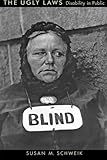
Susan M. Schweik. The Ugly Laws: Disability in Public. New York: New York University Press, 2010. 448 pp. $24.00 (paper), ISBN 978-0-8147-8361-0.
Reviewed by Daniel S. Goldberg (East Carolina University)
Published on H-Disability (February, 2012)
Commissioned by Iain C. Hutchison (University of Glasgow)
In a classic essay on Philoctetes, Drew Leder explores the significance of the eponymous character’s stinking, festering wound in context of a larger phenomenology of the ill body.[1] Unable to bear the stench any longer, Philoctetes’s companions cast him off on the isle of Lemnos. Philoctetes, says Leder, was thereby exiled both from the cosmos and from his own community, and this exile is central to the phenomenology of illness: “When we fall sick, we are banished from the daily round of roles and duties upon which so much of our conventional identity is based.... We dwell in our bed, the sole inhabitants of a far-off island, as is Philoctetes”.[2]
At issue in Philoctetes is the relationship between the (disabled) sick and the well; the negotiation of social space between them; and the ways in which visible, unsightly, and offensive injuries, illnesses, and disabilities are constructed and ordered in that space. Given that these same issues are central themes in the genesis of the so-called ugly laws in mid-to-late nineteenth-century to early twentieth-century American cityscapes, it is unsurprising that Susan M. Schweik’s seminal study on the subject mentions Philoctetes as one of the earliest Western treatments of the “social exclusion of ill, wounded, and disabled people” (p. 86). These laws, passed in a number of American cities from the 1860s to 1920, are remarkable at least in part for their blatant and unapologetic efforts to exclude maimed, diseased, or otherwise “unsightly” beggars from plying their trade on public thoroughfares.
The Ugly Laws is not only a major substantive contribution to histories of disability and stigma in American history, but also exemplifies best practices in truly interdisciplinary studies, a creature much spoken of but less commonly seen. Indeed, understanding the attitudes, practices, and beliefs that animated the ugly laws recommends, if not requires, an interdisciplinary framework. Such a study should ideally draw from social, intellectual, legal, cultural, Marxist, medical, public health, and disability historiographies, as well as narrative, performance, and cultural studies lenses. This is obviously a monumental task, and in the hands of a less able craftsperson could result in errors and insufficiencies.
But Schweik exhibits mastery of both her material and the tools necessary for its analysis. This level of control and understanding even permits the bending of disciplinary rules in ways that enhance rather than diminish the scholarship. For example, one of the most basic and serious errors a historian can make is to diverge from a tight chronology in explaining the events, ideas, and conditions at issue. Because, as Hegel argued, history is dialectic, skipping abruptly from an event in 1860 to further events in 1892 without explaining what happened in between and how that shapes the narrative can often lead to significant inaccuracies. Schweik in fact does not adhere to a strict chronology, but nevertheless weaves a cohesive narrative connecting ugly laws in the 1870s to those in, for example, 1911. The reader is not left with any sense of a large explanatory gap, even while the task set before Schweik is considerable from a chronological standpoint, given the extensive differences between Victorian and Gilded Age milieu and those of the Progressive Era. Schweik’s capacity to relate a cogent historical narrative across different time periods is testament to her skill and to the synthetic quality of The Ugly Laws.
Divided into three parts, The Ugly Laws addresses first the social, intellectual, and cultural contexts in which the ugly laws emerged; moves on to analyze constructs of race, gender, class, and alienage that underscored the existence and enforcement of the ugly laws; and concludes with an assessment of the end of the ugly laws, the latter coinciding with the rise of the rehabilitation movement of the early twentieth century.[3] Among the many strengths of the book, several stand out in particular: firstly, chapter 5’s assessment of the concern among so many municipal and charity officials and lawmakers regarding dissimulation and faking of disabilities and illnesses; secondly, chapter 6’s reading of the municipal code books as literature; and, thirdly, chapter 11’s pioneering study of “mendicant disability literature.”
Concerns over the faking of disability and injury are of course hardly the result of 1860s-era street beggars, but are widely noted in slave-owner narratives in the antebellum era, and proliferate among military administrators, doctors, and leaders on both sides during the American Civil War. While it is widely remembered that neurologist Silas Weir Mitchell (1829-1914) helped bring the phrase “phantom limb pain” into the American vernacular via his anonymous story “The Case of George Dedlow,” it is less commonly observed that he did the same, at roughly the same time, for the term “malingering.”[4] This concern for the performance of feigned disability accelerated through the wane of the nineteenth century, and Schweik offers a convincing account of the thesis, formulated in part by Martha Stoddard Holmes, that whether the disability was faked made little difference at the time since all were regarded as part of the same “‘immoral culture of mendacity’” (p. 109).[5]
Regarding the municipal code books, the ugly laws are just that--laws--and hence cannot be apprehended in any depth without a legal historical lens. However, Schweik analyzes the code books not simply by viewing them as fulfillment of the notice requirements of federal and state due process law, but by reading the code books themselves as literature. Doing so reveals the larger sociolegal structures in which the ugly laws were situated. She notes that “cities across the country ... embedded the ugly law specifically within a matrix of codes concerning local purity: decency and exhibition, gender and sexuality” (p. 144).
Cognizant of the importance of giving voice to the very people whom the ugly laws sought to efface, Schweik devotes the final chapter to an analysis of some rare texts belonging to a genre of what she terms “mendicant disability literature.” Schweik documents how some of these voices struck back against the structures and officials that sought to confine and erase them from public urban geography. In so doing, Schweik offers a potent reminder of the fact that hegemonic models of disability, be they medical or mendicant, have always been challenged even from the disenfranchised.[6]
To be sure, as in any work of this breadth and ambition, there are moments in which the coverage thins. For example, the idea advanced in chapter 3 that the rise of personal injury tort litigation in the mid-to-late nineteenth-century United States can be read as a justification for the curbing of almsgiving is unpersuasive absent significant further documentation. A large number of factors and variables contributed to this rise.[7] While there is little doubt that the industrialization of economies and labor contributed both to the rise of tort litigation and to the ugly laws, the thesis that the former is in some important way causally linked to the latter rather than both phenomena being effects of underlying sociopolitical forces is simply not established in the text. Similarly, the fact that the public space of the courtroom required participants to negotiate the time, place, and manner in which injuries and disabilities could be displayed and managed for finders of fact does not prove much about ugly laws, suspected links between the two phenomena notwithstanding.
But such concerns are exceedingly minor when balanced against the achievement of the entire book, which is nothing less than a comprehensive, nuanced, and frequently astonishing assessment of the past, present, and future of the ugly laws. As municipalities in the United States continue to tightly regulate the circumstances under which poor, sick, and disabled persons may solicit in public thoroughfares,[8] Schweik’s book serves as a penetrating and important analysis of the boundaries of social exclusion and inclusion in American cityscapes. The book incisively accounts for the history of the ugly laws in their own time and on their own terms, while it simultaneously suggests what lessons those histories hold for present and future efforts to negotiate the social space between disabled persons and the temporarily able-bodied.
Notes
[1]. Drew Leder, “Illness and Exile in Sophocles’ Philoctetes,” Literature and Medicine 9 (1990): 1-11.
[2]. Ibid., 4.
[3]. The fact that The Ugly Laws ends with the early twentieth-century rise of rehabilitation suggests an important congruence between The Ugly Laws and Beth Linker’s recent account of rehabilitation, disability, and World War I, War’s Waste (Chicago: University of Chicago Press, 2011). The latter was published two years after the hardcover version of The Ugly Laws, but Schweik does cite an earlier paper of Linker’s on the same subject (p. 343n25). Beth Linker, “Feet for Fighting: Locating Disability and Social Medicine in First World War America,” Social History of Medicine 20, no. 1 (2007): 91-109.
[4]. Silas Weir Mitchell, “The Case of George Dedlow,” The Atlantic Monthly 18, no. 105 (1866): 1-11; and William W. Keen, Silas Weir Mitchell, and George R. Morehouse, “On Malingering, Especially in Regard to Simulation of Diseases of the Nervous System,” American Journal of Medical Science 48 (1864): 367-394.
[5]. Martha Stoddard Holmes, Fictions of Affliction: Physical Disability in Victorian Culture (Ann Arbor: University of Michigan Press, 2004), 130.
[6]. Citing Paul Longmore and Lauri Umansky, “Introduction: Disability History: From the Margins to the Mainstream,” in The New Disability History, ed. Paul Longmore and Lauri Umansky (New York: New York University Press, 2001), 22.
[7]. For example, see Kenneth A. DeVille, Medical Malpractice in Nineteenth-Century America: Origins and Legacy (New York: New York University Press, 1990).
[8]. For example, see Thomasi McDonald, “For Raleigh Beggars, It’s a Handout Life,” Raleigh News & Observer, January 5, 2012.
If there is additional discussion of this review, you may access it through the network, at: https://networks.h-net.org/h-disability.
Citation:
Daniel S. Goldberg. Review of Schweik, Susan M., The Ugly Laws: Disability in Public.
H-Disability, H-Net Reviews.
February, 2012.
URL: http://www.h-net.org/reviews/showrev.php?id=33823
 | This work is licensed under a Creative Commons Attribution-Noncommercial-No Derivative Works 3.0 United States License. |

