



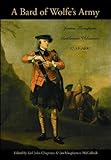
Ian M. McCulloch, Earl John Chapman, eds. A Bard of Wolfe's Army: James Thompson, Gentleman Volunteer, 1733-1830. Montreal: R. Brass Studio, 2010. xxiv + 361 pp. $37.95 (paper), ISBN 978-1-896941-62-2; $67.95 (cloth), ISBN 978-1-896941-63-9.
Reviewed by Timothy Compeau (Department of History, The University of Western Ontario)
Published on H-Canada (July, 2011)
Commissioned by Stephanie Bangarth (King's University College, UWO)
In the Army of the Red-Haired Corporal
The bard was an important figure in the clan life of Scotland. He was the chieftain’s senior “advisor and mouthpiece” and the keeper of the oral history of the clan. When James Thompson, a native of Tain, Scotland, joined the Fraser Highlanders as a “gentleman volunteer” in 1757 he had no intention of fulfilling this role. Yet, with his inclination towards storytelling, Thompson, according to Earl Chapman and Ian McCulloch, became the de facto bard of James Wolfe’s army, “a bard in that he kept the exploits of his friends, Highland kinsmen and clansmen alive forevermore in his stories” (p. xvi). The core of this book is made up of Thompson’s anecdotes, told in his later years and recorded by his son, James Thompson Jr. The authors have done a fine job in bringing these engaging sources to the reading public. Specialists, too, will find some fascinating insights into military and garrison life in the mid to late eighteenth century. This volume does not set out to provide a reinterpretation of the history of the Conquest and British rule in Quebec. Rather it presents the personal experiences of a middling sort of man who was caught up in some of the most transformative events in Canadian and Atlantic history.
Published by Robin Brass Studios, A Bard of Wolfe’s Army is an attractive volume, well designed and replete with maps, sketches, and other contemporary images. The book is divided into three sections: a narrative of Thompson’s life, a collection of his anecdotes, and a biographical section describing the notable people Thompson encountered in his lifetime. Clearly written and attentive to detail, the narrative describes Thompson’s life from his origins in Scotland to his funeral in Quebec City, and provides a trove of interesting vignettes captured from letters, newspaper accounts, and Thompson’s own diary. The authors succinctly present a detailed picture of a long life, without straying into imaginative speculation where the records are silent. Military historians will be interested in Thompson’s experiences of besieging Quebec in 1759 and being besieged in the same city in 1775. As the overseer of military fortifications at Quebec, Thompson played a central role in repelling the American assault. Thompson’s experiences also provide a fascinating look at a non-English-speaking regiment within the British army. Orders and cultural concepts had to be continually translated for the Gaelic-speaking Highlanders. A prime example is the excellent anecdote of a Scottish soldier who steals a French officer’s sword as a trophy after the fall of Louisbourg. Perhaps in keeping with the Highland way, when the soldier is ordered to relinquish his prize, Thompson declares that “devil a bit would he give up the sword” until he is finally forced to adhere to the courtesies of gentlemanly war (p. 147).
The chronological arrangement of the narrative sweeps along at a brisk pace, but there are places where the authors allow unrelated episodes to get mixed in with a central story. For example, Thompson’s beloved wife Fanny gets through her difficult pregnancy only to be stricken with mastitis, a potentially deadly affliction in the eighteenth century. On the same page his son is baptized, which is then followed by Thompson’s observations of a double execution and the teeming “hard-hearted crowd” that clamors for a view of the hangings. The scene then returns to his concern for his son (p. 52). It is unclear if the authors intend to show how the anxiety of his private life is affecting his thoughts on public matters, or if it is just an interesting tidbit that occurred around the same time. The narrative would have benefited from more explicit discussions on how these and other episodes are connected. Nevertheless, part 1 provides excellent context for the complete anecdotes of James Thompson presented in the second section.
In his final years, Thompson became something of celebrity in Quebec City. Remaining lucid and witty until his death in 1830, Thompson shared his stories with anyone who would listen, and was happy to dictate his anecdotes for his son to transcribe. The veracity of the tales was accepted by James Jr. and many others due to their “repeated recital” and the consistency of the details (p. xvii). George Ramsay, the 9th Earl of Dalhousie and governor general of British North America, 1820-28, delighted in the old Scotsman’s repeated yarns, commenting that he “told his stories in the very same words he always told them” (p. 83). In many instances we have to take James Jr.’s transcriptions on faith, but the authors have attempted to verify what tales they could from other primary sources.
Thompson’s anecdotes are not epic or expansive in scope, but focus on the personal experiences of his group of Highlanders. The same men appear repeatedly throughout the stories, such as Duncan McFee, the irascible thief who is transformed into one of Wolfe’s personal favorites, and David Kanavan, the tailor who repeatedly parades himself in an officer’s uniform to get into mischief. Far from relating an arduous life of privation and the lash, Thompson’s descriptions of army life depict adventure, antics, and dark humor. General Wolfe appears on numerous occasions and is shown as an amiable and down-to-earth sort of leader, earning the nickname “the red-haired corporal” from the Highlanders. James Jr. obviously tried to capture the folksy style and rough Scottish burr of an aged and adept storyteller, with choice lines such as “’afaith, I was nigh getting into a serious hobble for my Scholarship” (p. 155).
A Bard of Wolfe’s Army is an enjoyable book and will be of interest to general readers of early Canadian or military history, and by presenting the primary sources themselves, will be of use to historians of the period.
If there is additional discussion of this review, you may access it through the network, at: https://networks.h-net.org/h-canada.
Citation:
Timothy Compeau. Review of McCulloch, Ian M.; Chapman, Earl John, eds., A Bard of Wolfe's Army: James Thompson, Gentleman Volunteer, 1733-1830.
H-Canada, H-Net Reviews.
July, 2011.
URL: http://www.h-net.org/reviews/showrev.php?id=33681
 | This work is licensed under a Creative Commons Attribution-Noncommercial-No Derivative Works 3.0 United States License. |

