



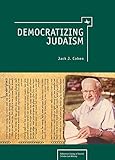
Jack Cohen. Democratizing Judaism. Brighton: Academic Studies Press, 2010. 301 pp. $49.00 (cloth), ISBN 978-1-936235-16-2.
Reviewed by Eric Caplan (McGill University)
Published on H-Judaic (August, 2011)
Commissioned by Jason Kalman (Hebrew Union College - Jewish Institute of Religion)
Still Relevant after All These Years: Jacob Cohen on Mordecai Kaplan
Jack Cohen is one of the leading writers on Mordecai M. Kaplan’s thought. Democratizing Judaism gathers together a number of Cohen’s already published articles and talks on Kaplan from the last forty years. Roughly half of the book, however, is comprised of previously unpublished material, much of which was written in the last two to five years. The book is divided into two sections. The first, approximately two-thirds of the book, mostly explicates and defends the continued relevance of aspects of Kaplan’s theology and highlights Kaplan’s writings. The second deals largely with Cohen’s personal thoughts on how the State of Israel can be both a democracy and a Jewish state. This section references Kaplan rather sparsely.
Cohen first met Kaplan in 1939, one year before beginning his rabbinic training at the Jewish Theological Seminary where Kaplan taught. It was reading Kaplan’s Judaism as a Civilization (1934) that inspired Cohen to become a rabbi. He quickly became one of those students--Ira Eisenstein and Emmanuel Goldsmith can also be counted among this group--whose intellectual worlds were so transformed by Kaplan that they became his disciples. They sought contact with him outside of the classroom, grew into jobs in the emerging Reconstructionist movement, and wrote books and articles that disseminated his ideas. Cohen moved to Israel in 1961, and has worked tirelessly to find an Israeli audience for Kaplan’s thought.
Democratizing Judaism opens with a wonderful essay in which Cohen shares his personal memories of Kaplan. The picture of Kaplan that emerges--one that echoes the recollections of others who were close to Kaplan--is of a difficult person. Kaplan had a temper, “could be ruthless in his criticism of students,” needed to control the content of conversations, would tell you what to think “if you did not respond as he wanted you to,” had little patience for small talk, and was thus “not easy to get to know” (pp. 12-13, 18). How can we account for the love that Cohen and other members of Kaplan’s inner circle had for him? Cohen’s chapter makes clear that his attachment to Kaplan was rooted in his great respect for Kaplan’s ideas, for “the cogency of his analysis of the problems of Jewish life” (p. 13), and for the breadth of his interests and knowledge. Cohen also admired Kaplan’s intellectual honesty. Although Kaplan’s first reaction was to reject fiercely any criticism of his ideas, the next day he would accept all “cogent criticism[s]” that had been made. Cohen credits Kaplan with teaching him how to think clearly, by insisting that “if I could not formulate [an] idea in one statement, it could not be clear in my mind” (p. 16). But Cohen’s love of Kaplan cannot only be traced to his admiration of Kaplan’s intellect. He reports that “those of us who managed, for whatever reason, to gain his affection and confidence were able time and again to observe his solicitude and concern for our welfare” (p. 18). Kaplan gave generously of his time to students and colleagues and some soon learned that behind a tough exterior lived a deeply emotional man who struggled with his temper and his unfortunate tendency to be an unsympathetic critic of human shortcomings.
Cohen is clearly frustrated by the way the work of his beloved teacher has been treated since his passing. Very little has been written on Kaplan “given the richness of [his] interests and the suggestiveness of many of his proposals” (p. 122). Some of his ideas are accepted but without proper attribution. More importantly, Kaplan’s theology is often rejected in favor of writers who put forth conceptions of God and the tradition that either cannot be defended intellectually or that carelessly ignore the real challenges facing the Jewish people. Thus Abraham Joshua Heschel’s belief that God is in search of man, is valued even though it claims to know God and His will in a way that Cohen believes is “pretentious” (p. 102). Franz Rosenzweig is admired, although, in Cohen’s view, his thought leads to a “disembodied intellectualism, unrelated to the changing environment” (p. 70) that dangerously sanctifies “homelessness [and] powerlessness” (p. 69). For Cohen, there is much to learn from Kaplan’s insistence that theology “must be tied to man’s existence as it evolves in real life” (p. 72) and that it must avoid all assertions that cannot be justified through experience. Thus, whereas “creativity is experienced at all times” (p. 105) and can be plausibly associated--as Kaplan did--with a force in the universe that makes it possible, to insist that God created the world is to venture into territory of which humanity has no knowledge. This belief in Creation is based on an embrace of the Torah account, even though “the evidence is heavily weighted in the direction of the belief that Jewish tradition and the traditions of the peoples were fashioned and continue to be developed by men and women of all manner of mental ability, temperament, and moral stature” (p. 171). Moreover, attributing Creation to God raises many troubling questions, including “the age-old perplexity as to why an omnipotent, all-good God should have created such a messy world” (p. 105).
Some answer such questions by stating that God’s ways are ultimately unknowable. Indeed, there is much about the world that humans cannot understand, but the Jewish view that “man is created in the image of God and therefore capable of reasoning and discriminating between right and wrong” (p. 292) obligates us not to plead ignorance when other understandings are possible. Like Kaplan, Cohen rejects any theology “in which the human mind is debased” by elevating “Divine morality ... to a sphere beyond human reach” (p. 282). Cohen’s faith in the abilities of man to understand the world and to improve it echoes similar beliefs held by secular humanists. Cohen lives in Israel, where secular-religious rifts often threaten to tear society apart. He devotes a number of the book’s essays to showing that the divide between religion and secular humanism is not so wide when one approaches religion from a non-supernatural perspective. Cohen clearly wishes that more religious Israelis would embrace naturalism, but he would settle for the more modest goal of convincing humanists that their belief in Man, like Kaplan’s faith in a cosmic force that makes for human salvation, though substantiated by experience, also “flies in the face of the immanent discontinuities of the universe and of human behavior” (p. 292). It, too, requires a leap of faith. Recognizing this commonality could help build bridges between secular and religious Jews.
Cohen, like Kaplan, believes that the desire of Israeli Jews to have a state that is both Jewish and democratic is irreconcilable in the way it is approached currently. A democratic state belongs equally to all of its citizens. Such a state cannot set out to be Jewish; it can be Jewish only in the natural way that the “cultural ambience” in states, like Israel, with “a large ethnic or religious majority ... will undoubtedly be conditioned by the way in which that majority conducts itself” (p. 234). Cohen feels that both the flag and national anthem of Israel are too Jewish to be the national symbols of a democracy and that their continued use “proclaim[s] that all non-Jews are second-class citizens” (p. 231). He laments the fact that Israeli Arabs can face discrimination in the workforce and that the country’s leadership often gives priority to the housing and other needs of Jews. Although Cohen is clearly critical of Israel’s approach to its minorities, I found him to be a fairly even-handed critic. He recognizes that Israel’s approach to its Arab population is influenced by the continued state of war between Israel and its Arab neighbors. Though it must strive to do better, it is hard for the Jewish majority to fully empathize with the needs of its Arab citizens at this time. Similarly, Cohen points out that Israel’s neighbors have built their national symbols around their Islamic faith and that it would be unfair if “Israel should be the only people in the world that is asked to abandon expression of its dominant culture in the symbols of the state” (p. 238). Cohen hopes that in time Israel, and other nations, will develop a set of less particularistic national symbols to complement their current ones. Like Kaplan, he dreams of a time when the world’s nations will develop “forms of polity” that are “more conducive to international peace and amity” than the current ones, and calls upon Jews to “cooperate in efforts to engender those forms” (pp. 213-14).
Cohen’s article on the kotel (Western Wall) is a highlight of the collection. He believes that the country’s leadership erred when it allowed the Ministry of Religion to turn the Wall into a place of organized (Orthodox) worship. The Wall should be a symbol of Jewish peoplehood and unity; a “site where every Jew can come to reflect on his or her renewed encounter with the history and cultural development of this unique people” (p. 254). Because of the proliferation of different streams of Judaism, including secular expressions, worship serves to divide Jews today. Accordingly, liberal and secular Jews cannot feel comfortable at the Wall as currently organized. Instead of fighting for the right to pray collectively as non-Orthodox Jews at the Wall, Cohen believes that Conservative and Reform Jews should be working to transform the Wall into a neutral, non-synagogue space. This would avoid the problematic of figuring out how to share the Wall between the various religious and non-religious streams--a requirement of any democracy--and make it more likely that non-Jews can also be moved by contact with the Wall. Cohen is a realist and recognizes that his vision “hasn’t the slightest chance of being accepted by this generation of our people” (p. 256). I admire Cohen’s courage in putting forth this controversial position.
Cohen’s essays on contemporary Israeli issues, though compelling, do not fit seamlessly into the book. Stylistically, their content is much lighter, much less academic, than the other articles in the collection. More importantly, the majority of Democratizing Judaism discusses Kaplan’s thought directly and delves quite deeply into aspects of his work. These other essays, however, make scant reference to Kaplan’s writings, although Cohen’s positions on Israel often echo ones that Kaplan expressed in his lifetime. In the book’s introduction, Cohen writes that these essays “illustrate Kaplan’s influence on my own Weltanscauung” (p. 10). Yet because the other pieces of the book mostly focus on Kaplan’s theology and not his Zionism, the connection between the sections is lost. Cohen needed to preface his essays on contemporary Israel with an extended discussion of Kaplan’s Zionist writings.
Cohen acknowledges that as a close colleague and admirer of Kaplan, he can be accused of “being too emotionally involved and therefore incapable of treating Kaplan with the requisite disinterest” to convincingly defend Kaplan’s ideas against his detractors. Cohen believes that his “case will have to rest on its merits” (p. 121) and on these terms, Democratizing Judaism is a success. For the most part, Cohen responds convincingly to the criticisms of Kaplan put forth by Eliezer Berkowits, David Novak, Eugene Borowitz, David Hartman, and others. On the other hand, Cohen does not hesitate to put forth his own critique of his teacher’s work, noting for example, that Kaplan erred when he claimed that “it is impossible for a modern-minded person to hold an idea of God as Wholly Other” (p. 145), and that he was naïve to believe that “reason is powerful enough to overcome, in a brief span of time, people’s resistance to new ideas and ideals” (p. 193). He believes that Kaplan could have attracted more Jews to his program if he had rooted his vision for changes to ritual more persistently in traditional sources. He laments the fact that Kaplan only moved to Israel in his later years when he could no longer have any effect on the intellectual life of the country. Although Cohen is justified in noting that contemporary Reconstructionism has not engaged with the State of Israel to the extent that Kaplan would have wanted, his belief that Kaplan would have been against Reconstructionism’s endorsement of rabbinic officiation at homosexual marriages is pure conjecture.
Democratizing Judaism is full of unpublished excerpts from Kaplan’s diaries that are often a joy to read. Cohen is a sensitive and knowledgeable reader of his teacher’s work. Scholars of modern Jewish thought will undoubtedly find something of interest in this book. Cohen’s work, however, lacks a systematic treatment of Kaplan’s thought and is thus not the place for neophytes to begin.
If there is additional discussion of this review, you may access it through the network, at: https://networks.h-net.org/h-judaic.
Citation:
Eric Caplan. Review of Cohen, Jack, Democratizing Judaism.
H-Judaic, H-Net Reviews.
August, 2011.
URL: http://www.h-net.org/reviews/showrev.php?id=33634
 | This work is licensed under a Creative Commons Attribution-Noncommercial-No Derivative Works 3.0 United States License. |

