



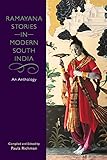
Paula Richman. Ramayana Stories in Modern South India: An Anthology. Bloomington: Indiana University Press, 2008. xxiii + 258 pp. $65.00 (cloth), ISBN 978-0-253-34988-0; $24.95 (paper), ISBN 978-0-253-21953-4.
Reviewed by Adheesh Sathaye (University of British Columbia - Asian Studies Center)
Published on H-Asia (August, 2011)
Commissioned by Sumit Guha (The University of Texas at Austin)
On the Modernity of Ramayana Stories in Modern South India
One of the more robust areas of South Asian literary and cultural studies has concerned the diversity of the Ramayana epic narrative tradition. Paula Richman has been a major contributor to this field, both through her own research as well as two collections of scholarly essays: the seminal Many Ramayanas (1991) and more recently, Questioning Ramayanas (2001). These volumes, along with those edited by Mandakranta Bose (Ramayana Culture [2003], Ramayana Revisited [2004]) Monika Theil-Horstmann (Contemporary Ramayana Traditions [1991], Ramayana and Ramayanas [1992]), and Joyce Burkehalter Flueckiger and Laurie Sears (Boundaries of Tradition [1990]), have joined older publications (e.g., V. Raghavan’s Ramayana in Greater India [1975], Ramayana Tradition in Asia [1980], and K. R. Srinivasa Iyengar’s Asian Variations in Ramayana [1983]) to form a comprehensive picture of the life of this epic. This cascade of scholarship has explored why the ancient account of how Rama defeated Ravana and rescued Sita has had such a long and profound impact on social, political, and religious life in South Asia, why it exhibits such rich variation in the major regional literatures, and why even today it is able to capture the imagination of populations far beyond the subcontinent. On the surface, then, it might appear challenging for an anthology of Ramayana Stories in Modern South India to tell us something new about the epic. This is, however, precisely what Paula Richman has been able to do through this lively and engaging volume.
Ramayana Stories brings together English translations of twenty-two short stories, poems, dramas, and other literary works that have been published over the last century in the major South Indian vernaculars: Tamil, Telugu, Kannada, and Malayalam. Secondary analysis is restricted mostly to a general introduction and prefaces to the three parts of the book, while the spotlight remains on the story texts themselves. The book is thus best regarded as a sourcebook, with the exception of two scholarly essays that analyze the film Kanchana Sita of Aravindan (by Usha Zacharias) and a modern theatrical adaptation of Kuvempu’s Shudra Tapasvi by Basavalingaiah (by Paula Richman). Richman explains that the stories have been selected because they “succeed as literary works and exhibit some kind of compelling innovation or new perspective” (p. xiv). This latter criterion raises some issues about modernity that I will address below. The former, however, cannot be disputed--writers such as K. V. Puttappa (“Kuvempu”), Pudumaippittan, or C. Subramania Bharati have been highly influential in modern Indian literature (pp. 23-25). Regarding the focus on the South, Richman argues for a greater narrative diversity in this region, since “no single text functions as the sole ‘classic’ Ramayana in South India” (p. xv, note 3). (This is in contrast to Tulsidas’s Ramcaritmanas in the North.) The inversion of the Ramayana in Dravidianist politics, sympathetic to the “southern” demons and critical of the “northern” Rama, is another factor that gives these critical retellings more cultural weight in the South (p. 14).
The anthology is organized into three thematic parts. Part 1, “Sita in Context,” presents ten stories focalizing Rama’s wife, each offering novel and often critical reinterpretations of her fire ordeal, banishment, and subordination. A moving example is a Telugu short story by “Volga” Popuri Lalitha Kumari, entitled “Reunion” (Samagamam) (story 8). In Volga’s story, Sita, after her banishment, and after the birth of her twin sons, is reunited with Shurpanakha, who has retired to the forest to tend to a beautiful garden. Sharing in the pain and humiliation that Rama has inflicted upon both of them, these erstwhile rivals develop a sisterly bond that serves to highlight the injustices of normative Hindu patriarchy. Part 2, “Stigmatized Characters,” features six stories that raise critical questions about Shambuka and Ahalya--two figures who are generally subjected to censure in the Ramayana tradition. The highlight of this section is an excerpt from Kuvempu’s Shudra Tapasvi (The Shudra ascetic) (story 11), published in 1944, juxtaposed with Richman’s detailed performance analysis of a new adaptation of this play by C. Basavalingaiah, first staged in 2001 (story 12). Both Kannada dramas take critical positions towards Rama’s execution of Shambuka, the low-caste ascetic condemned due to his performing religious penances deemed disruptive to the harmonic balance of dharma. At the same time, the differences between them give a clear picture of how this story continues to be reinterpreted amidst the social and political changes of the intervening six decades. Part 3, “So-Called Demons,” includes five stories that take sympathetic perspectives on Ravana and Shurpanakha, the demonic villains who have historically served as the embodiment of the cultural “Other” (pp. 174-175). This includes Kandula Varaha Narasimha Sarma’s (“Kavanasarma’s”) Telugu short story entitled “Shurpanakha’s Sorrow” (Surpanakha Sokam) (story 18), a modern adaptation of Shurpanakha’s mutilation. Kavanasarma imaginatively projects the conflict between Rama and Ravana into the contemporary world of politics, big business, and the Indian law courts, in which Shurpanakha and Sita are both victims of domestic abuse at the hands of two business competitors intent on proving their masculinity.
The translations (by seventeen contributors) are lucid and of consistently high quality. Most are being published in English for the first time, and assembling them into one accessible volume is a welcome achievement, one certain to inspire a number of essays, theses, and dissertations in the years to come. The greatest strength of this book, I believe, is its pedagogical value--especially for the North American undergraduate classroom. In introductory courses on South Asian mythology, religion, or history, we regularly assign essays from Richman’s Many Ramayanas volume in order to make a point that for most of us is self-evident: there is no one correct way to tell the story, and the canonical versions of Valmiki and Tulsidas have always coexisted with other tellings that challenge them. But due to a lack of readable translations, or a lack of time to read them, our students have mostly had to accept this argument on faith. With the publication of Modern Ramayana Stories, students may now easily come to their own conclusions by reflecting on short but pertinent primary texts, thereby discovering for themselves the diversity of the tradition. The utility of this book for active undergraduate learning cannot be overstated. Moreover, given the focus of most sourcebooks on ancient or medieval texts, this anthology illuminates new “here-and-now” perspectives on what is generally treated as a timeless classic.
“Modernity” is the basic connective tissue for the stories in this anthology, and worth closer consideration in assessing this book’s scholarly impact. Richman addresses this issue in the introductory chapter, alongside a synopsis of the epic plot, an overview of the South Indian cultural/historical milieu, and a picture of the diversity of this narrative tradition in its classical, regional, and folk incarnations. To these categories, she explains, this volume wishes to add a fourth: versions published in the last century. Among other things, Richman argues that the development of educational institutions, print technology, and new regional-language reading communities in South Asia have “allowed writers of literature in regional languages to tell Rama’s story in their own way for their own time” (p. 12). It must be noted, however, that premodern writers such as Kampan or Bhavabhuti, despite their misfortune of living before the advent of print capitalism, audiovisual media, or standardized education, still managed to “tell Rama’s story in their own way for their own time.” A number of contributors to Richman’s earlier volumes have argued as much (e.g., A. K. Ramanujan, “Three Hundred Ramayanas” [1991]; David Shulman, “Bhavabhuti on Cruelty and Compassion” [2001]; Robert Goldman, “Ravana’s Kitchen” [2001]), and Richman does acknowledge this at several points in this book (e.g., pp. 8-9, 17, 112). What then, if anything, is truly “modern” about these “Ramayana stories?”
One answer that appears consistently throughout these stories is a bold and unabashed critique of caste and gender hierarchy. As Richman points out, this actually cuts across social lines--Brahmins, non-Brahmins, male and female writers alike have questioned the discourses of social inequality and patriarchy embedded within the Ramayana (pp. 20-21). Can we then say that “modern ideals of equality, liberty, and individuality” (p. 19) directly shape the epic’s reinterpretation by today’s writers? The selections themselves, along with Richman’s careful analysis, do indeed support such a conclusion. Alongside this social critique, I believe that there is a textural factor involved in the making of “modern” Ramayanas: their fictionality. It is evident that most, if not all, of these selections position themselves as purely imaginative accounts, and not terribly interested in determining what actually happened in the ancient past. This is in stark contrast to the religious insistence upon the historicity of the epic, an issue that has become politically divisive during the last few decades, from the demolition of the Babri Masjid to controversies over course curricula at Delhi University or the dredging shipping channels through Adam’s (that is, “Rama’s”) Bridge. While Bhavabhuti and other premodern writers also invented imaginary scenes, their adaptations did not attempt to radically displace the discursive authority of the “master” narrative. Any social or political critique in their Ramayanas remained a necessarily muted one, something to be read between the lines. The writers in this anthology, on the other hand, carve out a new literary space that is both fictional and explicitly critical of the Ramayana’s social discourse. As a result, they are able to express something else that is more properly “modern”: the possibility of rupture, of a radical break from the past, and the production of a space for progress into the future. Such a sentiment is rarely, if ever, sustained in premodern versions. By bringing these works together for the first time in English, Richman has managed to produce something equally significant for Ramayana studies--a space in which students and general audiences may witness for themselves the diversity of this rich narrative tradition, while also inviting more seasoned scholars to consider more closely how the “traditional” narrative takes on the textures of the “modern” through the work of writers and readers in contemporary South India.
If there is additional discussion of this review, you may access it through the network, at: https://networks.h-net.org/h-asia.
Citation:
Adheesh Sathaye. Review of Richman, Paula, Ramayana Stories in Modern South India: An Anthology.
H-Asia, H-Net Reviews.
August, 2011.
URL: http://www.h-net.org/reviews/showrev.php?id=33583
 | This work is licensed under a Creative Commons Attribution-Noncommercial-No Derivative Works 3.0 United States License. |

