



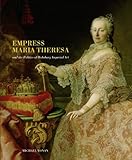
Michael Elia Yonan. Empress Maria Theresa and the Politics of Habsburg Imperial Art. University Park: Pennsylvania State University Press, 2011. xiii + 226 pp. $89.95 (cloth), ISBN 978-0-271-03722-6.
Reviewed by Franz A. J. Szabo (University of Alberta)
Published on HABSBURG (June, 2012)
Commissioned by Jonathan Kwan (University of Nottingham)
Legitimizing Female Rule through Art
Although she was invariably addressed as such by her ministers and officials, the famous Habsburg empress Maria Theresa (ruled 1740-80) was never an empress in her own right, but merely the spouse of the Holy Roman emperor Francis I. As hereditary ruler she was queen of Hungary and Bohemia, archduchess of Austria, and queen, duchess, countess, and margrave of the numerous other territories that constituted the Habsburg patrimony in central Europe. But even in these lands her succession was by no means a foregone conclusion. Once it became increasingly clear to her father, the emperor Charles VI, that he would have no male heirs, and that, indeed, the Habsburg dynasty in the male line was on the point of extinction, he devoted considerable energies and resources for the balance of his reign to secure a smooth and legitimate succession for his oldest daughter, Maria Theresa. That this was highly unusual, and for the Habsburgs unprecedented, is clear from the extraordinary document produced to serve this purpose, the so-called Pragmatic Sanction--at once a will and testament, an internal family ordinance setting the order of succession, a constitutional document, and an international treaty--and by the steps taken to secure its endorsement domestically and internationally.
The Pragmatic Sanction reversed an earlier family compact (the pactum mutuae successionis of 1703) concluded in the reign of Charles’s father, Emperor Leopold I, which stipulated the reversion to female in the absence of male heirs, but which gave precedence in the order of succession to the two daughters of Charles’s older brother, the emperor Joseph I. After the unexpected and premature death of Joseph and the accession of Charles, the latter now reversed the order of succession, giving precedence to his own two daughters over Joseph’s. In order to ensure that the entire Habsburg inheritance would pass to Maria Theresa, the Pragmatic Sanction further stipulated that the lands of the House of Habsburg were “indivisible and inseparable.” The acceptance of these provisions by the diets and estates of the various crown lands of the Habsburgs gave the document domestic constitutional force, while its endorsement by virtually every country in Europe gave it the force of an international treaty. Whatever the political wisdom of this exercise, there is little doubt that the net effect was to invest Maria Theresa with the legal right of succession and to confer legitimacy on her sovereignty over the Habsburg patrimony.[1]
In this groundbreaking work Michael Yonan examines what he calls the “unusual and unprecedented” status of Maria Theresa’s rule as a hereditary sovereign rather than the more common role of queens as a consort or a regent, and focuses on the visual arts strategies the queen-empress employed to construct what Yonan calls her “monarchical identity”--that is, the “fictive image of the ruler, a construction not necessarily reducible to a single textual reference or painting, but a collective ideological tissue born of various statements, legends, actions and representations” (p. 6). It is perhaps important to point out what this book is not: it is neither a history of Maria Theresa’s art patronage nor a survey of the visual arts during her reign. Rather, it is a highly analytical monograph that represents a rethinking of monarchical imagery in the eighteenth century. In that process, Yonan confronts the problem that “Maria Theresa’s monarchical identity was by necessity a fragmented one” (p. 6). As legitimate Habsburg heiress, Maria Theresa certainly had to emphasize aesthetic forms and gestures that underscored the fact that her rule was divinely ordained. But as a woman--and particularly as a woman on whose reproductive capacity the future of the dynasty hinged--the visual imagery also had to emphasize the traditional “female” qualities of fertility and motherhood. In examining some of the diverse artistic narratives employed to this end, Yonan does not attempt to be comprehensive, but rather is avowedly selective. Each of the six chapters of the book limits itself to singling out “a handful of noteworthy paintings, architectural settings, and objects in order to unravel in detail the ways in which Maria Theresa’s monarchical identity can be located in them” (p. 8).
In arguing that “it was predominately through her body that the empress formulated this imperial identity” (p. 4), the theoretical underpinning of Yonan’s study follows a historiographical and analytical direction first suggested by Ernst Kantorowicz’s observations about “the king’s two bodies”--the body natural and the body politic, the former mortal but the latter a symbol of his office and divine right to rule.[2] More recently scholars have brought a gender perspective to this model, which has yielded a much more complex and nuanced understanding of the bodies of queens.[3] In this connection Yonan seeks to demonstrate how both of Maria Theresa’s bodies “were potentially valuable to an imperial conception of rule” (p. 5). In line with Erving Goffman’s notion of the human body as a conveyor of meaning in social space and Peter Burke’s emphasis on image as message,[4] Yonan sees works of art that focus on Maria Theresa’s monarchical identity as “interventions into social semantics, and therefore a moment when meanings about monarchy can be manipulated” (p. 7).
The first two chapters approach this problem through the most predictably obvious medium: portraiture. The first chapter’s analytical centerpiece is Martin van Meytens’s famous state portrait of Maria Theresa dating from around 1750. Yonan contrasts this portrait with earlier portraits--beginning with Andreas Möller’s portrait of the young archduchess as an adolescent, through Gustav Adolf Müller’s 1740 engraving marking her accession, to Meytens’s 1744 double portrait, which adds a cameo of the young heir Archduke Joseph, to the top of the frame--all of which, while focusing on her royal status, were equally or perhaps even more concerned with focusing on her fertility. By 1750 Maria Theresa had already given birth to her tenth child and third son--Yonan repeats her oft-cited comment, “I never tire of having children” (p. 5)--so that neither her fertility nor her capacity to ensure the future of the dynasty were any longer in question. As a consequence, the 1750 portrait of a by-now more stout empress strives to “formulate a monarchical identity that is radically more empowering than anything that preceded [it]” (p. 34). A detailed analysis of the iconography of the portrait reveals the degree to which it focuses on her “monarchical power on its own terms” (p. 36) rather than her imperial status by virtue of her marriage to Holy Roman emperor Francis I. The second chapter is devoted to Anton von Maron’s 1773 portrait of Maria Theresia as widow, in which Yonan shows how the iconography of the earlier state portrait was modified to acknowledge her widowed status. While after the death of her husband in 1765 she was now the widowed Holy Roman empress, this in no way diminished her sovereign authority over the Habsburg patrimony guaranteed by the Pragmatic Sanction, so that Maron had to represent her “in a manner that codified [her] political power through credible visual codes” (p. 55).
The subsequent four chapters deal with the more complex problem of architectural settings and focus mainly on how the suburban Schönbrunn Palace’s “interior and exterior artistic programs were assembled” (p. 9). As Maria Theresa’s favorite palace, which received its current shape largely under her reign, Yonan seeks to demonstrate in three of the four chapters how room arrangement and decoration represent vital iconographic clues to the construction of the empress’s monarchical identity, and to show how the “strategic location of her body within architecture permitted her to maximize, or obviate, its social meanings” (pp. 8-9). This plan included the strategic placement of family portraits in the so-called Vieux-Laque room in such away that “the space’s circuits of power lead ultimately in all directions back to the omnipresent mother” (p. 125), and the decoration of the so-called Millionen-zimmer in a way that represents “an aesthetic choice with political overtones that highlight the role of a woman in the imaginary travel it invites” (p. 9).
The final chapter focuses on the Schönbrunn gardens, which were renovated under the supervision of the empress’s famous chancellor, Prince Wenzel Anton Kaunitz. As Wangermann demonstrated some years ago, the allegorical program drawn up by Kaunitz is an interesting study in the aspirations of enlightened absolutism,[5] but Yonan’s analysis takes this one step further by examining not only how the renovations “made visible the mythical dynastic meanings associated with the palace, but once again postulated a woman’s place in that myth through sculpture” (p. 9). In this connection Yonan emphasizes in particular the famous sculpture of the nymph Egeria, the mythological figure who imparted wisdom in her sacred groves, in the “Schöner Brunnen” pavilion of the garden, erected on the site of a spring that originally gave the palace its name. Egeria symbolically underscores the power of the empress, for “it is Egeria’s spring, her legacy, and her reincarnation in Maria Theresa that testifies to the Habsburg Empire’s success and future vigor” (p. 185).
As Yonan rightly points out, though Maria Theresa is certainly regarded in general Habsburg historiography as one of the most successful--if not the most successful--monarch in the history of the dynasty, and while she is clearly one of the most significant female monarchs in European history, she has been curiously neglected “from a feminist perspective, [or] one that seeks to integrate her into larger scholarly projects devoted to understanding representations of women or the history of female agency” (p. 8). With this important study of how the visual arts were employed to shape Maria Theresa’s monarchical identity Michael Yonan has taken a major step forward in filling this lacuna, and has made an original and imaginative contribution to the problem of how power was legitimated through art in women’s terms.
Notes
[1]. For a critical assessment see Charles Ingrao, “The Pragmatic Sanction and the Theresian Succession: A Reevaluation,” The Habsburg Dominions under Maria Theresa, special issue of Topic: A Journal of the Liberal Arts 34 (Fall 1980): 3-18.
[2]. Ernst H. Kantorowicz, The King’s Two Bodies: A Study in Mediaeval Political Theology (Princeton: Princeton University Press, 1957).
[3]. Dena Goodman and Thomas E. Kaiser, eds., Marie Antoinette: Writings on the Body of a Queen (London: Routledge, 2003); Regina Schulte, ed., The Body of the Queen: Gender and Rule in the Courtly World, 1500-2000 (Oxford: Berghahn, 2006).
[4]. Erving Goffman, The Presentation of Self in Everyday Life (New York: Penguin, 1959); and Peter Burke, The Fabrication of Louis XIV (New Haven: Yale University Press, 1992).
[5]. Ernst Wangermann, “Maria Theresa: A Reforming Monarchy,” in The Courts of Europe: Politics, Patronage and Royalty, 1400-1800, ed. A. G. Dickens (London: Thames and Hudson,1977), 127-140; Franz A. J. Szabo, Kaunitz and Enlightened Absolutism, 1753-1780 (Cambridge: Cambridge University Press, 1994), 199-200.
If there is additional discussion of this review, you may access it through the network, at: https://networks.h-net.org/habsburg.
Citation:
Franz A. J. Szabo. Review of Yonan, Michael Elia, Empress Maria Theresa and the Politics of Habsburg Imperial Art.
HABSBURG, H-Net Reviews.
June, 2012.
URL: http://www.h-net.org/reviews/showrev.php?id=33532
 | This work is licensed under a Creative Commons Attribution-Noncommercial-No Derivative Works 3.0 United States License. |

