



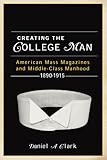
Daniel A. Clark. Creating the College Man: American Mass Magazines and Middle-Class Manhood, 1890-1915. Madison: University of Wisconsin Press, 2010. viii + 256 pp. $26.95 (paper), ISBN 978-0-299-23534-5.
Reviewed by Bonnie Laughlin-Schultz (Appalachian State University)
Published on H-Education (August, 2011)
Commissioned by Jonathan Anuik (University of Alberta)
The Emergence of the “College Man” in Early Twentieth-Century America
In Creating the College Man, Daniel A. Clark explains how a college education became fundamental to middle-class businessmen in the early twentieth century. In a well-researched and clearly argued book, Clark historicizes U.S. education and provides broad insight into all of the transitions sweeping the nation at the turn of the twentieth century. Against a backdrop of changing business practices, new waves of immigrants, and other factors that historians argue created a sense of crisis among white males, a widespread cultural transformation occurred that caused white, middle-class men to invest in higher education.
In the late nineteenth century, a college education was not seen as fundamental to many U.S. citizens; indeed, it was sometimes derided as proof of idleness and more harmful than good. Clark traces an ambivalent response to higher education: the term “academic,” he notes, was held in contempt rather than highly esteemed. The older Horatio Alger and John D. Rockefeller, models of the self-made, American man, retained a lot of cultural capital, even as the workplace changed and as so many flooded the business sector. Consequently, the idea of starting as a clerk and advancing proved impossible. Suddenly self-help and strong willpower were not enough, and the Saturday Evening Post reported a sense of “crisis” among U.S. clerks.
The Saturday Evening Post, along with other magazines, such as Collier’s, Munsey’s, and Cosmopolitan, advocated for college education as a solution, a new model for success in a changing world. Education reformers reinvigorated curriculum, and the mass media presented college--whether the curriculum was liberal arts or technical--as vital to inculcating the specific skills and broad outlook needed for business success, and even for manhood. In the Post in 1907, reporter John Corbin argued that a liberal education at Cornell University would form not only cultured men but also specialists, “‘efficient men among men,’” exactly what new, U.S. businesses demanded (p. 62). Magazine fiction began celebrating intellectual prowess, creativity, leadership, and liberal culture, all things that a college education was purported to provide. The self-made man of nineteenth-century lore gave way to the ideal of the self-supporting student or a Cornelius Vanderbilt, who worked his way up from the bottom after graduation. Clark cleverly describes this as an Alger hero with “some critical new corporate middle-class twists” (p. 135). Though the “college man” was a figure of status by the 1920s, he still had to prove himself.
He also needed to retain the vitality and vigor central to the U.S. cultural conception of manhood. Subsequently, college athletics (especially football) and fraternity culture became sites invested with great significance. The “manly scholar athlete as hero” trope emerged, with no less than President Theodore Roosevelt as a prime example (p. 116). Clark reminds his reader that Roosevelt demonstrated not only virile manhood but also a broad outlook and a celebration and pursuit of culture.
In this engaging book, Clark explores how a college education “seeped into the commonplace assumptions surrounding middle-class male identity, success, and mobility,” and he is especially focused on how this worked in the discursive realm (p. 9). Clark argues that a newly created U.S. mass media was central to both reflecting and actively shaping ideals. Magazines, such as the weekly Post and the monthly Cosmopolitan, featured articles and fiction that showed a new “infatuation” with college life (p. 14). These periodicals actively prescribed a new appreciation of college education, helping to invest it with the importance it still retains. Magazines, Clark argues strenuously, “functioned as integral forums of negotiation where evolving meanings and identities were hammed out in the process of cultural transformation” (p. 78). In his final chapter, Clark offers an extended meditation on the role that advertising played in this shift. Beginning in 1904, magazine ads for goods from tobacco to watches to ready-to-wear clothes in particular appealed to a desire for a college degree and the status that such education represented. College education was positioned as “familiar and ideal at the same time” and it was used to sell consumer goods (p. 176).
Clark does not shy away from reminding readers that the gross underbelly of the pro-college rhetoric was that it “facilitated new avenues for reasserting native-born, white male hegemony in an emerging corporate America” (p. 24). A good part of the “crisis of masculinity,” after all, stemmed from concerns about competition from new immigrants, women, and African Americans and from a perceived need among white, Anglo-Saxon, and Protestant men to reassert their supremacy. But Clark chooses to always highlight the possibilities inherent in the talk of college education and upward mobility. Such rhetoric allowed “entering wedges for eventual claims to meritocratic advancement in America” (p. 79). And “what would stop a young Pole, Slav, or Italian from happening upon an Adler’s Collegian Clothes ad and seeing themselves at college?” Clark questions, adding that “such is the ironic magic of consumerism” (p. 180).
In his introduction, Clark notes how today college education is necessary for U.S. citizens, seen as an indication of status and a provider of power in society. How (and when) this came to be is the central question of his book. And Creating the College Man offers a fascinating look at a moment of transformation in U.S. higher education and in the broader, cultural milieu where schooling occurred. By doing so, this book is of great importance to scholars of the history of (higher) education as well as turn-of-the-century U.S. culture, masculinity, and mass media.
If there is additional discussion of this review, you may access it through the network, at: https://networks.h-net.org/h-education.
Citation:
Bonnie Laughlin-Schultz. Review of Clark, Daniel A., Creating the College Man: American Mass Magazines and Middle-Class Manhood, 1890-1915.
H-Education, H-Net Reviews.
August, 2011.
URL: http://www.h-net.org/reviews/showrev.php?id=33370
 | This work is licensed under a Creative Commons Attribution-Noncommercial-No Derivative Works 3.0 United States License. |

