



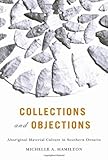
Michelle A. Hamilton. Collections and Objections: Aboriginal Material Culture in Southern Ontario. McGill-Queen's Native and Northern Series. Montréal: McGill-Queen's University Press, 2010. 352 pp. $95.00 (cloth), ISBN 978-0-7735-3754-5.
Reviewed by Katie Magee Labelle (SSHRC Postdoctoral Fellow, York University)
Published on H-Canada (September, 2011)
Commissioned by Stephanie Bangarth (King's University College, UWO)
Collections and Collaborations
On August 10, 1999, approximately four hundred Huron-Wendats traveled “home” for a modern, yet still customary Feast of Souls ceremony. Early that morning five hundred boxes of ancestral bones were loaded into a cube van and transported from the Royal Ontario Museum (ROM) to the burial site near present-day Midland, Ontario, and what was formerly Wendat territory in the seventeenth century.[1] Elaborate speeches were delivered before each box was smudged with sweetgrass.[2] This was followed by an individual blessing bestowed on each container by ninety-year-old Elder Madelaine Gros-Louis from Wendake, Quebec, the oldest attendee at the ceremony. The boxes were then carefully passed down one by one through a human chain, and opened to reveal the discolored fragments of human remains. Small child-size skulls, rib cages, and leg bones were exposed, looking more like bundles of firewood rather than remnants of human beings. Slowly they made their way down to the eight-foot ossuary pit. At the end of the line was Michel Gros-Louis who had lined the pit with over a dozen beaver pelts, as well as other customary burial items, such as kettles and pots. It was Gros-Louis who then placed the bones in a circle at the bottom of the pit. He explained the personal satisfaction of the moment in the following way, “I feel at peace seeing my ancestors returned to their rightful resting place.”[3]
This summer reburial was the result of years of work on the part of modern Wendats to repatriate bones and relics collected from a seventeenth-century Wendat burial site by archaeologist Kenneth Kidd in the 1940s. For forty years, these souls (as the Wendats call them) were kept in the basement of ROM’s anthropology department, and were never actually put on public display.[4] Many groups were involved in the process of repatriation. In addition to Wendat descendants from both Canada and the United States, other Aboriginal groups, such as the Chippewas of Mnjikaning at the Rama Reserve were involved, as well as less obvious non-Native interest groups including: the Martyrs Shrine, St-Johns Ambulance organization, Wye Heritage Marina, Friends of Ste-Marie, Ste-Marie Among The Hurons, the Wye Marsh and Wildlife Centre, Camp Simpresca, Girl Guides of Canada, Silver Birch Area, Chappel Farms, A&M Super Store of Barrie, and the Midland Ontario Provincial Police Detachment.[5]
The details of this Wendat reburial give way to several questions: Why and how were the bones moved in the first place? Who supported this acquisition? Why did it take Wendats so long to reacquire the artifacts? What role did local collectors, archaeologists, government policies, museums, and organizations have to play in this story? Luckily, Michelle A. Hamilton’s latest book Collections and Objections attempts to answer many of these questions. Although the specific circumstances of the aforementioned 1999 Feast of Souls ceremony are not described in any great detail by Hamilton, her work contextualizes similar cases across the province through the prism of nineteenth-century Ontario and Aboriginal material culture.
The acquisition of Aboriginal material culture has a long and complicated history in Ontario, and as Hamilton points out in her introduction, this is her “attempt to explore the complexities of the excavation, collection, exhibition, and interpretation” of these items (p. 3). Hamilton recreates a well-defined, complex web of amateur collectors, trained professionals, newly established institutions, popular historical societies, and educated Native leaders. These interest groups are the windows through which Hamilton gleans varied perspectives on her subject and achieves her goal of promoting a balanced narrative that does not privilege one group over another. Significantly, despite the title of this book, the message is more about the collaboration of these various interest groups, rather than their objections toward each other and the act of collecting. Certainly there was controversy that Hamilton duly notes, but the author consistently refers to the ways that people sought to overcome these conflicts. For Hamilton, the Victorian concepts of race, class, and colonialism were the fundamental factors shaping the relationships between all these groups.
Five well-documented chapters tie this book together: chapter 1, “Bric-a-brackers and Pot-hunters: Professionals and the Public”; chapter 2, “For the General Good of Science: Historical and Scientific Society Museums”; chapter 3, “Aboriginal Responses to Archaeology”; chapter 4, “Colonialism, Ethnographic Collecting, and Aboriginal Engagement”; and chapter 5, “Usable Pasts: Interpreting Aboriginal Material Culture.” Each chapter is a treasure trove of endnotes, citing over thirty-two archives. Indeed, the wide variety of published sources, such as newspapers, government legislation and reports, articles, textbooks, and novels, are complemented by the equally diverse unpublished personal field notes, journals, and letters. As a result, Hamilton’s work serves as a resource for any researcher interested in Ontario’s early history of Aboriginal material culture.
Aside from sources, this book contributes to the field by drawing attention to the common misconception that Native people always opposed the excavation and acquisition of Aboriginal artifacts. The famous Mohawk poetess Pauline Johnson, for instance, endorsed the preservation of material culture in museums. Johnson herself gave a dance mask to the Ontario Provincial Museum and sold a medicine mask, turtle shell rattle, wampum belt, and a belt of detalium shells to archaeologist David Boyle. Hamilton points to lesser-known Native figures as well. John Ojijatekha Brant-Sero of the Six Nations of the Grand River worked closely with ethnographers and desired to become an anthropologist himself. Similar to Johnson, he toured the United States and delivered papers on the Six Nations. His professionalism was expressed in numerous memberships to associations, such as the Anthropological Institute of Great Britain and Ireland, the Canadian Institute, the York Pioneers, and the Hamilton Association, even acting as the vice president of the Wentworth Historical Society. This said, moments of resistance do not go unnoticed by Hamilton. She describes, for example, the written protests of Evelyn Johnson, sister to Pauline Johnson, who wrote a letter to the minister of education accusing archaeologists of purposefully depicting contemporary Six Nations as poor and uncivilized. Johnson furthered her argument by focusing on the lack of information made available about the educated and progressive people within her society. Johnson contended that this strategy was calculated, in order to make her community seem more “traditional” and “authentic” (p. 115).
As with most books, authors cannot possibly cover everything. In this case, Hamilton’s focus on incorporating the voices of many interest groups, with special, yet balanced emphasis on Aboriginal perceptions, has left little room for the “official” or government perspective. Aside from a brief section dedicated to legislation, and mentions of the Indian Act and the Department of Indian Affairs, we are given very little insight into the actions, opinions, and influence of municipal, provincial, and federal governments as well as the civil servants and politicians who created and implemented policies concerning Aboriginal material culture. By de-emphasizing this particular interest group, Hamilton distances herself from the typical Native verses government narrative, which may or may not appeal to some readers.
Overall, Collections and Objections transcends geographic, scholarly, and temporal borders. Not only is it a study of Ontario, but it also touches on subjects pertinent to other cases across North America. Similarly it is not just a study of material culture, but also a narrative inspired by the complementary fields of history, archaeology, anthropology, and Aboriginal studies. Finally, Hamilton bridges the gaps between the past and present by connecting the actions of nineteenth-century collectors to present-day requests for repatriation. It is sure to be a welcome addition to many researchers’ bookshelves.
Notes
[1]. Roberta Avery, “Reunion Brings Tears of Joy, Sense of Belonging,” Toronto Star, August 30, 1999.
[2]. Brian Baker, “Ceremony Marks Return of Huron Bones to Final Resting Place,” Barrie Examiner, September 4, 1999.
[3]. Avery, “Reunion Brings Tears of Joy.”
[4]. Carey Moran, “Hurons Headed Home after 350 Years: Return of Remains to Proper Place Fulfills Man’s Dream,” Barrie Examiner, August 13, 1999.
[5]. Michel Gros-Louis and Michel Savard and Annette Vincent, letter to the editor, The Free Press, August 30, 1999.
If there is additional discussion of this review, you may access it through the network, at: https://networks.h-net.org/h-canada.
Citation:
Katie Magee Labelle. Review of Hamilton, Michelle A., Collections and Objections: Aboriginal Material Culture in Southern Ontario.
H-Canada, H-Net Reviews.
September, 2011.
URL: http://www.h-net.org/reviews/showrev.php?id=33330
 | This work is licensed under a Creative Commons Attribution-Noncommercial-No Derivative Works 3.0 United States License. |

