



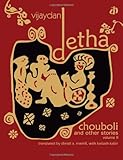
Vijaydan Detha. Chouboli and Other Stories. Translated by Christi A. Merrill and Kailash Kabir. New Delhi: Published by Katha in collaboration with Fordham University Press, 2010. Volume 2. 196 pp. $19.00 (paper), ISBN 978-0-8232-3404-2; $65.00 (cloth), ISBN 978-0-8232-3403-5.
Reviewed by Nishat Zaidi (Jamia Millia Islamia University)
Published on H-Asia (October, 2012)
Commissioned by Sumit Guha (The University of Texas at Austin)
Traversing the Two Worlds: The Folktales of Vijaydan Detha
“A folktale is a poetic text that carries some of its cultural contexts within it; it is also a travelling metaphor that finds a new meaning with every telling,” says A. K. Ramanujan in his famed compilation Folktales from India (1991).[1] Story is who we are. Folktales, which travel across times reshaping themselves every time they are retold, are embedded with a vast array of cultural codes, aspirations, and ethical preferences of the subsocial groups that they represent. Without any string of authorship attached to them, they represent a panorama of human aspirations and desires as well as anger and resistance against prevalent norms. However, as Michel Foucault points out in his seminal essay “What Is an Author?” “the coming into being of the notion of author constitutes the privileged moment of individualization of the history of ideas, knowledge, literature, philosophy and the sciences.”[2] The transition from the oral to written medium inevitably involves a process of individualization and privileging of certain perspectives.
Stories by the self-proclaimed folklorist Vijaydan Detha (b. 1926) stand at a unique juncture where the ever-dynamic collective consciousness preserved in oral cultures of folktales is represented through the privileged retelling by the author and where the sheer choice of medium tends to freeze the inherent fluidity and flexibility of these tales. Transmuting oral forms into such new mediums as writing is not unknown to the Indian narrative tradition, as some texts, like the Buddhist Jatakas, the Panchatantra (fifth century), and the Kathasaritasagara (eleventh century), owe their origin to oral traditions. Detha’s stories are inimitable insofar as they epitomize the confluence of the age-old oral world of folklore and the relatively modern genre of short story in which the interiority is as much a concern as the world of action; in which there is no moral compulsion of privileging good over evil; and most important, which is meant for readers, not listeners. Detha’s success in bridging the two apparently contrary genres may be ascribed to what his able translators Christi A. Merrill and Kailash Kabir inform us in the ingeniously perceptive introduction to the first volume (2010). They point to Detha’s own perception of his role as translator. At the same time, like a true craftsman, even while committed to folk forms, Detha refuses to step into the reductive role of transcribing stories as they were told to him. Like a true storyteller who always meddles with these “travelling metaphors” and instills new meanings in them to appeal to his audiences, Detha also revamps them with contemporary themes to appeal to the modern mind. Without compromising their archetypal motifs, psychic underpinnings, and context-sensitive performativity, Detha metamorphoses them into captivating stories, which have a spellbinding impact on the minds of the modern readers.
Detha, also known as Bijji to his close friends and associates, belongs to the bardic community of the Charans of Rajasthan who professionally sang praises of and sometimes criticized their feudal lords. His grandfather, Jugtidan Detha, was known in the entire Marwar region. His father, Sabaldan Detha, was a good poet too. It was this creative legacy inherited by Vijaydan Detha that prompted him to become a writer at an early age. After spending a few years in Jodhpur where he took up writing as a career, Detha was exposed to Russian literature, which inspired him to return to his native village Baroundi and write in his native language, Rajasthani. It was here at Baroundi that he along with his friend Dr. Komal Kothari set up the iconic Rupayan Sansthan, an institution that has done pathbreaking research and archival work gathering and restoring oral literature of Rajasthan. Determined to “‘garland the age-old Rajasthani folklores with story-writing skills’” (p. ii), Detha started a hand-composing press that brought out the periodical Lok Sanskriti (Folk culture).[3] The stories published in it were later compiled in his tour de force Bataan ri Phulwari (Garden of tales [1960-76]), a fourteen-volume collection of stories drawing on Rajasthan folklore. Having written more than eight hundred stories in Rajasthani, Detha has received several honors and awards for his life-long work, which include Padma Shri (2007), Sahitya Chudamani Award (2006), Katha Chudamani Award (2005), Fellowship of the Sahitya Akademi (2004), and the first Sahitya Akademi Award for Rajasthani (1974). His popularity, however, rose mainly after his story “Charandas Chor” was adapted first for theater by Habib Tanveer (1975) and for a children’s film by Satyajit Ray (1975). Amol Palekar’s Shahrukh Khan Starrer film Paheli (2005), based on Detha’s story “Duvidha,” made Detha a household name.
The collection under review is the second volume of a two-volume collection entitled Chouboli and Other Stories. The first volume contains the title story “Chouboli,” which is a string of eight connected stories and six other stories. The second volume includes eleven stories, adapted by Detha from Rajasthani folktales and tastefully selected from his vast body of work. The compilation is skillfully translated and presented by Detha’s able American translator Merrill along with Kabir (who has also translated a large body of Detha’s writing into Hindi). Eternally enthralling as they are, the stories throw new challenges in the understanding of fiction as a form in modern times. The paradoxicality of it is foregrounded in the insightful introduction to the first volume by the translators and in the diligently charted genealogy that attempts to give the source of each story retold by Detha. While the obsession with the “original” author both by Detha and Merrill appears ironic in the face of the fact that both deem their own roles as translators whose true calling is not just to reproduce but also to recreate the world of orality which inevitably involves creation, it also invites us to dispense with the polarized view of folklore and short story, oral and written, retold and authored, and so on. As both partake of the role of author in this altered mode of tale-telling that weds oratory with the “framed” world of story writing, both also acknowledge their secondary role as tale-tellers and not story writers.
The make-believe world of fantasy in these stories by Detha, as in the narrative tradition of any oratory, takes for granted the connection between nature, nurture, natural, and supernatural. Here, humans interact freely with other products of the mother environment, such as animals, birds, insects, and plants, often interchanging their forms as also their language; here, ghosts participate in worldly affairs, while mighty kings, seths (rich businessmen), and thakurs (lords) turn out to be cowards and foolish and ordinary lowly folk, wise. In this world of traditional wisdom, where worldly ways are ridiculed and human frailties and strengths are delineated, Detha has injected his own ideological preferences for social justice (influenced by Karl Marx and Friedrich Engels, Detha has been a leftist all his life). “‘My main themes are against god, religion and capital,’” says the writer acknowledging his Marxist values.[4] Hence, in spite of hardships, the subjugated always survive and the candle of hope is never allowed to extinguish. Notwithstanding their apparent simplicity, these stories unfold the complexities of human life in its myriad forms.
The first story in the collection under review, “I’m Alive, I’m Awake,” delineates a heart-wrenching tale of the steadfast love of a heron for his mate. Such is the love of the heron for his mate that even when he is being slaughtered, cooked, and eaten by the farmer who captured him, he continues to send out messages to his mate. Characters, like the greedy Brahmin of “Cannibal” or the thief of “Weigh Your Options,” represent prototypes of human frailties. The story “The Thakur’s Ghost” explicates the extraordinary wisdom of ordinary folk and takes a dig at the ever-oppressive class of feudal lords, like the thakur, who derive pleasure out of the hardships of the poor. “Alexander and the Crow” is an interesting story about Alexander the Great who is bitten by a burning desire to achieve immortality. When he follows the path to immortality told by the venerable physician, he meets a crow who has all the wealth and immortality but craves for death as “there is no curse worse than that of death-deprived immortality” (p. 79). The story begins and ends with teasers for readers as the teller challenges their wisdom and their ability to choose. In this way, the subjectivities of the readers, like yesteryears’ listeners of oral tales, are merged with the subjectivities of characters in the tale, as they are encouraged to actively engage with the dynamics of its direction. “To Each Her Own” is a light story about the plight of a fisherwoman who is forced to spend a night in the house of the royal gardener. While the fishy smell of the fisherwoman makes the gardener sick, the fisherwoman can barely stand the fragrance of flowers and feels relieved only when she quietly tiptoes out of the gardener’s room and sleeps on the floor outside with her empty fish basket over her face. “A True Calling” is yet another riveting story about a professional imposter who is so realistic in the guise of a dayan (witch) that the king who, in spite of being forewarned about the consequences, challenges him to don the guise, and runs for his life while a drunken brother-in-law is killed by the witch. The king, in order to eliminate him, finally asks the imposter to take the guise of sati--or a woman who immolates herself.
In the story “Untold Hitlers” (“Alekhun Hitler”), a professional cyclist dares the arrogant owners of a newly acquired tractor and meets his tragic end. Speaking of the story, Detha says, “‘There is a Hitler in every one of us. It draws its strength from condescension for another being and the realization of the power to overpower and destroy it.’”[5] The stark note on which the story closes brings out the evil lurking in the heart of man: “But ... the painting of the two World Wars, pictures of Hiroshima, Nagasaki, Vietnam, Bangladesh ... those are true masterpieces. Compared to this one, those are so much more refined, so much more complex and nuanced. This one doesn’t quite compare. Still, considering it was done by a band of rustics, it wasn’t bad. Yes, the five were only men. Each man spoke like a man. Each man walked like a man” (p. 138). Similarly, the story “Two Lives” introduces a contemporary theme of same-sex marriage where the two girls deceitfully married to each other by their parents due to their greed for dowry later develop a great love for each other and choose to continue living together.
Each story by Detha involves telling as well as a retelling. Drawing as it does from the repertoire of stories representing the collective wisdom gathered over the centuries, these stories are played out through earthy characters, occupying a world not fraught by disruptive forces of colonization or partition but rather a world of continuum, where the conflicts exist only at the level of internal structures of society, such as caste, class, and clan, as well as conflicts arising out of human emotions of ego, oppression, and desire for power and authority. Rich in the use of riddles, idioms, and proverbs, these stories reveal a dynamic use of language where the force of oral-aural telling-listening is retained in written words. Detha’s reverence for idiomatic expressions is borne out by the fact that he has coauthored a dictionary of Rajasthani idioms, called Rajasthani-Hindi-Kahawat Kosh (2001).
Detha certainly deserves adulation for passing on the verbally transmitted, traveling tales to us by translating them into the equally forceful and dynamic stories where the narrative voice retains the flexibility of the oral storytellers; where the readers are continuously prodded to partake of the wisdom carried in the story, or to face the same dilemma of choices that the characters are faced with; where the currency of hope always wins over the occasional disruption of the absurd; and where the seething psychoanalytic penetration into the established discourses results in an astute diagnosis of culture and society. Merrill and Kabir have accomplished a task no less daunting than Detha. Their success in translating the work in all its vibrancy and vitality into a completely alien language and to a completely different set of audience spells out their own excellence as tale-tellers. It would not be an overstatement to say that if Detha is the author of Rajasthani tales, Chouboli and Other Stories in its elegantly produced English avatar (surely the best English avatar of Detha’s stories by far) belongs to the two translators.
Notes
[1]. A. K. Ramanujan, Folktales from India: A Selection of Oral Tales from Twenty-two Languages (New York: Pantheon 1991), xi.
[2]. Michel Foucault, “What Is an Author?” in Modern Criticism and Theory, ed. David Lodge ( London: Longman, 1988), 197.
[3]. Quoted in Chitra Padmanabhan, “Vijaydan Detha ‘The English Adversary,’” Tehelka, May 19, 2012, http://www.tehelka.com/story_main16.asp?filename=hub012106The_English.asp.
[4]. Quoted in ibid.
[5].Quoted in Mahip Pratap Singh, “Will Bijji’s Tryst with the Nobel be Fruitful?” The Hindu, October 5, 2011, http://www.thehindu.com/news/states/other-states/article2514260.
If there is additional discussion of this review, you may access it through the network, at: https://networks.h-net.org/h-asia.
Citation:
Nishat Zaidi. Review of Detha, Vijaydan, Chouboli and Other Stories.
H-Asia, H-Net Reviews.
October, 2012.
URL: http://www.h-net.org/reviews/showrev.php?id=33309
 | This work is licensed under a Creative Commons Attribution-Noncommercial-No Derivative Works 3.0 United States License. |

