



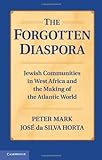
Peter Mark, José da Silva Horta. The Forgotten Diaspora: Jewish Communities in West Africa and the Making of the Atlantic World. New York: Cambridge University Press, 2011. xv + 262 pp. $80.00 (cloth), ISBN 978-0-521-19286-6.
Reviewed by Toby O. Green (University of Birmingham)
Published on H-Luso-Africa (May, 2011)
Commissioned by Philip J. Havik (Instituto de Higiene e Medicina Tropical (IHMT))
Bridging the Atlantic and Sephardi Diaspora
The past decade has seen the beginnings of a renaissance in historical studies of those areas of precolonial Africa most heavily influenced by contact with the Portuguese. While a decade ago, scholars such as David Eltis underrepresented the role of Portuguese trade in societies of the African Atlantic, this is now no longer possible.[1] Published books by Luís Filipe Alencastro, José Curto, and Linda Heywood and John Thornton on Angola, and by Walter Hawthorne and Linda Newson and Susie Minchin on the “Guiné de Cabo Verde,” have begun to redress the balance, while a clutch of books due to be published this year and next on Angola and Upper Guinea between the sixteenth and eighteenth centuries will continue the process.
The book under review takes it place within this growing body of literature based on ground-breaking new research, and yet also broadens the scope of this work. For Peter Mark and José da Silva Horta’s book concentrates on the Petite Côte region of Senegambia, an area more traditionally seen as falling under Dutch and French influence, and one for which, as they write in their introduction, the importance of Portuguese sources has traditionally been underrated. Yet as they show, in the first third of the seventeenth century there was a strong Brazilian and Portuguese influence in the region, and hence their book is of great interest to scholars of Lusophone Africa.
The main focus of The Forgotten Diaspora is on two communities of Sephardic Jews who established settled communities in the towns of Portudal and Joal, complete with synagogues and other ritual features necessary for the practice of Judaism, in the early seventeenth century. Mark and Horta have conducted an enormous amount of meticulous archival research, principally in Holland and Portugal, uncovering precious caches of documents which allow them to build a detailed picture of the commercial, material, religious, and social lives of these communities at an early time in Atlantic history. As this picture unfolds, searching questions are also asked relating to African-European relations, constructions of identity, and the unfolding of commercial practices in the early Atlantic world.
The Forgotten Diaspora is divided into six chapters. Chapters 1-3 situate the these communities in religious context, with chapters 1 and 2 detailing the documentary evidence on the presence of these communities in Senegambia, and outlining their ritual and religious functions in the context both of Atlantic pressures and of their existence as guests of an Islamic African community, and chapter 3 focusing on attitudes of members of these communities to Christianity and Islam. Chapters 4 and 5 focus especially on material culture, with chapter 4 dealing with the role of these Sephardic Jews in the sword trade linking Portugal and Senegambia in the sixteenth and seventeenth centuries, and chapter 5 with the way in which ivory carvings originating from Sierra Leone in the mid-sixteenth century may elucidate some aspects of the ritual and cultural lives of these communities. The final chapter places the community in a broad Atlantic context, examines the question of Atlantic slavery in this region, and looks at how the communities disappeared in the second half of the seventeenth century.
One of the great strengths of the book is the authors’ focus on material culture. The documentary evidence is rich indeed, and Mark and Horta succeed in constructing as detailed a portrait as I have read of the material, religious, and social contexts of a community in seventeenth-century Africa. The characters of the community members emerge as more than just ciphers who crop up in a handful of written documents. We learn about the nature of the religious books and practices, the types of clothing worn, the ways in which Jews in Senegambia related to and talked to their Islamic Jolof hosts, and much more. This is a triumph of historical reconstruction, and is due in large part to the meticulous thoroughness with which the authors have read and interpreted the documents they have found, and the deep knowledge they have of the sources.
However, it must be recognized that such a focus is unorthodox in contemporary African studies. Where “African history” as it was written prior to the post-independence revolution in the field tended to focus on European deeds in Africa, the publication of a book which again focuses on Europeans in Africa--albeit European “others”--might seem to risk revisiting such retrograde tendencies. And yet, all in all, Mark and Horta avoid such potential pitfalls with great skill. Far from writing Africa “out” of history, their book seeks to place African histories within a broader global context, and insists on the relevance of the African context to a broader understanding of the formation of Atlantic societies in the early seventeenth century. When so many soi-disant “Atlantic histories” willfully omit an entire continent--Africa--in their analysis, this context matters a great deal, and Mark and Horta put forward the important argument that relations between Senegambians and Sephardic Jews in this era were significant in influencing the formation of early mixed communities throughout the Atlantic world.
Indeed, one of the things which emerges most clearly from the book is just how deeply connected this small corner of Africa was with places as far distant as Amsterdam, Brazil, Cartagena (in modern Colombia), Livorno, and Morocco. In perhaps their most path-finding chapter, on the sword trade, Mark and Horta show how members of these Jewish communities connected both to artisans in Morocco linked to Al-Mansur and his conquest of Songhay in 1591, and to slave traders who returned to Iberia via Cartagena in the same era. Though as they stress, most of the members of these Jewish communities were not slave traders themselves, it was impossible to separate their activities from those of the wider trading environment of Senegambia, which already in the late sixteenth century was connected to spaces across the globe. Thus for the many historians today who need prodding to recognize that African history and historical influences in the world did not begin in the nineteenth century, this book is a timely and important reminder.
Note
[1]. David Eltis, The Rise of African Slavery in the Americas (Cambridge and New York: Cambridge University Press, 2000). As indeed Eltis and David Richardson recognized in Extending the Frontiers: Essays on the New Trans-Atlantic Slave Trade Database (New Haven and London: Yale University Press, 2008).
If there is additional discussion of this review, you may access it through the network, at: https://networks.h-net.org/h-luso-africa.
Citation:
Toby O. Green. Review of Mark, Peter; Horta, José da Silva, The Forgotten Diaspora: Jewish Communities in West Africa and the Making of the Atlantic World.
H-Luso-Africa, H-Net Reviews.
May, 2011.
URL: http://www.h-net.org/reviews/showrev.php?id=33292
 | This work is licensed under a Creative Commons Attribution-Noncommercial-No Derivative Works 3.0 United States License. |

