



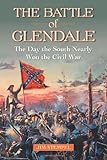
Jim Stempel. The Battle of Glendale: The Day the South Nearly Won the Civil War. Jefferson: McFarland & Co., 2011. 214 pp. $35.00 (paper), ISBN 978-0-7864-6300-8.
Reviewed by Wilson Greene (Pamplin Historical Park)
Published on H-CivWar (July, 2011)
Commissioned by Martin P. Johnson (Miami University Hamilton)
The Battle of Glendale: The Day the South Did Not Nearly Win the War
When one thinks of the pivotal battles of the American Civil War, engagements such as Antietam, Vicksburg, Gettysburg, Cedar Creek, or Atlanta most often come to mind. In Jim Stempel’s new book, The Battle of Glendale: The Day the South Nearly Won the Civil War, readers are asked to believe that the stakes on the sixth day of the Seven Days battles east of Richmond in the summer of 1862 exceeded those of every other clash of arms between 1861 and 1865. “Once ... and only once,” Stempel writes in his concluding paragraph, would the South come “within a hair of victory so compelling that it would have catapulted the Confederacy to its independence,” and that moment came on June 30, 1862 at Glendale (p. 194).
General Robert E. Lee, in command of the Army of Northern Virginia for less than a month in the early summer of 1862, began an offensive on June 26 designed to drive the forces of Major General George B. McClellan from the outskirts of Richmond, the Confederate capital. Lee’s bold initiative quickly launched McClellan’s Army of the Potomac on a desperate and difficult march southeast toward the James River and the protection of the Union navy. Lee devised a complicated plan to trap McClellan near the rural intersection of the Long Bridge, Charles City, and Willis Church roads east of Richmond. He divided his divisions into four distinct components, three of which were to descend on the vital crossroads that funneled the Federals toward their safe haven along the James. Three of those four wings failed to execute their portion of the plan, leaving only the divisions of James Longstreet and Ambrose Powell Hill to assault the bluecoats at a bloody but tactically inconclusive battle that became known as Glendale or Frayser’s Farm. McClellan’s battered men slipped away after dark, leading to the Confederate offensive disaster the next day at Malvern Hill and ultimately to the successful escape of the Union army. Lee had saved Richmond but failed to inflict a crippling blow on his enemy.
Mr. Stempel recites the familiar outlines of this engagement but his book is better understood as an extended interpretive essay rather than as narrative military history. The author consulted no manuscript material and instead relied on a thin collection of printed primary and secondary sources to posit his highly implausible speculation that a Confederate victory at Glendale would have caused the Army of the Potomac to surrender en masse and become a “bargaining chip” (p. 193) for a negotiated peace leading to the independence of the Confederate States of America.
Such a bold assertion requires a careful, well-documented analysis to attain any degree of credibility. Predictably, the author falls short of providing one--to the point that his thesis becomes more silly than serious.
In fairness to Mr. Stempel, his review of the various shortcomings of Generals Benjamin Huger, Theophilus Holmes, John Magruder, and especially Thomas “Stonewall” Jackson on June 30 stands mostly in the scholarly mainstream. His almost total reliance on Confederate artillerist E. Porter Alexander’s opinionated interpretation of Jackson’s performance during the Seven Days leads to explanations for Stonewall’s behavior that have been widely discredited by writers such as James I. Robertson Jr. (Stonewall Jackson: The Man, the Soldier, the Legend, New York: Macmillan, 1997) and Brian Burton (Extraordinary Circumstances: The Seven Days Battles, 2001). But clearly Mr. Stempel is on firm ground when he asserts that a series of errors--both operational and tactical--deprived Lee of his best chance during the campaign to earn a decisive victory.
If the author had stopped there, we would have been left with merely a superficially researched repetition of the familiar features of this engagement. But to suggest that Lee’s plan would have annihilated the Army of the Potomac stretches credulity. Such battles, though often coveted by Civil War commanders, almost never occurred. Civil War armies maintained too much resilience in defeat and experienced too much disorganization in victory to remove the vanquished forces from the map. At Glendale, no fewer than four of McClellan’s eleven divisions had cleared the crucial intersection and taken position on strong ground to the south by the time Lee’s attack occurred. Moreover, to suggest that the flawless execution of Lee’s plan would have not only prevented the escape of those units but resulted in the devastation of the seven Union divisions--more than 55,000 soldiers--that either engaged in the battle or were poised in reserve, goes too far.
Jackson’s experience on June 30 serves as an example of Mr. Stempel’s overreaching conclusions. Virtually every student of these events agrees that Stonewall’s exhaustion that day led to a mental paralysis that caused his intended offensive to degenerate into an ineffective artillery bombardment. Should an invigorated Jackson have exploited any one of several available options to assault or turn the Union position opposite White Oak Swamp? Unquestionably, yes. Would such action have resulted in the dispersal of the two well-posted Federal divisions and their supporting artillery, followed by Jackson’s victorious forces plowing decisively into the Union rear at Glendale? Maybe--maybe not. Just as Lieutenant General Richard Ewell is properly criticized for failing to assault Cemetery Hill on the first day at Gettysburg, Jackson deserves censure for his lethargy on June 30. But Stonewall’s success at White Oak Swamp was no more guaranteed than was Ewell’s in Pennsylvania. Failing to try does not automatically equate to victory squandered. The same analysis can be applied to the disappointing performances of the other delinquent Confederate commanders involved in Lee’s failed plan at Glendale.
Mr. Stempel’s book descends from merely flawed analysis to preposterous flights of fancy when he argues that the defeat of McClellan at Glendale would have led to the Lincoln administration’s abandonment of the war effort and acquiescence to Confederate independence. Nowhere does the author explain how and why other Union armies in the field in that summer--most of them victorious to date--would have been rendered impotent, including the new Union Army of Virginia under Major General John Pope, camped a few days march northwest of Richmond. What evidence is there that Abraham Lincoln, the Republican congressional leadership, or even the War Democrats in Washington maintained so fragile a commitment to preserving the Union that one military defeat--even a catastrophic one--would have prompted them to throw in the national towel? Not surprisingly, Mr. Stempel marshals no such evidence--primarily because none exists.
The author writes with a dramatic flair laden with metaphors and hyperbole that some readers might find a bit too breathless for their tastes. There are a handful of distracting factual errors, such as having McClellan arrive in Washington in the fall of 1861 (p. 8), stating that the U.S.S. Merrimack was under construction at the outset of the war (p. 6) and inexplicably referring to Glendale as a town or tiny village (pp. 41, 194). He exhibits an odd fascination with Union division commander Phil Kearny, elevating him to such a level of brilliance that the mere mention of his name intimidated his Rebel opponents (pp. 45, 47, 64, 66) but ultimately ascribes little credit to Kearny in the conduct of the battle. Stempel’s decision to quote secondary sources verbatim is unconventional, as is his citation of such sources as the origin of contemporary quotations. The maps are useful and various illustrations enhance the book.
Civil War military literature would benefit from a detailed accounting and analysis of the Battle of Glendale. Sadly, Mr. Stempel’s book is not that study--and he did not intend it to be. He chose instead to advocate a role for this engagement that far exceeded its actual potential, and given its lack of scholarship and its fanciful premise, The Battle of Glendale: The Day the South Nearly Won the Civil War cannot be taken seriously.
If there is additional discussion of this review, you may access it through the network, at: https://networks.h-net.org/h-civwar.
Citation:
Wilson Greene. Review of Stempel, Jim, The Battle of Glendale: The Day the South Nearly Won the Civil War.
H-CivWar, H-Net Reviews.
July, 2011.
URL: http://www.h-net.org/reviews/showrev.php?id=33188
 | This work is licensed under a Creative Commons Attribution-Noncommercial-No Derivative Works 3.0 United States License. |

