



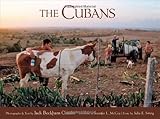
Jack Beckham Combs. The Cubans. Charlottesville: University of Virginia Press, 2010. 191 pp. $49.95 (cloth), ISBN 978-0-9842432-0-4.
Reviewed by Luis Martínez-Fernández (University of Central Florida)
Published on H-LatAm (March, 2014)
Commissioned by Dennis R. Hidalgo (Virginia Tech)
Cuban Photogeneity
It has been said numerous times--and it is true--that Cuba, particularly Havana, and its people are among the most photogenic in the world. In the last fifty-odd years, which coincide with the Cuban Revolution, the island has gone through three distinctive phases of photogeneity. First, an initial period of charismatic revolutionary fervor, masterfully captured by the lenses of Cuban photographers Osvaldo Salas, Alberto Korda, and Raúl Corrales, among others. They produced memorable black-and-white images of effusive peasants attending mass rallies, of Fidel Castro playing baseball with fellow barbudos (bearded revolutionaries), and of legendary guerrilla leader Camilo Cienfuegos sporting his mesmerizing smile under the shade of his signature cowboy hat. Most iconically of all was Korda’s famous photograph of an enigmatic-looking Che Guevara crowned under a black beret. The initial revolutionary phase of idealist and youthful photogeneity ended in the late 1960s and early 1970s--not coincidentally--around the time of Guevara’s martyrdom and the somber Sovietization of the revolution. The 1970s and 1980s produced few emblematic photographs, as the vibrant aesthetics of the idealist phase succumbed to lackluster, institutional photographs, characterized by Soviet-style military parades showing off the latest weaponry, and boring, functional, prefabricated school buildings dotting the island’s splendid landscape, a space also insidiously profaned by ugly, concrete water towers aping those of Leonid Brezhnev’s Soviet Union. Paradoxically, the profound economic depression of the so-called Special Period (since 1993), with all its misery and decay, initiated a moment of photogenic revival, partially made possible by Cuba’s gradual opening to the West, including its journalists and photographers.
The colorful and insightful photographs of Jack Beckham Combs, assembled in The Cubans, are exemplary of the latest stage of Cuban photogeneity, a moment that reflects the period’s manifold contradictions of resilience in light of decadence, of movement in times of inertia, and of enduring human connections and solidarity in a context marred by alienation and hopelessness. These intimate photographs also reveal Cuba’s perennial struggles between manmade civilization and the forces of nature, an unforgiving sun, the periodic passage of merciless hurricanes, and the ever-present face of nature. The images show weeds sprouting out of concrete walls and between cobblestones, flowers adorning dilapidated kitchens and the jet-black manes of middle-aged Habaneras, stray pets scavenging through city streets, and solo-flying vultures scanning verdant landscapes in search for a putrid meal.
One of the book’s salient themes is the physical and infrastructural decay of Havana. But Combs’s skills compel the viewer to imagine the opulence and elegance of which only nebulous glimpses survive. A shoot of a hall in the Gran Teatro de La Habana--whose elegance at one point in the nineteenth century rivaled that of La Scala of Milan--illustrates the photographer’s artistry. The majestic ceiling paintings have been obliterated by relentless sunshine and neglect; the floor is strewn with broken, dust-covered chairs and other forms of debris. Likewise, a photograph of a formerly palatial building façade appears as if purposely sandblasted; its frieze is obliterated like an old coin; and one of its two Doric columns is missing except for a foot and a half that is hanging, like a stalactite, from the architrave. Equally dramatic is a photograph of a store window located in Havana’s Obispo Street; the surviving marble footing of this once elegant store contrasts with the tawdry window décor consisting of mutilated, unclad male mannequins in odd poses; large straw baskets; gift-wrapped boxes; and an unintelligible installation of wood sticks, rope, and a canvas bearing the resemblance of a colorful polo shirt.
In contrast with the striking decay of Habana stand its residents, whose vigor and resilience are captured through Combs’s lenses. A black man drives a 1950s U.S.-made car; his profile is statue-like, as if chiseled by an artist off a block of fine mahogany. In another photograph, two dozen Cubans frolic in a Cienfuegos beach undaunted by the fact that the sun is about to sink in the cloudy horizon. In one image, a broad-hipped mulata in a tight-fitting military-looking dress--cap and all--walks graciously in front of a palatial Vedado home with a curvaceous staircase of its own. Her hair is died red; she sports a fashionable watch, a ring, and earrings; she holds an elegant black bag to which she has tied a silk scarf. She cuts an elegant figure, the sort that one would expect to find in affluent Paris or Milan; but she is a Habanera resisting the Special Period’s lumpenization. In another photograph, two young Habaneros, one black the other one white, resist lumpenization in their own way: playing chess on the street on a makeshift board. The white man’s white pieces are on the offensive; his more sable opponent ponders which black piece to move next. They both know that Cuba gave birth to José Raúl Capablanca, world champion chess player of the 1920s. Likewise the ballerinas in two portraits know that Alicia Alonso is one of the twentieth century’s most renowned prima ballerinas; and the red-clad boxer boy is well aware that he follows in the steps of world welterweight champion Kid Gavilán and three-time heavyweight Olympic gold medalist Teófilo Stevenson.
Combs has an uncanny ability to simultaneously capture motion and inertia. The book’s first photograph, for example, includes an elderly, white-haired woman peering beyond the bars of her window and the intrusive gloved hand of a boy seemingly poised to catch a baseball. Another photograph, one of a man driving a flashy 1950s Oldsmobile through a narrow Havana street, reveals the movement of the car’s beaming grill, while its driver, with his arm stretched out, seems motionless. A classroom scene in an Old Havana school shows a similar effect. Above, on the chamber’s wall, a sculpted wood carving of Cuban patriot José Martí looks motionlessly at the students, while just underneath a red-haired and intense Afro-Cuban teacher cajoles her students into studying.
The Cubans includes more than Combs’s photographs. Among its other features are a distractingly politicized foreword by Jennifer L. McCoy; an elegant essay by Julia E. Sweig; thoughtful comments and observations by the photographer; appropriate excerpts from Cuban literature and song lyrics; and interesting reproductions of Cuban posters, vintage photographs, and postal stamps. Combs’s book is a pleasure to observe and read. The pictures, while documenting the political and economic bankruptcy of present-day Cuba, also testify to the creative, resilient, and dignified Cuban spirit. It has earned a place of distinction on my coffee table, in the company of books with the photographs of Walker Evans and Salas.
If there is additional discussion of this review, you may access it through the network, at: https://networks.h-net.org/h-latam.
Citation:
Luis Martínez-Fernández. Review of Combs, Jack Beckham, The Cubans.
H-LatAm, H-Net Reviews.
March, 2014.
URL: http://www.h-net.org/reviews/showrev.php?id=33170
 | This work is licensed under a Creative Commons Attribution-Noncommercial-No Derivative Works 3.0 United States License. |

