



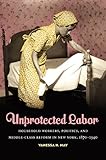
Vanessa H. May. Unprotected Labor: Household Workers, Politics, and Middle-Class Reform in New York, 1870-1940. Chapel Hill: University of North Carolina Press, 2011. 256 pp. $65.00 (cloth), ISBN 978-0-8078-3477-0; $26.95 (paper), ISBN 978-0-8078-7193-5.
Reviewed by Joseph R. Golowka (Binghamton University)
Published on H-SHGAPE (July, 2011)
Commissioned by K. Stephen Prince (University of South Florida)
Domestic Servants and the Limits of Labor Reform
Domestic service, the largest source of employment for women in the United States prior to 1940, was systematically excluded from labor legislation passed by Congress and state legislatures throughout the first half of the twentieth century. Earlier historians argued that the exclusion of domestic servants from the Fair Labor Standards Act and other New Deal legislation was the result of opposition by Southern Democrats in Congress, who insisted that the two largest sources of African American employment, domestic service and agriculture, not be covered. Vanessa H. May’s Unprotected Labor convincingly critiques this argument and offers a compelling alternative interpretation focused on the limits of cross-class coalitions and the gendered ideology of Progressive Era women’s activism. May analyzes middle-class debates about domestic service, attempts to reform domestic service, race and ethnicity, servant resistance and agency, and servants’ attempts to organize a trade union.
Although focused on domestic servants in New York, May repeatedly emphasizes the implications of her work for domestic servants nationwide. Like the rest of the nation, the state of New York excluded domestic servants from state-level labor legislation, even though it was at the forefront of labor reform, was a hotbed of Progressive women’s activism, had the largest domestic workers union in the nation, and was a center of support for the New Deal. In addition, state level reformers did not have to contend with opposition from southern Jim Crow congressmen. If labor reform for domestic servants “could not be made” in New York, it “could not be made anywhere” (p. 5). The exclusion of domestic servants from labor reform even in New York shows that the usual emphasis on racist southern congressmen is inadequate, and that other reasons must account for servants’ exclusion from labor protections.
May argues that domestic servants were excluded from labor legislation because their employers, including middle-class Progressive activists who otherwise supported labor reform, thought the fact that domestic service took place in the home made it fundamentally different. What domestic servants considered their workplace, members of the middle-class considered their home. Debates over domestic service brought private issues into the public, turning “the middle-class home inside out. Private problems became public” (p. 3). While servants supported applying the same labor regulations to their workplaces that were applied to shops and factories, employers feared bringing labor strife and government regulation into their homes. Middle-class employers insisted that the home had special qualities that should exempt it from the regulations that applied to other workplaces.
Although middle-class Progressive women’s organizations actively campaigned for protective labor legislation aimed at women in industry, they did not advocate similar legislation for domestic servants. Due to their gender and their role in the home, middle-class female activists cast themselves as advocates for children and the poor, especially working-class women. Advocating labor protections for their own servants would have undercut these claims. Their “stake in protecting the morality and privacy of the middle-class home impeded the inclusion of domestic workers in protective labor legislation” because state regulation of “the private middle-class home” would have meant “acknowledging that the home held no special qualities to differentiate it from the public world of work and industry” (p. 11).
While Unprotected Labor’s analysis of middle-class reformism is probably its strongest point, the monograph does not ignore servants’ perspectives. May demonstrates that domestic servants were not merely passive victims. Domestic servants resisted their employers and shaped their workplaces in a variety of ways. They quit, filed lawsuits, talked back to their employers, demanded higher wages, and tried to organize a labor union. In the 1930s, servants successfully organized against the state’s attempts to impose health regulations. Supporters of regulation stereotyped servants as disease-ridden and worried that they brought contagion into the home, but servants pointed out that they were at least as likely to get disease from their employers’ homes as to bring disease to it. Servants packed the meetings of city councils, campaigned against the regulations, and finally defeated them. Servants were not completely cloistered in middle-class homes, cut off from all outside contact, but were able to interact with other servants and form working-class communities.
Examining the servants’ perspectives requires overcoming the paucity of sources written by servants themselves. Although a few writings by servants do exist, and May does use them, there are not many of them and many of those that do exist are not completely credible. May deals with this problem by using oral histories, many produced by the Works Progress Administration, and by reading sources not written by domestic servants against the grain. Her sources include documents from middle-class reform organizations, union records, city council minutes, newspapers, and interviews with servants.
Overall, Unprotected Labor is an excellent work that expands our understanding of Progressivism, the welfare state, and their limits. Anyone interested in domestic servants, women’s history, or labor reform in the Gilded Age and Progressive Era will find May’s work worth reading.
If there is additional discussion of this review, you may access it through the network, at: https://networks.h-net.org/h-shgape.
Citation:
Joseph R. Golowka. Review of May, Vanessa H., Unprotected Labor: Household Workers, Politics, and Middle-Class Reform in New York, 1870-1940.
H-SHGAPE, H-Net Reviews.
July, 2011.
URL: http://www.h-net.org/reviews/showrev.php?id=33161
 | This work is licensed under a Creative Commons Attribution-Noncommercial-No Derivative Works 3.0 United States License. |

