



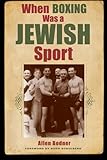
Allen Bodner. When Boxing Was a Jewish Sport. Albany: State University of New York Press, 2011. 207 pp. $24.95 (paper), ISBN 978-1-4384-3608-1.
Reviewed by Adam Chill (Castleton State College)
Published on H-Judaic (March, 2012)
Commissioned by Jason Kalman (Hebrew Union College - Jewish Institute of Religion)
Rediscovering Past Glories
Before undertaking his study of Jewish American boxers in the twentieth century, Allen Bodner attended a meeting of Ring 8, a mutual aid society for retired boxers. The aging pugilists received him warmly and invited him to discuss his project. Bodner was clearly moved by this reception and by the opportunity to meet some of his boyhood idols. The spirit of this meeting informs When Boxing Was a Jewish Sport, a lively and affectionately written popular history of Jewish American boxers in the second quarter of the twentieth century.
When Boxing Was a Jewish Sport, first published in 1997 and reprinted in 2011, is an oral history of Jewish boxers active in the 1920s, 1930s, and 1940s; Bodner recorded interviews with eighteen former boxers and a number of other people associated with the sport at different levels. The book begins with several brief chapters that provide some background on boxing, immigration, and Jewish New York City after World War One. Much of the rest of the book is organized in chapters that follow the trajectory of a boxer’s career, from entry into the ring to retirement. A chapter called “In the Beginning,” for example, argues that most Jewish boxers were second-generation immigrants for whom success was measured “in the American marketplace, on the American stage” (p. 26). Much of the evidence in the chapter demonstrates this point with stories about young men finding their way to the boxing ring in a quest for money and fame. The chapter “After the Ring” shows that the “majority of Jewish boxers,” unlike many of their contemporaries in boxing and other sports, “left the ring while still in their mid-twenties” (p. 149). Bodner’s sources show that this was usually because of fears of injury, the disapproval of parents, and the availability of other opportunities.
Interspersed among these longer chapters about the career path of boxers are shorter chapters on such themes as the Jewish cultural elite’s disapproval of boxing and boxers’ fears of brain injury. In a chapter called “Es Haypt Zuch Nisht Un (It Doesn’t Exist),” Bodner shows how Jewish publications, such as The Forward, ignored the exploits of Jewish boxers, even while happily reporting matches involving pugilists from other backgrounds. “A Dangerous Sport,” another brief chapter, details the nearly ubiquitous fear among boxers of brain damage. Several of those interviewed refer to Ray Robinson and Muhammad Ali as examples of fighters who stayed in the ring too long and as a result suffered brain injury. Most of Bodner’s subjects agree with boxer Artie Levine, who remarked that he was “very lucky” to escape the sport without such an injury (p. 140). The narrative ends with an account of a Ring 8 event held in December 1992, which Bodner uses to reflect on some of the meanings of boxing for ex-fighters. He also helpfully includes six appendices with a wealth of information about Jewish boxers.
While Bodner, an attorney and the son of a boxer from the era, generally lets the boxers speak for themselves, he draws a number of related conclusions from his sources. One of his central claims is that the proliferation of Jewish boxers in the second quarter of the twentieth century was related to their status as second-generation immigrants. In this, Bodner argues, the Jewish experience in boxing was much like that of other ethnic groups. Indeed, he contends that the “most unusual aspect” of the proliferation of Jewish boxers in this era “is how thoroughly normative it actually was” (p. 7). Many of Bodner’s sources recount stories about disapproving parents and a desire to win money and fame that will be familiar to those who know something of the twentieth-century immigrant experience. More surprising is his claim that “Jews in boxing encountered virtually no anti-Semitism in the ring or outside it” (p. 4). Bodner, following his sources, attributes this success to the boxing community, which was, in the words of one former boxer, “like one family” (p. 71). Indeed, Jewish boxers proudly identified their Jewishness by, for example, displaying the Star of David in the ring. The most successful boxers, Bodner shows, believed that they were representing the Jewish people.
Bodner’s book is at its best when documenting the stories of some of the most famous boxers of the 1920s, 1930s, and 1940s. He rightly notes that the exploits of these men have often been overlooked because of their participation in what many consider a debased profession. Bodner’s work deserves praise for reminding us of this nearly forgotten history. But it also offers much more. For boxing enthusiasts of any background, Bodner has collected an invaluable treasure of stories and anecdotes that recreate a vanished world of shady promoters, heroic young fighters, and smoke-filled arenas. For those interested in the Jewish experience in interwar New York, When Boxing Was a Jewish Sport offers a record of some of the challenges and opportunities for young, second-generation Jewish men. In discussing events long past, Bodner’s interviewees are remarkably open not only about their training and bouts, but also about their religious practices (or, often, lack thereof); their relationships with their families; and their ever-present fears of brain damage--Bodner’s chapter on this topic will surely give any boxing fan pause. Long quotations from interviews offer readers the chance to consider stories about these and many other topics in the boxers’ own words. Bodner has performed a great service in recording these voices and his work will no doubt be appreciated by many readers and fans of the sport.
Despite the rich anecdotal evidence Bodner has collected, however, academic historians may find the book somewhat frustrating. While he aims to situate his material historiographically, his engagement with the work of other historians is rather limited. There is comparatively little account of the rich literature on immigration to the United States, for instance, despite the importance of the topic to this book. Likewise, Bodner only briefly references recent scholarly works on sport and identity and, indeed, relies heavily on a master’s thesis from the 1950s. Some readers may also take issue with his use of sources. Long quotations (often more than a page in length) from interviews allow the boxers’ stories to unfold in their own words, but at times they also prevent Bodner from providing his own analysis. Finally, though the book is broadly organized around the timeline of a boxer’s career, transitions between chapters are sometimes weak and the placement of thematic chapters can seem haphazard.
These weaknesses do not detract from the value of When Boxing Was a Jewish Sport as a record of a nearly forgotten chapter in Jewish sports history. Boxing enthusiasts and those interested in a fascinating slice of life in interwar New York will find much to appreciate in its pages. Historians of twentieth-century Jewish life, immigration, and sport will find a rich vein of source material to tap in this book as well. Finally, Bodner’s affection for the heroes of his youth and his success in gathering their stories make When Boxing Was a Jewish Sport a pleasure to read.
If there is additional discussion of this review, you may access it through the network, at: https://networks.h-net.org/h-judaic.
Citation:
Adam Chill. Review of Bodner, Allen, When Boxing Was a Jewish Sport.
H-Judaic, H-Net Reviews.
March, 2012.
URL: http://www.h-net.org/reviews/showrev.php?id=33110
 | This work is licensed under a Creative Commons Attribution-Noncommercial-No Derivative Works 3.0 United States License. |

