



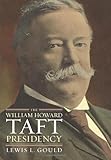
Lewis L. Gould. The William Howard Taft Presidency. American Presidency Series. Lawrence: University Press of Kansas, 2009. xv + 269 pp. $34.95 (cloth), ISBN 978-0-7006-1674-9.

Lewis L. Gould. Helen Taft: Our Musical First Lady. Modern First Ladies Series. Lawrence: University Press of Kansas, 2010. viii + 220 pp. $34.95 (cloth), ISBN 978-0-7006-1731-9.
Reviewed by Benjamin Coates
Published on H-SHGAPE (September, 2011)
Commissioned by Julia Irwin (University of South Florida)
Reconsidering the Tafts
Despite an impressive governmental resume, William Howard Taft has the misfortune of being remembered today chiefly for his girth. The small number of scholarly books devoted to his life have made but minor impressions on the popular mind, where Taft’s need of an oversize bathtub overshadows his service as federal court judge, colonial governor of the Philippines, secretary of war, chief justice of the Supreme Court, and of course, president.[1] His wife, Helen (“Nellie”) Herron Taft, has met the perhaps kinder fate of simply being ignored. In a pair of books written for the American Presidency series and Modern First Lady series, respectively, published by the University Press of Kansas, political historian Lewis L. Gould aims to rescue the couple from obscurity. Drawing on impressive archival research, Gould succeeds in amending the historical record, though not fundamentally reshaping it. Little can be done to make Will Taft anything other than a middling president, as Gould admits. Nevertheless, examining this First Couple provides a fascinating look into the complex connections between ideology, personality, and politics in early twentieth-century America.
The William Howard Taft Presidency is admirably comprehensive. Gould has drawn on more than forty years of research in nearly fifty manuscript collections. A more exhaustive study could hardly be expected. (Nor does one imagine that any future Taft portrait will equal Gould’s use of Batman puns: as he tells it, the Tafts’ dairy cow, Pauline Wayne, produced up to sixty-four quarts of milk per day “when milked in a stately Wayne manner” [WHT, p. 39].[2]) On the whole, Gould’s prose is spare, though livened with choice quotations. The book is well organized and easy to follow. Though it scants Taft’s life pre- and post-presidency, it serves as a ready and trustworthy reference for students of American politics.
Gould’s central argument is that Taft’s presidency was not “a failure.” Many historians have drawn such a conclusion from Taft’s embarrassing third place finish in his 1912 race for reelection. But Gould observes that Taft did not leave office in disgrace. In fact, newspapers of the time treated the departing president almost fondly; the Portland Oregonian called him “the worst licked, best liked, and least sore” of all presidents (WHT, p. 208). Taft was not outstanding, but he was “creditable” and “competent” and worked earnestly to make government more efficient and effective (WHT, p. xiii).
Among the president’s legislative accomplishments, which Gould admits are modest, are the creation of postal savings banks, a governmental efficiency committee, and the Mann-Elkins Act which expanded regulation of railroad rates. Taft faithfully applied the antitrust law, and “busted” more trusts in four years than the more celebrated Theodore Roosevelt did in seven (WHT, p. 165). Abroad, his legacy was mixed. Taft’s ambitious foreign policy goals became a watered-down “dollar diplomacy,” and he failed to gain Senate approval for conventions with Nicaragua and Honduras. A major trade reciprocity deal with Canada fizzled. But at least he avoided major wars or crises. Gould portrays the administration as uninspiring but honorable, with one major exception: Taft’s decision to marginalize African Americans in a vain attempt to attract the votes of southern whites.
If Taft’s was not a “failed presidency,” why then did the American electorate so overwhelmingly reject his bid for a second term? Gould suggests three reasons: a tricky political environment, a conservative ideology at odds with a progressive age, and a tin ear for public relations.
Political conditions created difficulties for a Republican president. A steep rise in the cost of living made the GOP’s pro-tariff position vulnerable to attack, just as the Panic of 1907 had undercut Republican claims to superior economic stewardship. In the 1910 elections, Democrats retook the House for the first time since 1894. Meanwhile, the Republican caucus was divided between progressives and conservatives. By compromising with the latter--necessary to get anything passed, in Gould’s eyes--Taft alienated the former. He might have survived the resulting enmity had he not increased it unnecessarily through bumbling speeches. Take for instance the major legislation of Taft’s first year in office, the Payne-Aldrich Tariff. The tariff lowered rates only marginally, and progressives attacked Taft for selling out to conservative leadership in the House and Senate. Yet, as Gould observes, the topic did not become a major political liability for Taft until he made an ill-advised speech in Winona, Minnesota, in which he called the legislation “the best tariff bill that the Republican party ever passed” (WHT, p. 62). This gaffe ensured that Taft would personally suffer from any antipathy to the tariff--and there was antipathy aplenty for a bill that conciliated special interests while making basic goods more expensive for most. The president might have avoided this misstep had he employed a speechwriter or had political advisers vet his remarks in advance. But Taft did not share his predecessors’ concern for public opinion. Instead, he carried his judicial temperament into the White House, preferring to analyze matters personally and then pronounce a judgment. Once presented with the facts, he assumed, the public would follow. In fact, they did not. In addition to the tariff flap, Taft’s insufficient concern for public opinion frequently proved costly. The Ballinger-Pinchot controversy--which included allegations of corruption against a Taft appointee and a public feud with a close ally of Roosevelt--is a case in point. Though Gould exonerates Taft and his administration in the particulars, the matter was poorly handled. And Gould provides plenty of other examples of similar tone deaf behavior.
But if Taft was so politically inept, how did he get elected in the first place? At times Gould accepts the standard view of Taft as the judge-in-politics. Conservative by temperament and devoted to a narrow reading of the Constitution, Taft made an able administrator but lacked the capacity to act broadly and creatively or to marshal sustained public support. The image is of a man comfortable with policies but not with the give and take of politics; indeed Taft himself claimed that “politics when I am in it makes me sick.” Yet Gould does not accept this image completely. Rather, he contends that “the extent to which he [Taft] disliked the customs and practices of politics has often been overstated. His self-deprecation about his skills as a leader disguised a man who was as determined as [William] McKinley and Roosevelt had been in getting his way” (WHT, p. 42). This leaves us with a rather more enigmatic Taft: simultaneously politically ingenuous and cunning, disinterested and ambitious. The William Howard Taft Presidency is not a biography, and Gould does not probe Taft’s internal motivations to resolve these contradictions. But his coverage of Taft’s relationship with Roosevelt provides an opportunity to consider the matter further.
The Taft-Roosevelt relationship hangs over this book just as it often overshadowed the Taft presidency. The two men had been friends since serving together in Washington in the early 1890s. Roosevelt appointed Taft his secretary of war in 1904, and in 1908 anointed him as his successor. Roosevelt believed that “he and I view public questions exactly alike” (WHT, p. 5). Yet the relationship began to fray almost immediately. In part their disputes involved control. Roosevelt imagined that he would continue to exert some influence over policymaking, and took offense when Taft replaced nearly his entire cabinet. The two men also differed on policy, especially in regard to conservation and the role of the judiciary. By 1911, Roosevelt was calling Taft “a flubdub with a streak of the second-rate and the common in him” and the following year he famously launched a presidential campaign against his former protégé (WHT, p. 161).
Personality and family also figured heavily. Here Gould’s biography of Nellie Taft is helpful. The First Lady felt--not unreasonably, says Gould--that Roosevelt’s wife, Edith, and daughter, Alice, never respected her. They “acted in 1908-1909 as though the presidency was on loan to Will Taft and his wife” (HT, p. 66). To assert her own status, Nellie rearranged White House furnishings and staff and bragged of having squashed Alice’s husband Nicholas Longworth’s bid for minister to China. She and Will also took revenge on Roosevelt’s friend Henry White, who many years earlier had snubbed the Tafts on their honeymoon. Upon taking office, Taft stripped White of his ambassadorship to France. Though Gould concludes that these personal squabbles played only a contributing role, many at the time blamed them for Taft and Roosevelt’s political divorce. In 1910, Longworth wrote Roosevelt that Taft “has not changed a bit in his personal feelings either to yourself or to the things you stand for.” The problem was that “he is surrounded by influences which are opposed to you, and I doubt very much if he knows it; and those influences, I believe, are largely in his own family” (HT, pp. 65-66). The following year Roosevelt concluded that Taft “permitted his wife and brother, and a number of less disinterested advisors, to make him very jealous of me, and very anxious to emphasize the contrast between our administrations by sundering himself from my especial friends and followers, and appearing hereafter as the great wise conservative” (HT, p. 135). This evidence for the importance of interpersonal relationships in the formation of political programs is enticing, though Gould leaves its implications largely unexplored.
The Taft-Roosevelt partnership disintegrated so rapidly that one wonders how it arose in the first place. Gould finds it “striking that Taft and Roosevelt collaborated for as long as they did” (WHT, p. 184). Considering their many political differences, why did Roosevelt assume Taft would continue his legacy? Roosevelt was ever the savvy politician and Gould does not suggest that Taft changed his political views substantially. Did Taft deceive Roosevelt as to his true ambitions in 1908? Was the stolid judge also a sophisticated political actor? Gould suggests as much when he reveals that Taft’s image as a political naïf was at least partially a conscious strategy. For instance, both Nellie and Will Taft promoted the belief that Nellie was the politically ambitious one. Supposedly she had long coveted being the First Lady and pushed her husband accordingly. As Will told a friend: “My own inclination and desire was to go on the Supreme bench. She felt I was presidential timber, and vetoed my wish” (HT, p. 126). Yet Taft was not the pushover he sometimes pretended. Playing the amiable judge simply offered the easiest way to the top. Taft let others think they directed him. But as he told his wife, “I usually have my way in the long run” (HT, p. 115).
Gould is not interested in resolving the tension between Taft as judge and Taft as politician, but more might be made of this seeming contradiction. For instance, one of Taft’s signature foreign policies was the signing of general arbitration treaties with Great Britain and France. Gould suggests that these were a natural outgrowth of Taft’s judicial consciousness. Yet Donald F. Anderson suggests that Taft proposed these treaties as a tactical maneuver “merely to draw the sting of Old [Andrew] Carnegie and other peace cranks” (as the president put it at the time). Only after he realized their political popularity did he make them a centerpiece of his diplomacy.[3]
Rather than counterposing law and politics, we might recognize their fluid boundary. As any modern observer can attest, garbing political agendas in judicial robes is often an attractive strategy. Professing disinterestedness helps to remove the taint of power. A judge at heart, Taft understood this connection. Yet while the judicial identity seemed to work for him in 1908 (when observers expected Taftian progress through “orderliness” rather than Rooseveltian “jolting speed”), by 1910 the press had concluded that “the people do not want a lawyer in the White House. They want a leader” (WHT, pp. 33, 102). Gould attributes this shift to the public’s growing expectations of an active presidency in the wake of McKinley and Roosevelt. One might also point to changing American attitudes toward law itself. The Supreme Court’s high-profile rejection of progressive legislation was controversial. Taft’s strident defenses of judicial supremacy (and his appointment of six conservatives to the bench) stood at the center of this transformation.[4]
What about Taft’s wife? Helen Taft: Our Musical First Lady seeks to elevate Nellie Taft in her own right. In Gould’s telling, she emerges as a fascinatingly complex figure. An opponent of woman suffrage and a defender of traditional gender roles, Nellie nevertheless smoked, drank, and played cards for money. She had high ambitions, and sought to transform Washington DC into a social and cultural hub. Though a May 1909 stroke hindered her plans, Gould contends that she made “significant contributions to the cultural life of her era” (HT, p. 2). It is difficult to determine just how “significant” these contributions were. Gould devotes most of his attention to a series of concerts, twenty-five in total, held at the White House between 1909 and 1913. Relying on her broad knowledge of music, Nellie Taft recruited a series of famous and soon-to-be-famous professional musicians to perform for gatherings of a few hundred guests.
Over two full chapters, Gould provides exhaustive details of the concerts as well as capsule biographies of the artists involved. He makes much of these musical programs. The fact that the only other biography of Nellie Taft, Carl Anthony’s Nellie Taft: The Unconventional First Lady of the Ragtime Era (2005), fails to do so is for Gould a chief justification for his own biography. Certainly those interested in the history of music in general and of White House performances in particular will find much useful material here (an appendix lists the program for every performance). And there are many entertaining anecdotes. Where else could we learn that famed (and stout) diva Luisa Tetrazzini told reporters after a performance for the First Couple: “Mr. Taft is a grande papa. I am glad he is fat. It is a pleasure to sing to him” (HT, p. 76). The broader importance of Nellie Taft’s cultural agenda are difficult to distinguish, however.
Gould argues that the concerts “enriched” Washington life and provided a valuable patronage to young (and especially to female) artists. And he suggests that the range of musicians invited was extraordinary. Indeed, “When her cultural contributions are properly assessed, Helen Taft becomes a far more interesting and consequential first lady than Anthony and other authors have perceived” (HT, p. 3). Unfortunately, Gould does not analyze in much detail the influence of these concerts on those who attended, on Washington society more broadly, or on American “culture” writ large. It is difficult therefore to evaluate Helen Taft’s contributions or to appreciate the need for such detailed treatment of her White House gatherings. It might be that Gould is hampered by his methodological approach. He examines the musical program in the straight-ahead fashion of a traditional political historian. We learn who the musicians are, what they perform, and where they are from. A cultural history approach might pay more dividends. What did the patronage of these musical styles say about Nellie Taft’s own beliefs or about the correlation of cultural taste and social class?
Other events cry out for a similarly probing analysis. How can we assess, for instance, Nellie Taft’s insistence that White House doormen be replaced by “African American men, dressed in liveried uniforms” (HT, p. 35)? Was the association of black butlers with proper “decorum” a reflection of her upbringing in Cincinnati (across the river from Kentucky)? Might we treat the pressure she put on her husband to reach the White House as a sublimation of aspirations denied to her by virtue of her gender? Connecting Helen Taft’s actions more firmly to broader cultural trends could have made this book more lively and appealing to a broader audience.
Though missing some opportunities for larger revelations, each of Gould’s two books on the Tafts is successful on its own terms. Featuring extensive bibliographic essays, they should stand as standard works and valuable resources for those interested in the twenty-seventh president and his wife.
Notes
[1]. Among the books on Taft are Henry F. Pringle, The Life and Times of William Howard Taft, 2 vols. (New York: Farrar & Rinehart, 1939); Judith Icke Anderson, William Howard Taft: An Intimate History (New York: Norton, 1981); Paolo E. Coletta, The Presidency of William Howard Taft (Lawrence: University Press of Kansas, 1973); and David H. Burton and Clarence E. Wunderlin Jr., eds., The Collected Works of William Howard Taft, 8 vols. (Athens: Ohio University Press, 2002-2004).
[2]. For citations, WHT refers to passages from The William Howard Taft Presidency, while HT refers to Helen Taft: Our Musical First Lady.
[3]. Donald F. Anderson, William Howard Taft: A Conservative’s Conception of the Presidency (Ithaca: Cornell University Press, 1968), 277.
[4]. For one examination of these legal-political disputes, see Barry Friedman, “The History of the Countermajoritarian Difficulty, Part Three: The Lesson of Lochner,” NYU Law Review 76 (November 2001): 1383-1455.
If there is additional discussion of this review, you may access it through the network, at: https://networks.h-net.org/h-shgape.
Citation:
Benjamin Coates. Review of Gould, Lewis L., The William Howard Taft Presidency and
Gould, Lewis L., Helen Taft: Our Musical First Lady.
H-SHGAPE, H-Net Reviews.
September, 2011.
URL: http://www.h-net.org/reviews/showrev.php?id=33095
 | This work is licensed under a Creative Commons Attribution-Noncommercial-No Derivative Works 3.0 United States License. |

