



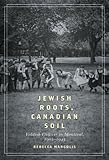
Rebecca Margolis. Jewish Roots, Canadian Soil: Yiddish Cultural Life in Montreal, 1905-1945. Montreal: McGill-Queen's University Press, 2011. xxi + 293 pp. $85.00 (cloth), ISBN 978-0-7735-3812-2.
Reviewed by Joel B. Berkowitz (University of Wisconsin, Milwaukee)
Published on H-Judaic (August, 2012)
Commissioned by Jason Kalman (Hebrew Union College - Jewish Institute of Religion)
Building Yiddish Culture in Montreal
Over the course of the first half of the twentieth century, the city of Montreal became not only Canada’s most important center of Yiddish culture, but also one whose vitality in this arena outstripped that of most other North American cities of similar size. In her meticulously researched study, Rebecca Margolis examines Yiddish culture in Montreal as both a distinctively Canadian phenomenon and a part of an international Yiddish cultural network.
Jewish immigration to Canada followed some patterns of immigration to the United States, although it was much more modest in numbers and it started later. As of 1901, according to Margolis, the total Canadian Jewish population reached above 16,000, up from just 2,443 in 1881. By 1931, that number had surpassed 150,000, and Yiddish became the third most commonly spoken language in Montreal after French and English. At that time, almost all Canadian Jews over the age of ten declared Yiddish their mother tongue (though almost all said they could speak English as well). Predictably, this percentage fell precipitously over the next couple of decades--to under 80 percent in 1941, and around half in 1951.
Yet the demographics of the province of Quebec at least partially applied the brakes to the process of integration that happened more quickly in the United States (although as Margolis points out, elsewhere in the Americas, such as in Mexico City, the dominance of Roman Catholics also slowed the integration of Jewish immigrants and their descendants). Quebec Jews constituted one of many minority groups whose numbers paled in comparison to the two dominant populations: the Franco-Catholic majority and the Anglo-Protestant elite. The decidedly outsider status of Jewish immigrants led them, like other ethnic minorities in Canada, to create their own cultural infrastructure.
Margolis approaches the story of Yiddish culture in Montreal through multiple lenses, organizing the book around four distinct (though often intersecting) spheres of activity: the Yiddish press, literary endeavors in Yiddish, Jewish secular schools, and Yiddish theater. After an introduction that paints the background for the discussion at the heart of her study, Margolis proceeds to provide vivid, detailed descriptions of how Montreal’s Jews created a constellation of cultural and educational institutions from the ground up. These included the daily Yiddish newspaper the Adler (eagle); the Jewish Public Library; the National Radical School, Jewish People’s School, and Peretz School; and the Yiddish Theatre Group (Yidishe teater grupe, or YTEG).
She begins with the Jewish press which in Montreal’s case was dominated by the Adler. Founded in 1907 and in existence until the late 1980s, it was for most of that time a daily newspaper. Unlike most other Yiddish publications in Montreal (and elsewhere), the Adler walked a decidedly moderate political line--so much so that on a visit to Montreal, the Russian socialist and literary critic Chaim Zhitlowsky quipped that the paper should have been called not the Adler (eagle), but the Ganz (goose).
Political ideologies are central to Margolis’s story, not only in the world of newspaper publishing, but in most other spheres of Yiddish activity in Montreal as well. While the Adler was the dominant Yiddish newspaper in Montreal, the city gave birth to a number of other publications, providing for different religious and political viewpoints, and catering to particular literary genres and aesthetic approaches. Passionate political ideologies, particularly on the left, also fueled much of the other activity that Margolis surveys. She offers a nuanced portrait of the politics of individual writers, educators, and other cultural leaders.
Similarly balanced is the author’s sense of perspective on the importance of her subject. Without making exaggerated claims for the influence of writers like J. I. Segal or Ida Maza, or actors and directors like Chayele Grober, Margolis documents their contributions to Yiddish activity in Montreal (and sometimes beyond), and at times helps us better understand their efforts by comparing them to analogous figures in other satellite cities in the Yiddish-speaking world. She also notes Montreal’s physical proximity to New York City, a relationship that often put the Canadian city in the shadow of its American sister, but also offered benefits, such as the ease of bringing major figures (a number of whom make cameo appearances here) for speaking engagements and other activities. And while the author realizes that Montreal could never build the sort of Yiddish empire that once flourished in New York, in some significant ways the smaller city’s Yiddish legacy has been more enduring. Montreal’s Jewish secular schools gave Yiddish a pride of place that never took hold in comparable schools in any American city, and the legacy of Yiddish-language education in such schools has survived, at least to an extent, even the significant demographic shifts of the postwar era that radically altered Montreal’s presence on the Canadian Jewish map.
Margolis’s carefully researched monograph tells the story of how Yiddish culture developed in Montreal over the course of four decades. Moving beyond Montreal, she also is mindful throughout the book of connections to other places. The ebb and flow of immigration from eastern Europe affected the fortunes of Yiddish cultural institutions in Montreal, as did the efforts of a number of key actors who came to Montreal and created and maintained the institutions that stand at the center of the city’s Yiddish cultural network. One of the most admirable features of this study is that the author manages to tell the stories of these people and institutions in rich detail, while constantly keeping an eye on their connection to similar efforts elsewhere, from Toronto and Winnipeg, to New York City, to other centers farther afield. If Margolis does not definitively answer her own question “Why Montreal and not elsewhere?” she goes a long way toward answering it, while giving a thorough accounting of the who, what, and how of Yiddish culture in Montreal.
If there is additional discussion of this review, you may access it through the network, at: https://networks.h-net.org/h-judaic.
Citation:
Joel B. Berkowitz. Review of Margolis, Rebecca, Jewish Roots, Canadian Soil: Yiddish Cultural Life in Montreal, 1905-1945.
H-Judaic, H-Net Reviews.
August, 2012.
URL: http://www.h-net.org/reviews/showrev.php?id=32986
 | This work is licensed under a Creative Commons Attribution-Noncommercial-No Derivative Works 3.0 United States License. |

