



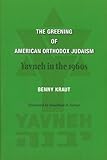
Benny Kraut. The Greening of American Orthodox Judaism: Yavneh in the 1960s. Cincinnati: Hebrew Union College Press, 2010. 200 pp. $35.00 (cloth), ISBN 978-0-87820-465-6.
Reviewed by Adam S. Ferziger (Bar-Ilan University)
Published on H-Judaic (October, 2011)
Commissioned by Jason Kalman (Hebrew Union College - Jewish Institute of Religion)
I Had a Dream
An accomplished historian sets out on a daunting task: to investigate and tell the story of an organization in which he was once an "ardent partisan" and that shaped his personal and professional life. Such circumstances can compromise any author's ability to offer a balanced narrative.
Benny Kraut recognized the risk and shows that his close connection with Yavneh, the defunct National Jewish Religious Students Association, did not become an impediment to solid scholarly work. The final product is, in fact, enriched by his personal recollections and access to key documents and individuals--including a trove of archival material that Kraut uncannily stumbled upon. This meticulously researched volume may be read as well as an ode to the dreams of youth and an elegy to those unfulfilled.
Readers will find it sobering from the start to discover the tragic circumstances that shadow the author's fine achievement. Kraut died of a heart attack just as he approached the book's finishing touches. His death and unique place as a participant-observer in Yavneh's story is recognized in an opening note by leading historian Michael A. Meyer, chairman of the Hebrew Union College publication committee, and a foreword by Jonathan Sarna, the prominent authority on American Judaism.
Sarna's excellent essay introduces the author's key argument, that Yavne should be seen through the lens of the 1960s, an age of dreams in which especially young people believed they could change the world. It's a theme Kraut refers to in his title, borrowed from Charles Reich's classic 1970 treatment of the "revolution" of the previous decade, The Greening of America.
Of course the image conjured in Reich's contemplation of counterculture is a far cry from the rather "square"-looking Orthodox Jewish college students who inhabit Kraut's monograph. He maintains, nonetheless, that these young adults "bore a new consciousness that seemed to epitomize and embody modern Orthodoxy's grand possibilities" (p. 11). As such, modern Orthodoxy--the synthetic trend that encapsulated the desire of one segment of the Jewish community to be fully Americanized without dramatically adjusting traditional Jewish practice and ideals--is the broader theme of this book. Through the development and demise of Yavne between 1960 and 1980, Kraut seeks to depict and even celebrate the innovative and pioneering qualities that characterized this component of American Jewry during that "long" decade: the conflicts that flared, and the changes that he suggests ultimately undermined its vitality. Yet in doing so the Jewish students featured in his book become a metaphor for that entire generation whose aims were so pristine that in retrospect the disappointments seem almost inevitable.
Kraut stresses that Yavne stood alone among national Jewish organizations in being founded and led throughout its existence by students rather than by more established public or professional figures. Its initial impetus was to attend to the particular needs of the mostly second-generation North American Orthodox students who were making their presence felt on college campuses, including prestigious private universities such as Columbia, Princeton, Harvard, and M.I.T. The administrators at these elite institutions were for the most part numb if not antagonistic toward basic Orthodox religious lifestyle issues such as maintaining strictly kosher facilities and Sabbath/holiday observance. In this regard some useful comparisons could have been provided by referencing both Dan Oren's Joining the Club: A History of Jews at Yale and Jeffrey Gurock's The Men and Women of Yeshiva.[1]
In parallel with feeling that their rights were impinged upon, many of these Orthodox students had become acutely aware of the challenges to religious commitment posed by the intellectual and social potency of the academy. Yavne, then, was initially an advocacy group that morphed into a framework for fleshing out ideas, enriching Jewish knowledge and commitment, and creating a sense of proud Orthodox identity throughout its constituency. Indeed, a recurring theme among the main players was that unlike other organizations for Jewish young adults, Yavne's activities focused on content and not "contacts." It is refreshing, therefore, to encounter this author/alumnus who notes that some members were less beneficent regarding its true import. Declaring that "Yavneh was built on a bluff," one former president related that all of the seminar weekends and special events with their cerebral debates were essentially an excuse to enable young Orthodox men and women to socialize. Kraut opines that like most youth organizations the truth was probably somewhere in between the last account and the utopian image put forward by others. In fact he compiled lists that testify to this seemingly healthy tension. One is of the many married couples who met through Yavne and the other of the numerous communal leaders, rabbis, educators, scientists, academics, and other prominent modern Orthodox figures who got their start through its activities.
Building primarily on the works of social scientists Charles Liebman and Chaim Waxman, the first chapter is entitled "Yavneh in Historical Context." It serves as a fine introduction to the internal ethos and discourse of mid twentieth-century modern Orthodoxy, addressing its makeup, central ideals, and vicissitudes in an authoritative manner. The second chapter describes Yavneh's initial emergence and how the founders defined its mission. Subsequent entries each pick up on themes first raised in these chapters, including: Yavne's one year program for men and women in Israeli institutions for Torah study; the organization's considerable efforts to publish English versions of basic Jewish texts and sophisticated theological essays; and the frictions surrounding Yavne's interaction with non-Orthodox counterparts and thinkers on one hand, and right-wing Orthodox authority figures on the other. A complete chapter is dedicated to Yavne's complex relationship with B’nai Brith Hillel, the well-funded national organization whose mandate is to serve all Jewish students and whose leadership at the time was predominantly non-Orthodox clergy and communal service professionals. Kraut portrays Yavne as an upstart whose initiatives foreshadowed what became core elements of American Orthodoxy in subsequent decades, such as the Artscroll English publications phenomenon and the now standard post high-school gap year programs at Israeli yeshivas and seminaries. No doubt connections can be drawn, although here possibly the desire of the alumnus to demonstrate the importance of the organization, where he presided over a local chapter and served as national treasurer, may have been more compelling than the evidence.
Notwithstanding its student-driven character, other outstanding personalities within the modern Orthodox orbit who had passed their college days also played central roles in Yavne's existence. An advisory committee was established that was chaired consecutively during the first decade by three rising luminaries: Rabbi Dr. Irving "Yitz" Greenberg (1960-66), Rabbi Dr. Norman Lamm (1966-69, founding editor of Tradition magazine and former president of Yeshiva University), and Rabbi Dr. Aharon Lichtenstein (1969-70, son-in-law and central disciple of Rabbi Joseph B. Soloveitchik and leading Israeli yeshiva head). Kraut became active during Greenberg's tenure, and dedicates a subchapter to the profound impact that this young rabbi-historian-theologian who was educated both in Brooklyn yeshivas and at Harvard had on the organization in general and on him in particular. He describes in detail his mentor's energy, idealism, original perspective, and the way in which he enthralled his admirers.
Kraut does not lose sight of the fact that already then Greenberg was gaining a reputation as a talented but highly controversial figure. In point of fact, he laments that by the mid 1970s even as Greenberg remained a steadfast observant Jew, his influence was expanding mainly among broader American Jewry while, to a great degree, he was dismissed by mainstream modern Orthodox circles. Carrying this forward, Kraut suggests that part of the explanation for Yavne's ultimate collapse, or at least one of the symptoms that accompanied it, was the so-called move to the right of American modern Orthodoxy. This was manifest in, among other ways, a narrowing of the boundaries of theological discourse and acceptable halakhic behavior. As part of this process, inspiring yet nonconformist figures like Greenberg were no longer perceived as part of the normative modern Orthodox spectrum. In its time, Yavne's relatively loose criteria for eligibility to speak at their events had facilitated a far wider range of opinions and a healthy atmosphere of honest deliberation.
Kraut's discussion focuses almost exclusively on the 1960s and early 1970s. Nevertheless an additional explanation for the folding of Yavne as a national organization (some individual chapters remained active) engages the reader with the realities of American Orthodox life circa 1980 as well. Simply put, the organization had lost its initial raison d'etre. By this time Orthodox Judaism was a fact on the ground throughout American campuses and the exclusive universities even vied for the talented day-school graduates. Rarely if ever did conflicts between official requirements and religious standards arise. When they did, as in the famed "Yale Five" case, Orthodox self-assurance was so high that the proponents had no qualms confronting the institution head on.[2] To be sure, Orthodox parents considered carefully whether campus environments were conducive to their values, but this was a matter of personal choice. The days of campaigning to insure Jewish religious rights were winding down, while Israel advocacy had yet to emerge as the new major campus flashpoint.
Like Yavne, the Student Struggle for Soviet Jewry (SSSJ) arose in the early 1960s. It also attracted a large contingent of modern Orthodox college students although not exclusively so. Its cause was more directly altruistic than Yavne's focus on self-preservation and personal development. Yet akin to Yavne, and even more so, it was a vehicle for moving beyond the previous generation's focus on acceptance in America towards a more assertive external Jewish identity. As part of this process, both frameworks tested the abilities of young Orthodox Jews to maintain their particularistic allegiances while stepping out into a less controlled--intellectual, social, or public--sphere. Their respective declines similarly resulted from the obsolescence of their fundamental founding purposes. Thanks to Benny Kraut's work, however, the record regarding Yavne has now been set in place.
One can debate whether its forerunner status was as pronounced as he maintains. Yet the contribution of these organizations to the development of Orthodox Judaism in America moves beyond their lofty goals. They served as incubators for a cohort of future academics, rabbis, educators, and community leaders that were confident in their abilities to live full lives as Orthodox Jews within secular society. Benny Kraut was a proud member of this generation, and he left his fellow activists as well as their offspring a fine gift. No doubt, at times his reminiscences for what was and what was lost can blur the lines between memoir and academic inquiry, but this never compromises his dedication to supporting his portrayal with solid documentation. Ultimately we can only "rejoice in tears" at the delicate hybrid quality of this volume--which in addition to its substantial intellectual contribution will now serve as an ethical will of sorts for a serious scholar and values-driven individual who exemplified his generation of dreamers.
Notes
[1]. Dan A. Oren, Joining the Club: A History of Jews at Yale (New Haven: Yale University Press, 1985); Jeffrey S. Gurock, The Men and Women of Yeshiva: Higher Education, Orthodoxy, and American Judaism (New York: Columbia University Press, 1988).
[2]. See Samuel I. Freedman, Jew vs. Jew: The Struggle for the Soul of American Jewry (New York: Simon and Schuster, 2000), 227-274.
If there is additional discussion of this review, you may access it through the network, at: https://networks.h-net.org/h-judaic.
Citation:
Adam S. Ferziger. Review of Kraut, Benny, The Greening of American Orthodox Judaism: Yavneh in the 1960s.
H-Judaic, H-Net Reviews.
October, 2011.
URL: http://www.h-net.org/reviews/showrev.php?id=32985
 | This work is licensed under a Creative Commons Attribution-Noncommercial-No Derivative Works 3.0 United States License. |

