



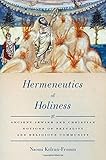
Naomi Koltun-Fromm. Hermeneutics of Holiness: Ancient Jewish and Christian Notions of Sexuality and Religious Community. New York: Oxford University Press, 2010. xii + 309 pp. $74.00 (cloth), ISBN 978-0-19-973648-5.
Reviewed by William Loader (Murdoch University)
Published on H-Judaic (February, 2012)
Commissioned by Jason Kalman (Hebrew Union College - Jewish Institute of Religion)
A Thousand Years of Holiness and Sexuality
This richly informative study spans nearly a thousand years, beginning with diverse notions of holiness reflected in the sources of the Pentateuch and ending with consideration of Christian and Jewish notions of sexuality in fourth-century CE Persia. Its primary focus is the latter, in particular the writings of Aphrahat and contemporary rabbinic discussion, for which the preceding chapters are informative background. Both movements explicated their notions of holiness by developing particular attitudes and practices in relation to sexuality: “their topic is holiness, and their ‘hermeneutics’ is sexuality” (p. 5). The book asks how this came to be.
The discussion begins at the conceptual level with recognition of the difference between purity and holiness and the growing tendency to confuse the two, already within the period under discussion. It delineates two basic approaches: one considers holiness as something ascribed by God (as in the Priestly Source [P]), which is then protected by purity provisions, often relating to sexuality, and is best served through endogamy; the other envisages that holiness or greater holiness can be achieved (as in the Holiness Code [H]), often through sexual restraint. Moses is an important paradigm, especially if his greater holiness is seen in relation to his allegedly giving up married life. Naomi Koltun-Fromm argues that “Syriac Christian asceticism, as manifested in Aphrahat, and early rabbinic asceticism share an Aramaic biblical tradition and cultural milieu that bring their scriptural exercises closer together while differentiating them both from the biblical interpretive practices and cultural influences of the Greco-Roman West” (pp. 14-15). She also emphasizes the role of such asceticism in defining group boundaries.
Koltun-Fromm concludes her discussion of the “several competing and seemingly incompatible paradigms of holiness” within the Pentateuchal sources by noting that the redactor “leaves the theological differences side by side in uneasy coexistence,” which, in turn, helps explain the different emphases among later readers (p. 41). Biblical texts limiting marriage partners of priests, prohibiting certain sexual behaviors, and identifying moments of divine revelation that require sexual abstinence underlie the assumption that how one handles sex has an impact on one’s holiness. Ezra assumes that Israel’s ascribed holiness (attributed to all Israel, not just priests) must be protected from contamination through foreign seed, its land preserved from impurity, and holiness lived out in separateness. Prophetic employment of the metaphor of prostitution, but more especially adultery, opens the way for Israel’s faithfulness to be understood in sexual terms as chasteness or even celibacy. Biblical texts could also suggest that avoiding semen pollution had a close correlation with holiness (p. 52).
Turning to Second Temple literature, she shows how in Tobit, the Aramaic Levi Document, and the Damascus Document, the notion of zenut (originally “prostitution”) has expanded to refer to all kinds of forbidden sex relations. Jubilees treats all Israel as priestly, and so applies priestly marriage restrictions to all; intermarriage is zenut. One might have noted here that Jubilees’ concern was also with bad moral influence (25:1). It is not clear to me that Jubilees treats Dinah as having committed zenut (pp. 57-58), unlike the Aramaic Levi Document; rather, she is a victim, but certainly her story serves to underline the prohibition. By contrast, Qumran sectarian literature deems holiness as something achieved by entering its covenant and sustaining obedience (as in H), holy deeds rather than holy seed (p. 64). Arguably we are dealing in effect with a combination of ascribed holiness (implicit in covenant) and achieved holiness--staying in by obedience. This coheres better with the Temple and War Scrolls, where the issue is protecting the ascribed holiness by expanding the boundaries of holy space, especially against semen and human excrement impurity, and keeping it “super-pure” (p. 67). None of this need imply a negative attitude toward sexual relations as long as they remain in their place, though, as Koltun-Fromm notes, “they prevent a person from entering holy space or holy presence” (p. 72). One might here have explored the implications for developments in eschatology, especially where the future was envisaged as totally holy space.
The discussion of Paul notes the expansion of holiness to include non-Israelites, though here notions of ascribed and achieved holiness break down. On the one hand, the claim that in Paul “true holiness is achieved, not ascribed, and it is achieved only through faith” is problematic. Putting H’s “hermeneutic that promotes holiness as achievable through obedience to the law” and Paul’s notion of faith in Christ together as instances of achieving holiness misreads Paul’s understanding of faith (p. 78). On the other hand, the discussion rightly notes that Paul is concerned with sin as pollution. On porneia (illicit sexual intercourse) in 1 Thessalonians 4:2-7, Koltun-Fromm begins by suggesting that it alludes to “nonconsanguineous relations, as per Leviticus 18-20,” which may be, although adultery is more likely, but then she moves to suggest that here Paul is “advocating a one-spouse policy,” an unlikely interpretation given that polygyny was not a feature of Greco-Roman society (p. 81). Interpretations of 1 Corinthians 5–6 are similarly problematic, for instance, that Paul’s concern is that someone is living with “his father’s former wife”--why “former”?--and that the concern in 6:15-19 is incest or adultery within the Christian community (pp. 84, 87). Yet she rightly argues that Paul assumes that a holy person can lose that status by sexual wrongdoing and portrays Paul’s flexibility in dealing with mixed marriages in relation to holiness. I would see this flexibility as limited to existing mixed marriages and not applying to entering new exogamous relations. 1 Corinthians 7:5, where Paul supports avoiding sexual relations during a period of prayer, a concept related to Sinai abstinence, belongs here, though it receives mention only later (p. 161). Discussions of what may have inspired Paul’s preference and his opponents’ insistence on celibacy, including eschatology, would have been relevant here.
The fascinating discussion of the Acts of Thomas brings out the tension within the document between insistence in the narratives on celibacy as achieving holiness and insistence in the speeches on protecting one’s holiness, but primarily by avoiding sexual wrongdoing and espousing monogamy. The view in the narratives finds fuller development in Aphrahat, who provided his own distinctive rationale. Unlike the Acts of Thomas, he drew inspiration for his view from the account of Moses at Sinai and the polluting character of semen.
Aphrahat composed the first ten of the twenty-three essays in The Demonstrations in 337 CE, and in the sixth we find his treatment of celibacy, which he argued was the best protection against impurity and the basis for attaining to a higher level of holiness than that achieved through faith and baptism, thus a hierarchy of holiness based on sexual behavior. It is addressed to the elite. The issue is not the danger of human passions, as in Greco-Roman discourse, but rather the dependency created by engaging in marriage. One might compare here Paul’s argument in 1 Corinthians 7:33-34. Aphrahat rejected spiritual marriages of male and female celibates living together as exposing them to too much temptation; instead they should marry. The author shows how Aphrahat sometimes wrote as though all should be celibate, but at other times still allowed for levels, one of which included the possibility of marriage among the less holy. Among the later essays, which were composed polemically against Judaism, the eighteenth, she argues, shows that it is best to see his position throughout as reflecting the hierarchical view.
For Aphrahat, Moses was the primary example. Using as evidence that the biblical text spoke of Joshua serving him (Numbers 11:28), which he took as implying that Zipporah did not, Aphrahat argued that Moses renounced his marriage. For Aphrahat the people’s sexual abstinence before Sinai had less to do with purification, argues Koltun-Fromm, than with preparation by sexual abstinence, as an act of obedience. God’s command here, as he read it, had greater weight than the command to multiply, which contemporary Jews used against its neglect by celibate Christians. Being constantly in God’s presence necessarily entails being constantly celibate, at least for the elite. I was surprised that the discussion of angels focused only on their immortality, so lack of need to procreate, and their separation, rather than on their being in holy presence, but perhaps this reflects Aphrahat’s emphasis.
Moses’s example of celibacy plays a role in both Philo and early rabbinic traditions. Philo knew or, she suggests, might even have created, the tradition of Moses’s celibacy. It is then striking that the tradition appears in early rabbinic literature, as she goes on to demonstrate. Aphrahat used the tradition to argue its applicability to all who would pursue highest holiness, a move that the rabbis, she shows, did not make despite their admiration for Moses’s abstinence. Supererogation and asceticism are evident among those rabbis who sought to place themselves apart from and above their fellow Jews through going beyond the letter of the law, to create “a hierarchy of achieved holiness” and in this, a degree of sexual restraint played a role (p. 237).
This monograph makes a major contribution to our knowledge of early Syrian Christianity. It shows convincingly that the ascetic tendencies or at least the views that see a relationship between sexual restraint and holiness, in both Syriac Christianity and in early rabbinic tradition, are native to the Judaeo-Christian tradition rather than due to influences from Greco-Roman discourses about the dangers of the passions. The range of material considered is immense. Inevitably there are unevennesses as she traverses so many fields, an unevenness this reviewer sensed in his own different levels of competence across the range.
I am left wondering about the extent to which eschatology played a role in these developments. Where, for instance, people envisaged the future as completely holy or even as a temple, there would be no room for sexual relations, an idea reflected, I believe, in Mark 12:25 and probably assumed by Paul. This, too, would have generated among some a choice to live now as one will live then--or even to want to impose this on all. Most Jewish eschatology, by contrast, assumes a continuity that allows space for the sacred and for normal life. This aspect was missing from the discussion. For the careful reader, endnotes rather than footnotes are an inconvenience. Otherwise, the publication is of high standard. Koltun-Fromm has succeeded in producing a finely written, closely argued account that will prove a major resource for research and reconstruction for years to come.
If there is additional discussion of this review, you may access it through the network, at: https://networks.h-net.org/h-judaic.
Citation:
William Loader. Review of Koltun-Fromm, Naomi, Hermeneutics of Holiness: Ancient Jewish and Christian Notions of Sexuality and Religious Community.
H-Judaic, H-Net Reviews.
February, 2012.
URL: http://www.h-net.org/reviews/showrev.php?id=32936
 | This work is licensed under a Creative Commons Attribution-Noncommercial-No Derivative Works 3.0 United States License. |

