



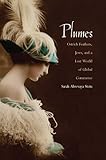
Sarah Abrevaya Stein. Plumes: Ostrich Feathers, Jews, and a Lost World of Global Commerce. New Haven: Yale University Press, 2010. 256 pp. $20.00 (paper), ISBN 978-0-300-16818-1.
Reviewed by Paul Lerner (University of Southern California)
Published on H-Judaic (July, 2011)
Commissioned by Jason Kalman (Hebrew Union College - Jewish Institute of Religion)
The World in a Feather
Sarah Abrevaya Stein’s elegant book opens by conjuring up a now forgotten world, a so-called Jerusalem on the cape of Africa, where hundreds of eastern European Jews found tremendous opportunity as ostrich feather merchants at the moment when these plumes became an international fashion craze. Stein provides a glimpse into this fascinating world and narrates a dramatic and sweeping rise-and-fall story, from the late-nineteenth-century emergence of this specialized industry through its World War I-era bust, taking the reader on an epic voyage from Lithuanian towns to South African farms, through Mediterranean trade networks, London commercial centers, and Parisian fashion houses, and ending up in New York factories and on Pasadena plantations. As such the book painstakingly recreates what Stein calls a “lost world of global commerce.” But Plumes is more than that. This slim volume about a seemingly superficial subject operates on many levels and carries a weighty historiographic agenda. Indeed, Stein uses this story to make timely and important interventions in Jewish history, economic history, and cultural history.
While no one could deny the central significance of the economy to Jewish life, experience, and thought, for decades historians of modern Jewry hesitated to take up the topic. Perhaps the explanation is that Jewish historians were preoccupied with other issues: religious currents, legal status, the pressures and limits of integration, etc. An even more significant factor might be the influence of enduring anti-Semitic caricatures and the consequent taboos around talking about Jews and capitalism or Jews and global commerce. Only very recently, and owing to the work of such historians as Derek Penslar and Jonathan Karp,[1] have scholars begun to do serious and sober research on Jewish trade and commerce in the early modern and modern periods, a trend perhaps best exemplified by Francesca Trivellato’s magnificent study of Sephardic trade networks in the seventeenth and eighteenth centuries.[2] Stein builds on this foundation with her book on one commercial sector dominated by Jews. The ostrich feather world was very much a Jewish world, from top to bottom, from big industrial magnates down to the (largely female) workers on New York and London shop floors, and everywhere in the middle, including Yiddish-speaking traders in South Africa--who comprised some 90 percent of the region’s feather merchants--and Sephardic families from Mediterranean port cities who built their fortunes in shipping.
What does it mean to say that the feather trade was a Jewish economic niche? Stein handles the issue deftly. Eschewing broad generalizations about Jews’ economic roles, Stein offers up concrete and nuanced answers, showing that a confluence of factors--skills acquired in their lands of origin, familial networks, shared languages, etc.--determined Jewish dominance of the ostrich feather industry. That the feather boom went bust, with devastating economic consequences--i.e., the failure of many of these economic actors--is yet another argument against the assumption of Jews’ affinity for capitalism. Furthermore, Stein emphasizes the heterogeneity of the Jewish groups involved in the feather business; she shows that Ashkenazim and Sephardim dominated different aspects and regions in feather supply and production, and thus that sub-ethnicity ends up being a more useful explanatory category than Jewishness in many cases.
In addition to placing economic activity at the forefront of Jewish history and historiography, Stein also furthers the integration of economic history and cultural history. She notes that cultural history--in particular the recent wave of works on consumption and consumer culture--seldom attends to the issues surrounding production and distribution, often eliding crucial questions such as where commodities come from, how they are cultivated and fashioned, how they reach their final destination, and who performs the necessary labor. Plumes serves as an exemplary corrective to this tendency. It describes the material side in great detail both on the level of factory production (with due attention to labor unrest and the often appalling working conditions) and also in terms of the international scope of the feather trade.
This book thus knits culture together with economy and Jewish history together with commercial history, and it accomplishes this on a global canvas. Indeed, the book is deeply invested in globalizing Jewish history, and Stein’s research is impressively far-ranging. Its four chapters concentrate on individuals or family businesses in South Africa, London, the Mediterranean, and New York, but in each case they locate their subject more broadly in international commercial networks, on supply chains and trade routes that stretched over land and sea. Through the circulation of one commodity she captures the inherent transnationalism of Jewish history and portrays the ways in which global commercial networks linked Jews (and some non-Jews) of various nationalities, classes, and sub-ethnicities. Significantly, Plumes does not fit into the “how one commodity changed the world” genre. Instead it uses the ostrich feather industry to reveal the interconnectedness of disparate parts of the globe and to show how certain Jewish groups helped forge and were in turn influenced by those connections.
In light of the scope and ambition of this concise book, it is not surprising that Stein can only gesture at certain contexts and themes without providing a full explication. The colonial dimension, for example, and competition between the British, French, and Ottoman empires, plays a crucial role in this story and although Stein repeatedly alludes to it, the book would have benefited from a deeper treatment of the economics of colonialism and its impact on Jewish merchants. Stein’s account, as we have seen, emphasizes production and supply almost exclusively, no doubt to redress the historiographic imbalance toward consumption. Nevertheless, more attention to the promotion, advertising, and consumption of ostrich plumes would have been useful to readers unfamiliar with the feather craze. Dealing with the consumption side, furthermore, would have helped explain the source of this powerful, yet fleeting phenomenon which had such profound economic consequences. It would have also made the book resonate more deeply for historians of American and European culture. Yet, notwithstanding these minor critiques, Plumes makes extremely valuable contributions to Jewish history, economic history, and cultural history. It succeeds admirably and eloquently both as historiographic exhortation and historical evocation, richly bringing life to lost worlds of commerce and culture.
Notes
[1]. See, e.g., Derek Penslar, Shylock’s Children: Economics and Jewish Identity in Modern Europe (Berkeley: University of California Press, 2001); and Jonathan Karp, The Politics of Jewish Commerce: Economic Thought and Emancipation in Europe (New York: Cambridge University Press, 2008).
[2]. Francesca Trivellato, The Familiarity of Strangers: The Sephardic Diaspora, Livorno, and Cross-Cultural Trade in the Early Modern Period (New Haven: Yale University Press, 2009).
If there is additional discussion of this review, you may access it through the network, at: https://networks.h-net.org/h-judaic.
Citation:
Paul Lerner. Review of Stein, Sarah Abrevaya, Plumes: Ostrich Feathers, Jews, and a Lost World of Global Commerce.
H-Judaic, H-Net Reviews.
July, 2011.
URL: http://www.h-net.org/reviews/showrev.php?id=32869
 | This work is licensed under a Creative Commons Attribution-Noncommercial-No Derivative Works 3.0 United States License. |

