



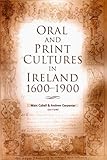
Marc Caball, Andrew Carpenter, eds. Oral and Print Cultures in Ireland, 1600-1900. Dublin: Four Courts, 2009. 256 pp. $74.50 (cloth), ISBN 978-1-84682-195-0.
Reviewed by Niall O'Ciosain (National University of Ireland, Galway)
Published on H-Albion (December, 2011)
Commissioned by Brendan Kane (University of Connecticut)
A book is not to be judged by its cover, or even by its title, and this volume is no exception. On the dust jacket, the words “Oral and Print Cultures” are superimposed on a reproduction of a manuscript, which of course is neither oral nor print. The reader’s curiosity is increased by the statement on the dust jacket and in the acknowledgements that the book examines “the interchange between written and verbal cultures in Ireland,” as if what was written was not verbal. In practice, as the editors make clear in the introduction, the essays in this book deal with oral, manuscript and print materials and their various interactions. The subject has been neglected in Ireland, write the editors, because literary scholars tend to work with printed material, Irish-language scholars with manuscripts, and folklorists with oral material, whether in written or recorded form. (Historians, readers will regret to hear, are not included in this typology.)
The strategy of most of the essays in this book is to look for traces of orality in printed or manuscript texts. Andrew Carpenter reproduces the texts of four ballads printed in Limerick in the late eighteenth century--printed, he suggests persuasively, from the dictation of a traveling singer who would have commissioned and later sold them. Their oral characteristics included the migration of verses between songs and the phonetic reproduction of contemporary local pronunciation and of phrases in the Irish language, and the results frequently bordered on incomprehensibility. Nicholas Williams explores the way in which Irish and Scottish Gaelic were rendered in English-language orthography in texts, both manuscript and printed, from the sixteenth to the twentieth century. He contrasts this style with Gaelic or Celtic script, and argues that the survival, even the dominance, of the latter was a “hindrance to the survival of the [Irish] language” in Ireland (p. 101). Lesa Ní Mhunghaile reconstructs the genesis of what she describes as “the first major point of intersection between oral tradition and print culture in Ireland,” Charlotte Brooke’s Reliques of Irish Poetry, published in 1789, which included texts from Irish-language manuscripts as well as songs (p. 14). The influence was not unidirectional, however, and Ní Mhunghaile shows how material was later appropriated into the manuscript tradition from the printed book.
Marie-Louise Coolahan examines the extensive depositions that were taken from victims of the outbreak of the rebellion of 1641 “in order to trace how these oral narratives were shaped into writing” (pp. 70-71). She sifts the various layers of the texts carefully, showing for example how, as well as the words of the deponents, the reported treasonable speech of the rebels was also crucial to the narratives. There was an additional print dimension, moreover, since the most brutal and graphic accounts of massacre and plunder in the depositions were printed in early histories of the rebellion, and have been central to controversy over the rebellion ever since. Linde Lunney takes as her case study James Orr (1770-1816), a Presbyterian weaver from southeast Antrim whose poetry, mostly written in an Ulster-Scots dialect reminiscent of Robert Burns, was published in 1804 and 1817. Orr’s verse, highly literate and reflecting a biblically based culture, contains a good deal of description of reading and writing practices in rural east Ulster, and Lunney brings elements of different poems together into a nuanced picture of a regional culture. At the same time, there is something a little decontextualized about that picture, in that the extraordinary political mobilization of the 1790s, which produced unprecedented amounts of printed propaganda and in which Orr himself was heavily involved, is almost entirely absent from the discussion. It struck this reader that the reading practices described in this poetry could equally convincingly be read as a nostalgic literary construction. As Roger Chartier and others have shown, depictions of peasant reading are frequently imbued with such nostalgia.
Another micro-study from east Ulster comes in John Moulden’s description of a remarkable collection of some sixty-five ballad books and other small texts which formed the collection of a single farming family in Co. Down. Moulden’s authority in this field is as great as that of anyone living--he says that “over the last forty years I have examined and listed most, if not all, of the Irish-printed song books in Irish libraries, in the principal ones in Britain and at Harvard University”--and his claims about the unique nature of this collection carry some weight (p. 105). The article contains a material description of the collection, a brief listing of its contents, and some suggestions about the reading practices of the family.
The remaining article is an exception within this book, being a study of the reception of the principal history of Ireland composed in Irish. This was Foras Feasa ar Éireann, written in the 1630s by Geoffrey Keating, which was one of the most frequently copied works in the manuscript tradition and first printed, in an English translation, in 1722. Marc Caball examines three contrasting readers of this text: the composer of an almost simultaneous English manuscript translation in the 1630s, a legal scholar in early nineteenth-century England, and an amateur archaeologist in Kerry in the middle of the nineteenth century, the latter two of whom read the English-language printed version. The translator wrote his own preface, which not surprisingly expressed the same politics as Keating’s; the legal scholar was dismissive of the “fabulous relations” of the book; and the archaeologist read it in a more practical manner, with his local archaeological investigations in mind.
Reception history is challenging, and Caball’s reconstruction of the reactions of these three readers is ingenious, but it is hard to see how this essay fits in the collection, as its focus is not in any substantial way on the interaction between orality, manuscripts, and print. Moreover, it is hard to go along with his suggestion that the three readers “reveal changing perceptions" of the work (p. 49). The skeptical, even incredulous, English reader could surely be found at any point from David Hume or Samuel Johnson onwards, and perhaps even before, as could “Faith and Fatherland” Catholic nationalists such as the translator. The same can be said of Ní Mhunghaile’s suggestion that the less aural presentation of Fenian lays by Charlotte Brooke in the Reliques of Irish Poetry (1789) compared to her manuscript sources “marks the shift in emphasis that took place during the course of the eighteenth century from material that was intended for reading aloud, from either handwritten or printed books, to works that were intended for silent private reading” (p. 23). In fact, what has happened in both cases is that texts have been transferred from one cultural milieu to another with different reading practices, rather than any evolution in the reading practices of either milieu. This type of misreading results, it seems to me, from a focus on specific texts as the units of analysis rather than on reading communities, a feature which is characteristic of the collection as a whole.
While this attention to texts is common to all contributors, those texts are quite varied; as a result, although the essays are all accomplished, they feel like stand-alone pieces. This is reinforced by the absence of a proper introduction that could present an overall view of the field, establish links between the different essays, and perhaps give some guidance to a non-Irish reader regarding the specificities of the Irish case. The papers were originally given, orally, at a symposium in 2008, and presumably there was discussion, criticism, and interchange of ideas at the event and afterwards. It is ironic, in a book about the interchanges between oral and written, that hardly any trace remains in the text of the oral aspects of its own origins. In this respect, the book might have followed the example of a similar collection, The Spoken Word: Oral Culture in Britain, 1500-1850 (2002), which has a magisterial introduction, longer than any of the individual contributions, written by its editors, Adam Fox and Daniel Woolf (a team indeed to rival those famous authors of The Imperial Animal [1971], Robin Fox and Lionel Tiger). In fact the short introduction of the present book is in some respects positively unhelpful--for “a case-study of the influence of print on oral culture” (p. 11) the reader is referred to a notorious episode in which a fraud, more or less, was committed on a folklore collector by one of his informants, and that in 1969, well outside the time frame of this book.
A more substantial introduction might also have drawn out some more general arguments and implications from the papers and suggested contexts for them. The depositions examined by Coolahan, for example, are, as she points out, written renditions of oral statements, and she reconstructs this process convincingly. The concept of a deposition in itself, however, also bears examination for what it reveals about the relationship between the oral and the written. Depositions were standard practice in cases where witnesses could not appear themselves in court, but they were by definition less satisfactory than an appearance by the witnesses themselves. In particular, they did not allow the cross-questioning of witnesses that was a fundamental right in common law. In the words of the seventeenth-century English jurist Matthew Hale: “Too often, a crafty clerk, commissioner, or examiner, will make a witness speak what he truly never meant, by dressing of it up in his own terms, phrases, and expressions. Whereas on the other hand, many times the very manner of delivering testimony will give a probable indication whether the witness speaks truly or falsely. And by this means also, he has an opportunity to correct, amend, or explain his testimony, upon further questioning with him, which he can never have after a deposition is set down in writing.”[1] Here, strikingly, the oral is of decidedly greater authority than the written.
Another line of thought is suggested by the rendering of the Irish language in an English-language phonetic orthography, the subject of Williams’s paper and mentioned also in that of Carpenter. One implication of a widespread use of such a system, unmentioned by either, is that literacy in English, for those whose first language was Irish, would have meant literacy in Irish as well. This flies against the orthodox presentations of language shift in Ireland, and in Britain and Europe also, according to which people adopted an official language partly or mainly because it was “the language of literacy” and abandoned the local language because it was “the language of orality.” If literacy in the two languages is functionally equivalent, than the force of this explanation is considerably diminished. Such a conception of “biliteracy” has been current in linguistics for some time, but has not been absorbed yet into historical study.
All of the essays in this collection suggest similar lines of thought, all of which will eventually contribute to a new, more interdisciplinary and synthetic view of orality and literacy in early modern Ireland and elsewhere.
Note
[1]. Matthew Hale, The History and Analysis of the Common Law of England (London: J. Nutt, 1715), 257-58.
If there is additional discussion of this review, you may access it through the network, at: https://networks.h-net.org/h-albion.
Citation:
Niall O'Ciosain. Review of Caball, Marc; Carpenter, Andrew, eds., Oral and Print Cultures in Ireland, 1600-1900.
H-Albion, H-Net Reviews.
December, 2011.
URL: http://www.h-net.org/reviews/showrev.php?id=32732
 | This work is licensed under a Creative Commons Attribution-Noncommercial-No Derivative Works 3.0 United States License. |

