



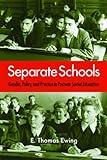
E. Thomas Ewing. Separate Schools: Gender, Policy, and Practice in Postwar Soviet Education. DeKalb: Northern Illinois University Press, 2010. xii + 300 pp. $42.00 (cloth), ISBN 978-0-87580-434-7.
Reviewed by Sergei Zhuk (Ball State University)
Published on H-Childhood (June, 2011)
Commissioned by Patrick J. Ryan (University of Western Ontario)
Late Stalinist Schooling
From July 1943 to July 1954, the Soviet government introduced a unique pedagogical experiment in history of Soviet education--separate schools for girls and boys. This interesting and forgotten experiment of late Stalinism is the theme of E. Thomas Ewing’s book. Using archival documents of the Soviet Ministry of Education, the Communist Party, Komsomol, and trade unions, along with contemporary Soviet periodicals and pedagogical literature, especially an unpublished 1946 Soviet doctoral dissertation by Konstantin I. L’vov, Ewing shows how this Soviet postwar policy became “a unique example of a large-scale effort to use gender segregation as a tool for social engineering” of Stalinist political regime (p. 4). According to the author, his study of Soviet separate schools “contributes to a broader understanding of late Stalinist period as well as the construction, experience, and negotiation of gender roles in distinct social contexts.” The author argues that the growing militarization of Soviet society led Soviet educators “to see separate schooling as a viable and even desirable strategy for training Soviet youth for future civic responsibilities.” The decision about separate education coincided with pro-natalist policies, which began in the prewar period but saw further extensions during the war, “including restrictions on divorce, bans on abortion, and awards offered to mothers with many children” (p. 7).
In contrast to a traditional view that the war with Germany exerted a direct influence on Soviet educators’ gender-specific expectations of future generations (e.g., boys fight and girls bear and rear children), Ewing shows that Soviet separate education “responded to serious shortcomings in classroom discipline, especially in large cities, which persisted in spite of the increasingly severe disciplinary techniques of the Stalinist school” (p. 8). Ewing’s central question is “why gender segregation appeared an attractive and effective instrument for disciplining boys and girls at a time when other techniques--such as reinforcing the authority of teachers, monitoring behavior through daily record keeping, or accusing unruly pupils of “anti-Soviet” acts--proved ineffective in maintaining desired levels of individual obedience and classroom order." (p.8) While such authors as Gail Warshofsky Lapidus, Ann Livschiz, and Richard Stites have represented the Soviet experiment of separate schooling as the Stalinist conservative rejection of the principle of equal coeducation and socialist sex equality, Ewing argues that “broad commitment to gender equality as an ideological promise remained a powerful factor in popular evaluations of separate schooling and would contribute directly to the restoration of coeducation” in 1954 (p. 8).
In the first chapter, Ewing explores the reasons for the school reform and shows that separate schooling responded to “the mobilization of society to meet the military emergency, concerns about women’s roles in families and society, and especially the problem of discipline in schools” (p. 16). In three subsequent chapters, Ewing discusses teachers’ “expectations” of pupils’ experience (one chapter focuses especially on girls’ schools and another chapter on boys’ schools). In the two final chapters, Ewing explores public discussions about problems of separate schooling and growing opposition of Soviet society to this educational experiment. According to Ewing, his history of this Soviet educational experiment “offers important lessons about the possible difficulties and potential consequences of imposing gender segregation in educational contexts,” as revealed by his “substantive examination of the short-term effects and long-term implications of using separate schools as a strategy of social engineering.” (pp. 225 and 227) At the end, Ewing argues that gender inequality became the major problem for Soviet educators, whose “assumptions about boys’ need for more experienced and effective teachers,” as well as their perceptions of “girls as more successful and reliable, demonstrate how powerfully separate schools manufactured inequality” (p. 227).
Although Ewing devotes a small section to senrollment in Soviet separate schools, he does not adequately discuss this issue. Ninety percent of all Soviet schools (classified as “rural schools”) were ineligible for this education experiment. Only 8 percent, mainly urban, Soviet schools were subject to gender segregation. In many provincial cities, such as Dnipropetrovsk and Kharkiv in Ukraine, only a minority of schools participated in the program. Thus, sex-segregated schooling was an urban educational experience for a minority of children and youth in postwar Soviet Union. This does not mean it was an unimportant historical event, but it demands that the experiment of sex-segregated schools be placed in the social and cultural context of the cities that participated in the program. Typically, these were the capital cities of the Soviet republics, such as Moscow and Alma-Ata, Baku, and other big industrial urban areas.
Ewing is at his best using archival documents and periodical publications. But personal interviews and memoirs of people who grew up during the late Stalinist era and who were enrolled in Soviet separate schools are missing from his book. At the same time, bringing together all these interviews and memoirs would have made Ewing’s arguments about Soviet educational reforms more interesting and more convincing.
Despite these minor criticisms, Ewing’s book is still a necessary and important contribution to a growing field of social and cultural history of late Stalinism. This book is a good addition to the studies of “Stalin’s last generation” and can be recommended for college courses not only on Soviet history but also on the history of education in general.
If there is additional discussion of this review, you may access it through the network, at: https://networks.h-net.org/h-childhood.
Citation:
Sergei Zhuk. Review of Ewing, E. Thomas, Separate Schools: Gender, Policy, and Practice in Postwar Soviet Education.
H-Childhood, H-Net Reviews.
June, 2011.
URL: http://www.h-net.org/reviews/showrev.php?id=32690
 | This work is licensed under a Creative Commons Attribution-Noncommercial-No Derivative Works 3.0 United States License. |

