



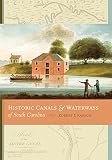
Robert J. Kapsch. Historic Canals and Waterways of South Carolina. Columbia: University of South Carolina Press, 2010. Illustrations, maps, tables. 296 pp. $44.95 (cloth), ISBN 978-1-57003-867-9.
Reviewed by Eldred "Wink" Prince Jr.
Published on H-Southern-Industry (April, 2011)
Commissioned by Tom Downey (Papers of Thomas Jefferson, Princeton University)
Liquid Highways
Robert J. Kapsch has filled an important gap in the historiography of South Carolina's early national period. Historic Canals and Waterways of South Carolina traces the history of canal construction and river navigation in the Palmetto State from the 1790s through the 1830s. With the first cotton boom, the expansion of cotton culture into the backcountry heightened the need for better transportation. Roads, where they existed at all, were narrow, rutted, and dangerous. Indeed, land travel was considered slow and hazardous at best and especially unsuited to moving bulky freight, such as cotton bales. Like New York, Pennsylvania, and other states, South Carolina viewed improving water transportation as the best way to bring cotton to the coast and return goods upriver to eager consumers. And South Carolina began improvements early: Kapsch boldly asserts that South Carolina's waterway improvement program began the nation's Industrial Revolution.
Turning South Carolina's rivers into liquid highways was a two-step process: clearing the rivers of fallen trees, snags, and sandbars; and connecting the rivers with canals. The state's first waterway project was the Santee Canal, designed to link Charleston with Columbia via the Congaree River and with Camden via the Wateree. Begun in 1793, the Santee Canal was among the first such projects in America. And at twenty-two miles in length with ten sets of locks, it was among the most ambitious. Seven years in construction, the Santee Canal was the first leg of a complex waterway system that extended into the piedmont and became the funnel through which traffic flowed to Charleston.
Throughout the 1810s and 1820s, South Carolina continued its waterway improvements by clearing rivers of hazards to navigation. Barges of workmen--usually slaves--removed fallen trees, stumps, and snags, and cut through sandbars along the Broad, Saluda, Pee Dee, Wateree, and Catawba rivers. They dug "by-pass canals" around rapids so backcountry commerce could flow to and from Charleston and Georgetown. The capital for these expensive undertakings came from public and private sources. Investors formed joint stock companies expecting to profit from tolls, and the general assembly appropriated tax dollars to clear rivers and dig canals. Of course, spending on this scale required broad political consensus, and the author suggests South Carolinians of all economic classes supported waterway improvements. Better transportation lowered freight rates in both directions, and, while cotton growers profited most from the improvements, everyone benefited from lower prices for consumer goods.
Financed with native capital and directed by engineers from Europe and the northern states, most of the actual labor was done by slaves--both male and female. Typically, owners rented slaves for cash. Sometimes, they donated the labor of their slaves to bring a waterway closer to their plantations. Teams of slaves often manned the cotton barges, polling and rowing them along the rivers and towing them through narrow canals and locks. Slaves also dug the canals. One can hardly imagine the difficulties of digging through miles of swamps, grappling with stumps and roots with only hand tools. The book would have benefited from exploring labor issues in greater depth. Another missing piece is the role of draft animals in the excavations. None are mentioned though many were likely employed.
Kapsch is correct in describing South Carolina's waterway improvement project as an "immense achievement" for the period (p. 135). The state invested about two million dollars in public funds to improve 2,400 miles of water navigation. Given South Carolina's relatively small population, this was a very impressive sum, indeed. Even so, it was only moderately successful. Freight rates fell, cotton shipments doubled, and steam boats chugged from the coast to Columbia. But the river system had problems from the start. Waterways above the fall line, including canals and locks, were not navigable by larger steamboats and soon fell into disuse. Moreover, investors and legislators underestimated the costs of servicing 2,400 miles of navigation. The rivers, cleared at great expense, did not stay cleared. Trees continued to fall from undermined banks, currents rebuilt sandbars, and droughts dried up canals. Maintaining the state's waterway system was a constant expense that the government was unwilling to bear.
By the 1830s, land transportation was improving. Construction of the 110-mile State Road linking Charleston and Columbia rendered much of the waterway system superfluous. But the greatest threat to canals were railroads. South Carolina's pioneering role in the nation's rail history is well known. By the 1830s, railways were extending their iron fingers into the backcountry, and the canals and waterways "were overtaken by new technologies" (p. 148).
There is much to praise here. Historic photographs, maps, and tables appear throughout as well as eight pages of color images. This reviewer especially enjoyed the numerous newspaper reproductions that appear on a score of pages. The depth of research is also praiseworthy, and describing the notes as “extensive” risks understatement. Many notes are essays in themselves, reaching a half-page and some a page in length. Indeed, the notes are the most substantial this reviewer has seen this side of Edward Gibbon. A glossary would have been helpful in defining terms, which, though familiar in the nineteenth century, are obscure in the twenty-first. For example, what is a "portage" and a "waste weir"? These minor issues notwithstanding, Historic Canals and Waterways of South Carolina has earned a place in the historiography of South Carolina's early national period.
If there is additional discussion of this review, you may access it through the network, at: https://networks.h-net.org/h-southern-industry.
Citation:
Eldred "Wink" Prince Jr. Review of Kapsch, Robert J., Historic Canals and Waterways of South Carolina.
H-Southern-Industry, H-Net Reviews.
April, 2011.
URL: http://www.h-net.org/reviews/showrev.php?id=32554
 | This work is licensed under a Creative Commons Attribution-Noncommercial-No Derivative Works 3.0 United States License. |

