

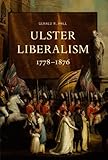
Gerald R. Hall. Ulster Liberalism, 1778-1876. Dublin: Four Courts Press, 2011. 272 pp. EUR 49.50 (cloth), ISBN 978-1-84682-202-5.
Reviewed by Douglas Kanter
Published on H-Albion (August, 2011)
Commissioned by Nicholas M. Wolf (New York University)
A quarter-century ago, modern Irish political history was dominated by analyses of nationalism in its various forms. Unionism has, more recently, also emerged as a significant subject of study, but there remain few works that explore alternative political movements, particularly in nineteenth-century Ireland.[1] These lacunae make Gerald R. Hall’s Ulster Liberalism, 1778-1876 a particularly welcome addition to Irish political historiography. In this impressive first book, Hall seeks “to rescue the history of a political tradition in Ulster in which neither nationalism nor unionism was the foremost consideration.” This tradition, Hall contends, is “best described as liberal” (p. 11). In four chapters, Hall charts the emergence and efflorescence of liberalism in Ulster, before concluding with an examination of the factors that precipitated its decline.
Hall locates the origins of Ulster liberalism in the Volunteer movement. Although the Volunteers employed several types of political discourse, some spoke the language of “nascent liberalism” (p. 27). The liberal Volunteers had imbibed the ideals of the Scottish Enlightenment either directly from the Scottish universities or indirectly through the publications of its leading lights, particularly John Millar. Their political creed was defined by religious toleration; a skepticism about the martial values associated with civic republicanism; and a stadial, progressive conception of society. Many of Ulster’s early liberals persevered in their support of peaceful political change during the turbulent 1790s, and they were well equipped, after 1800, to accept the new union with Britain as providing a framework for further reform.
Social and economic changes in Ulster provided a stimulus to liberalism following the conclusion of the French Revolutionary and Napoleonic Wars. The landed elite resisted a political accommodation with the growing mercantile, manufacturing, and professional middle class, which provoked a liberal assault on the oligarchic structure of politics in the North. Hall argues that scholars have tended to overrate the influence of the Reverend Henry Cooke, who sought to establish a pan-Protestant conservative coalition in the aftermath of the wars. Instead, he maintains, liberal Presbyterians and Catholics cooperated to undermine landed control of local government. In 1828, Ulster liberals succeeded in securing permissive parliamentary legislation, enabling local communities to establish town commissions which possessed broad powers over cleaning, lighting, and policing. The Irish town commissions, which numbered eighteen in 1829 and eighty-eight in 1876, enabled Ulster liberals “to mount a surprisingly widespread, prolonged and effective challenge to the traditional order in Ulster towns” (p. 106). By mid-century, moreover, three of the four leading newspapers in Ulster, as measured by circulation, were liberal, while the leading political cause in the North, tenant right, was also identified with liberalism.
Hall attributes the decline of Ulster liberalism to changes in both Catholic and Presbyterian religious practice after 1850. The Devotional Revolution, and Cardinal Paul Cullen’s ultramontane leadership, encouraged the development of a more confessional identity among Ulster’s Catholics. Presbyterians experienced a parallel revival that attracted proselytizers and anti-Catholic street preachers. The result of mounting intercommunal tension was increased violence. Predictably, the repeal of the Party Processions Act in 1872 only exacerbated hostilities. Though Ulster liberalism experienced a St. Martin’s Summer between 1868 and 1874, when liberals captured a number of parliamentary seats at two general elections, such successes were inevitably ephemeral in the absence of a genuine ecumenism. The survival of Ulster liberalism depended on the alliance of Catholics and liberal Presbyterians, and sectarianism subverted the sense of a common community on which their cooperation depended.
Ulster Liberalism makes two significant contributions to the historiography. First, by examining what Hall, following Habermas, refers to as the “public sphere,” rather than focusing more narrowly on parliamentary election results and elite politics, it persuasively demonstrates the long-term vitality of liberalism in the North. Second, the study of town commissions points to an aspect of local government in Ireland that historians have neglected. Hall has devoted considerable attention to the Ulster commissions, and provides detailed case studies throughout the book, but the commissions in southern and western Ireland are understandably not explored. Here, then, is an agenda for future research. No book is perfect, of course, and Hall may have understated the unionism of Ulster’s liberal Presbyterians. He briefly examines the sectarian tensions that developed when Daniel O’Connell pursued the repeal of the Act of Union in the 1840s, but avoids similar engagement with the challenge of Home Rule by ending his study in 1874. Hall portrays liberalism as providing a “middle path” between the polarized alternatives of nationalism and unionism, but perhaps nineteenth-century Ulster liberalism was essentially a regional variant of liberal unionism. This reviewer, at any rate, would have appreciated further discussion of liberal attitudes toward the union. If, however, Hall has not exhausted the subject of Ulster liberalism, he has provided the indispensable foundation on which all subsequent scholars will build.
Note
[1]. For a thorough overview of the literature, see Patrick Maume, “Irish Political History: Guidelines and Reflections,” in Palgrave Advances in Irish History, ed. Mary McAuliffe, Katherine O’Donnell, and Leeann Lane (Houndmills: Palgrave Macmillan, 2009), 1-48.
If there is additional discussion of this review, you may access it through the network, at: https://networks.h-net.org/h-albion.
Citation:
Douglas Kanter. Review of Hall, Gerald R., Ulster Liberalism, 1778-1876.
H-Albion, H-Net Reviews.
August, 2011.
URL: http://www.h-net.org/reviews/showrev.php?id=32552
 | This work is licensed under a Creative Commons Attribution-Noncommercial-No Derivative Works 3.0 United States License. |

