



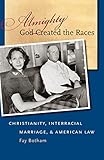
Fay Botham. Almighty God Created the Races: Christianity, Interracial Marriage, and American Law. Chapel Hill: University of North Carolina Press, 2009. xiii + 271 pp. $35.00 (cloth), ISBN 978-0-8078-3318-6.
Reviewed by Martin Hardeman (Eastern Illinois University)
Published on H-Law (June, 2011)
Commissioned by Christopher R. Waldrep (San Francisco State University)
Law, race, sex, and theology come together in Fay Botham’s study, Almighty God Created the Races. Beginning with the California Supreme Court’s decision in Perez v. Lippold (1948) and the United States Supreme Court’s decision in Loving v. Virginia (1967), Botham goes back to explore the origins of anti-interracial marriage laws as well as their eventual demise.
In essence, Botham argues that the Protestant Reformation marks the spot where Christian theology begins to divide in matters of race and marriage. Rejecting the Catholic Church’s doctrine that it possessed the exclusive authority to interpret the Bible’s meaning, Protestant theologians emphasized the “priesthood of all believers.” Botham writes that in this view “God endowed individual believers with the ability to discern scriptural truths and that the faithful required no mediator or priest to explain the message of the Gospel, but only the guidance of the Holy Spirit within the context of a faith community” (p. 181). The ultimate consequence of this (particularly in the American South) would be a locally oriented, individualistic Protestantism with as many interpretations of the Bible as there were denominations--and almost as many as there were congregations.
As outposts of Protestantism, Britain’s North American colonies had no initial stance on either race or interracial marriage. Yet race-based servitude eventually demanded some sort of accommodation between Protestantism and the enslavement of Africans. This situation generally allowed secular authorities to fill the void. Between 1664 and 1750, ten of the thirteen colonies had proscribed interracial marriage and all of their legal codes had severely restricted the legal status of Negroes--both free and slave.
In contrast, the Catholic colonies of France, Portugal, and Spain took a far less rigid position. According to Botham, theology explains the difference. In 1553, the Council of Trent declared that marriage was a holy sacrament and, as such, was under the exclusive authority of the church. Although it was forced to gradually give way to the growing power of the state during the seventeenth and eighteenth centuries, the church’s position was that marriage between communicants should be free from state interference. Protestant theology, in contrast, viewed marriage as sacred, but not as a holy sacrament. Thus marriage, like any other civil contract, could be regulated by the state.
At the core of laws prohibiting miscegenation and interracial marriage, however, was the concept of race. By the beginning of the first decades of the nineteenth century and with even greater vehemence in the years following the Civil War, the Bible’s authority was enlisted first to justify race-based slavery and then to justify racial segregation--most especially interracial marriage. Evidence of God’s intentions was most often located in Genesis 10-11. Noah’s curse condemning his son Ham and Ham’s descendants to be “the servants of servants” became the cornerstone of southern white Protestants’ racial theology. (The mark of Cain, the destruction of the Tower of Babel, and the geographic dispersal of Noah’s descendants also were enlisted as further proof of God’s design.) Botham writes, “If God had deemed racial separation as the divine plan, then humans must enact legal rules preventing any violation of that plan. Failure to uphold God’s wishes constituted a direct affront to God” (p. 129).
Combining this design together with a post-Civil War resurgence of states’ rights, state after state enacted laws carrying out God’s plan. Ironically, a decision of Pennsylvania’s Supreme Court, which had nothing to do with miscegenation or interracial marriage, became the first invocation of the Protestant theology of separate races. Speaking for the court, Chief Justice Daniel Agnew declared in Philadelphia &West Chester R.R. Co. v. Miles (1867) that the railroad had the constitutional right to segregate passengers on the basis of race. Asserting that God had made the black race and the white “dissimilar,” he added that “the natural law, which forbids their intermarriage and that amalgamation which leads to a corruption of races is as clearly divine as that which imparted to them different natures. The tendency of intimate social intermixture is to amalgamation, contrary to the law of races” (p. 134).
The Philadelphia decision along with the Tenth Amendment provided reinforcing precedents for racial segregation and anti-miscegenation laws for almost one hundred years. Despite the opposition of Catholic dogma to both the idea of separate and distinct races and the exclusive authority of the state over marriage, Catholicism was a minority religion in the United States--and a significant portion of its adherents rejected the church’s theological conclusions. In Perez v. Lippold, for example, the successful challenge of a Catholic interracial couple to California’s law proscribing interracial marriage received far less than wholehearted support from the church’s local hierarchy.
Almighty God Has Created the Races tightly focuses on the intersection of theology and law. Yet in neither Perez nor Loving is theology central. In the former, religion plays a secondary role in the majority decision, and in the latter, it seems to play no part at all in the Supreme Court’s unanimous decision. The ruling in both the California Supreme Court and the United States Supreme Court, respectively, declared that laws prohibiting marriage on the grounds of race are contrary to the guarantees of the Fourteenth Amendment and that they are an unwarranted intervention by the states into the private lives of their citizens.
Botham has done a yeoman-like job of research in public and private papers, in the secondary literature, and in the legal and theological archives. But her narrow concentration does not support her conclusion. Catholic and Protestant theology is clear as an element in the rise and fall of anti-interracial marriage laws. Particularly for those she identifies as southern white Protestants, a biblical interpretation postulating separate and distinct races incalculably aids in the justification of laws segregating the races and absolutely proscribing miscegenation. But whether theology is as important as economic, social, psychological, and political considerations is a question that Botham never asks. And, this failure significantly undermines the usefulness of her book.
If there is additional discussion of this review, you may access it through the network, at: https://networks.h-net.org/h-law.
Citation:
Martin Hardeman. Review of Botham, Fay, Almighty God Created the Races: Christianity, Interracial Marriage, and American Law.
H-Law, H-Net Reviews.
June, 2011.
URL: http://www.h-net.org/reviews/showrev.php?id=32352
 | This work is licensed under a Creative Commons Attribution-Noncommercial-No Derivative Works 3.0 United States License. |

