



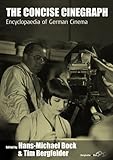
Michael Bock, Tim Bergfelder, eds. The Concise Cinegraph: Encyclopaedia of German Cinema. New York: Berghahn Books, 2009. 574 pp. $150.00 (cloth), ISBN 978-1-57181-655-9.
Reviewed by Sebastian Heiduschke (Oregon State University)
Published on H-German (February, 2011)
Commissioned by Benita Blessing (Oregon State University)
The Who's Who of German Cinema
The German original CineGraph Lexikon zum deutschsprachigen Film is anything but concise.[1] A loose-leaf collection of biographic and filmographic information on personalities from German cinema history, CineGraph has grown from its first installment in 1984 in the meantime to eight binders, holding more than one thousand entries that extend to an impressive and overwhelming work spanning almost twelve thousand pages--a Mecca for film scholars capable of reading German.
For their English-language edition The Concise CineGraph: Encyclopaedia of German Cinema, Hans-Michael Bock and Tim Bergfelder have condensed their meticulous work to 574 pages as "CineGraph's international outreach in promoting a better understanding of German film history across borders" (p. x). Released as volume 1 in Berghahn's excellent series Film Europa: German Cinema in International Context, this encyclopedia of bio-filmographic information--grouped alphabetically by surnames of German film personas--ranges from Alfred Abel (starring as despotic CEO Joh Fredersen in Fritz Lang's Metropolis [1927]), to Hanns Zischler, the multitalented actor, director, author, translator, photographer, and publisher, known to many as speech therapist in Wim Wender's Im Lauf der Zeit (Kings of the Road [1975]). Each entry provides a biography and a filmography, identifying the person's role in each film through a simple system of abbreviations. Unique to the English-language edition is an appendix, containing short essays of less than one thousand words that sketch a chronology of German film. The appendix begins with Wilhelmine cinema, and continues with Weimar cinema and then topical treatments of Nazi cinema, so-called rubble films, DEFA (Deutsche Filmaktiengesellschaft, the East German film production company), West German film, German cinema since unification, Austria, and Switzerland, and ends with the topic "Exile and Transnational Traffic."
Bock and Bergfelder explain in the introduction that they wrote their English-language reference work of German film "with a non-German readership in mind" (p. xi), hoping to enable new audiences to take a look at German cinema. This becomes particularly evident in the appendix that serves as a brief introduction to the complex history of German film. The appendix attempts a chronologic periodization along with essential names and provides suggestions for further reading. For example, the entry about DEFA and East German cinema lists approximately one hundred important names at the end of a three-column text that summarizes roughly forty-six years of DEFA film, and references three seminal works, Sean Allan and John Sandford's 1999 volume DEFA: East German Cinema, 1946-1992, Barton Byg and Betheny Moore's 2002 publication Moving Images of East Germany: Past and Future of DEFA Film, as well as Daniela Berghahn's Hollywood behind the Wall: The Cinema of East Germany from 2005.
In general terms, the editors state as their goal to challenge "isolationist definitions of national film cultures and ... [demonstrate] cinema's intrinsic internationalism and hybridity" (p. ix-x). To that extent, the volume transcends simplistic notions of what constitutes "German" cinema as it includes Austrian and Swiss cinema along with the often international personnel found in all three cinemas. It contains information about "German cinema's acknowledged 'classics'" (p. x)--F. W. Murnau, Fritz Lang, R. W. Fassbinder, Marlene Dietrich, Alexander Kluge--as well as those who have rightly been elevated into those ranks in recent years--for instance many DEFA directors such as Konrad Wolf and Kurt Maetzig. It is especially refreshing to see that The Concise CineGraph also devotes equal attention to the dual structure of German cinema between 1945 and 1990, and the work of the often ignored or forgotten exiles of the Third Reich.
Needless to say, even 574 pages cannot hold each and every single person of importance in German cinema. Before I received the volume, I created a list of names I believed to be vital for an understanding of German cinema, yet not necessarily among the canonical names. I was disappointed to see many of these names left out. Among those unaccounted for are, for instance, Michael "Bully" Herbig and Thomas Arslan. Herbig has created numerous blockbusters with (T)Raumschiff Surprise, Periode 1 (2004) and Lissi und der Wilde Kaiser (2007), and his film Der Schuh des Manitu (2001) sold more than eleven million tickets to become the most successful German film since the advent of television changed entertainment. Thomas Arslan is one of the initiators of the "Berlin School" or "Nouvelle Vague Allemande," as Cahiers du Cinéma dubbed a group of filmmakers who trained at the Deutsche Film- und Fernsehakademie Berlin and created their films in the 1990s as counterpoint to the German film comedies. Another prolific director of the Berlin School, Christian Petzold, gets an entry, perhaps due to the fact that his film Yella (2007) received international recognition. Since Herbig and his films are virtually unknown outside of the German-speaking realm, and Arslan's Turkish-German films are overshadowed by the success of another Turkish-German director, Fatih Akin, international recognition, along with personal preferences other than mine, may explain the selection of some names and the exclusion of others.
Nonetheless, the question of the work's intended target audience remains. Without a doubt, non-German readers interested in German cinema will profit immensely from the information in this book. Its value is evident, yet I wonder if film scholars will add this to their private collection. For specialists of German cinema without access to the multivolume CineGraph binders, this book is a welcome and recommended addition for almost daily perusal, or as an invitation to browse German film history. For a college library with programs in film studies or German studies, this book is a must, and anyone teaching a course related to German cinema should include it as part of their course reserves. The appendix will prove particularly useful for students and teachers seeking concise, introductory readings about certain periods of German cinema.
Note
[1]. Hans-Michael Bock, ed., CineGraph Lexikon zum deutschsprachigen Film (Munich: Edition Text + Kritik, 2010).
If there is additional discussion of this review, you may access it through the network, at: https://networks.h-net.org/h-german.
Citation:
Sebastian Heiduschke. Review of Bock, Michael; Bergfelder, Tim, eds., The Concise Cinegraph: Encyclopaedia of German Cinema.
H-German, H-Net Reviews.
February, 2011.
URL: http://www.h-net.org/reviews/showrev.php?id=32305
 | This work is licensed under a Creative Commons Attribution-Noncommercial-No Derivative Works 3.0 United States License. |

