



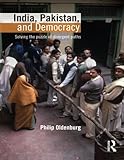
Philip Oldenburg. India, Pakistan, and Democracy: Solving the Puzzle of Divergent Paths. Milton Park, Abingdon, Oxon: Routledge, 2010. x + 273 pp. $145.00 (cloth), ISBN 978-0-415-78018-6; $39.95 (paper), ISBN 978-0-415-78019-3.
Reviewed by Sumit Ganguly (Rabindranath Tagore Chair in Indian Cultures and Civilizations at Indiana University, Bloomington.)
Published on H-Asia (January, 2011)
Commissioned by Sumit Guha (The University of Texas at Austin)
Common Origins, Divergent Paths
From the perspective of the present it is hard to come to terms with the fact that both India and Pakistan emerged as independent states from the collapse of the British Indian Empire in 1947. The political trajectories of the two states have so significantly diverged that it seems inconceivable that they had common roots. Today, despite a plethora of domestic problems that are sandbagging its growth, India is increasingly a significant global actor. Pakistan, in contrast, is caught in a vortex of economic, political, and social problems, which have no possible panacea in the foreseeable future.
Some past scholarship seeking to compare the two states has bordered on the polemical. For example, Ayesha Jalal’s book, Democracy and Authoritarianism in South Asia: A Comparative and Historical Perspective (1995), suggested that the differences between India and Pakistan were little more than epiphenomenal. Instead, she argued that beneath their superficial and apparent differences the two states were structurally quite similar. Jalal’s claims were, bluntly put, extraordinarily flawed. Her analysis overlooked the fundamentally different patterns of civil-military relations, the political mobilization of India’s lower castes and minorities, the fitful but eventual success of India’s federalism, and the independence of its judiciary.
Fortunately, elements of an explanation for the divergence in their chosen roads can be gleaned from the work of other scholars. For example, the Indian historian, Mushirul Hasan, has provided more nuanced accounts of how the trajectories of the two nationalist movements had predisposed them toward disparate political outcomes. Also, the Indian political scientist, Rajni Kothari, in an early work, had correctly shown how the Indian National Congress was, in effect, a virtual parliament where contending views could be aired, discussed, and debated. This legacy played a vital role in socializing India’s postindependence political leadership to the habits of negotiation and compromise.
Philip Oldenburg’s work, India, Pakistan and Democracy, is a timely and useful corrective to Jalal’s breathtakingly lopsided analysis. Oldenburg emphasizes the critical choices of key nationalist leaders, especially Jawaharlal Nehru and Muhammad Ali Jinnah, in shaping the respective political arenas of their two nascent countries. However, he does not attribute the vastly divergent pathways of the two states to the agency of their respective nationalist leaderships. Instead, he alludes to the differences in the two principal nationalist movements, the ability (and the lack thereof) of the political class to establish firm control over their respective military establishments, and their differing approaches to the handling of the Indian Civil Service inheritance. He also bluntly deals with the rather delicate issue of the religious composition of the two states and the fraught relationship between nationalism and religion.
The book is carefully researched, well documented, and clearly argued. That said, it has some important limitations. At the outset, it needs to be spelled out that it is almost completely derivative. Oldenburg makes excellent and deft use of the extant literature, but, in the end, the study is not based on new historical scholarship or on extensive fieldwork in the two states. This is, at best, a superb work of synthesis.
In a related vein, Oldenburg displays a proclivity to rely inordinately on long quotations. Many of them are indeed apposite and telling. However, the sheer array of quotations from other works, both scholarly and popular, detracts from the quality of his analysis.
Furthermore, despite its obvious strengths, Oldenburg’s work suffers from two other limitations. First, the argument that he proffers, while complex, is hardly parsimonious. Eventually, the reader looks in vain for a straightforward causal explanation that would explain the markedly different pathways that the two states have trodden since independence. Second, and at a more substantive level, Oldenburg, in his quest for nuance, fails to adequately emphasize the markedly different internal organization and ideology of the two nationalist movements and their critical impact on the evolution of the political orders in the respective states. The dominant strand of one was inclusive, civic, and democratic. The principal characteristics of the other were its lack of internal democracy; its construction of a monolithic Muslim identity that sought to efface differences of region, class, and sect; and a charismatic leader’s domination of its course. No discussion of the emergence and evolution of the two states can afford to elide over this fundamental set of differences. In the wake of independence and partition, the Indian National Congress possessed a legitimacy and standing among a wide swath of Indian society. The Muslim League, though instrumental in creating a new state, simply failed to command such widespread popular legitimacy. Not surprisingly, it came to rely on the military to maintain public order and thereby opened the door to authoritarian temptation.
These shortcomings notwithstanding, this is a topical and worthwhile work. Policy analysts, journalists, and students interested in the contemporary politics of India and Pakistan will benefit considerably from a careful perusal of this book.
If there is additional discussion of this review, you may access it through the network, at: https://networks.h-net.org/h-asia.
Citation:
Sumit Ganguly. Review of Oldenburg, Philip, India, Pakistan, and Democracy: Solving the Puzzle of Divergent Paths.
H-Asia, H-Net Reviews.
January, 2011.
URL: http://www.h-net.org/reviews/showrev.php?id=32219
 | This work is licensed under a Creative Commons Attribution-Noncommercial-No Derivative Works 3.0 United States License. |

