



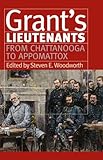
Steven E. Woodworth, ed. Grant's Lieutenants: From Chattanooga to Appomattox. Modern War Studies. Lawrence: University Press of Kansas, 2008. vii + 263 pp. $34.95 (cloth), ISBN 978-0-7006-1589-6.
Reviewed by Joshua Camper (Mississippi State University)
Published on H-CivWar (January, 2011)
Commissioned by Hugh F. Dubrulle (Saint Anselm College)
The Relationships between Grant and His Commanders
Noted Civil War scholar Steven E. Woodworth, professor of history at Texas Christian University, who has authored most recently Manifest Destinies: Westward Expansion and the Civil War (2010) and The Chickamauga Campaign (2010), has edited a companion volume to Grant’s Lieutenant’s: Cairo to Vicksburg (2001). Woodworth’s Grant’s Lieutenant’s From Chattanooga To Appomattox is a collection of essays written by distinguished scholars in the field that illustrate the ways Grant’s lieutenants contributed to or challenged their commander’s success and developments as a general. The book’s central thesis is that Grant depended heavily upon his subordinates to implement his orders and carry them out as best they could.
The book’s nine chapters highlight Grant’s professional and personal relationships with his Union colleagues. John F. Marszalek, emeritus professor of history at Mississippi State University and recognized scholar of William T. Sherman, writes about the friendship and working partnership between Grant and Sherman in the western theater, at Chattanooga, and in Georgia. Of particular interest in this chapter is Marszalek’s discussion of Grant coming to terms with Sherman’s concept of total war in the South. Woodworth tackles the relationship between Grant’s “warfare of momentum” versus George H. Thomas’s careful, methodical, and perfectionist attitude toward war. This chapter highlights Grant’s dogged determination to pursue the enemy while Thomas held a more reserved and cautious attitude similar to William Rosecrans and George McClellan. Ethan S. Rafuse, military historian at the U.S. Army Command and General Staff College, examines Grant’s relationship with George Meade when the former assumed personal oversight of the Army of the Potomac as it engaged Lee’s army in the last year of the Civil War. This is the longest chapter in the book and one of the most interesting. Rafuse discusses Grant’s strategy, and the role Meade played in that strategy. Earl J. Hess, associate professor of history at Lincoln Memorial University, explores Grant’s political problems when he assumed command of all Union armies. German Americans were essential to the Union war effort, and the ever-popular though inept German general Franz Sigel proved to be a burden for Grant as he tried to balance keeping this ethnic group in the war while working with an indifferent commander. Another headache for Grant, illustrated by Mark Grimsley, associate professor of history at the Ohio State University, was the political general Benjamin Butler, who Grant believed useful in his offensive strategy for 1864. Grimsley, however, argues that Grant misused Butler by not giving him proper directions. Benjamin Franklin Cooling, professor of grand strategy and mobilization at the Industrial College of the Armed Forces, looks at unsuccessful generals David Hunter, Lewis Wallace, and Horatio Wright as they tried to stop and capture Jubal Early in the summer of 1864 in the Shenandoah Valley. The following chapter, written by Steven E. Nash, a doctoral candidate at the University of Georgia, explores Phil Sheridan’s rise to become one of Grant’s most trusted cavalry officers. The final two chapters, by William Fies and Grimsley, examine Grant’s relationships with Edward O.C. Ord and Henry W. Halleck.
Editing a book of collected essays is never an easy task as each essay should match a desired theme, but Steven Woodworth has surmounted this obstacle. Each essay is superbly written and provides an excellent overview of the men with whom Grant worked closely during the last phases of the Civil War. These essays are written in ways that will appeal to a wide readership and to the professional academic. They illustrate Grant’s ability to work closely with others during the war and they also shows much of his personality, a factor that is sometimes forgotten or overlooked when studying Grant in the Civil War. There are a few weaknesses with Grant’s Lieutenants. First, it ends abruptly with no concluding chapter. The introduction lays the groundwork for the book’s content but there is no conclusion that truly ties it all together. Second, the book lacks illustrations of any kind. With all of the individuals discussed in the book images would have been helpful.
Within the last few years there has been a growing interest among Civil War historians to examine the people who served under the “big-name generals.” David Coffey, history professor at the University of Tennessee Martin, wrote Sheridan’s Lieutenants: Phil Sheridan, His Generals, and the Final Years of the Civil War (2005), which examines the role Sheridan and his lieutenants played in helping defeat Lee’s army. Michael Bradley’s Nathan Bedford Forrest’s Escort and Staff (2006) examines the relationship between Forrest and his men and their Confederate military contributions in the western theater. This reviewer has written also on Forrest’s commanders during the West Tennessee Raid of December 1862 and how his commanders contributed to Forrest’s success in the Civil War. Both volumes of Grant’s Lieutenants add to this growing historiographical trend. With the histories of Grant’s and Sheridan's lieutenants there should now be a call for the histories of William T. Sherman’s lieutenants to address the reasons for the triumvirate’s ultimate success in the Civil War.
If there is additional discussion of this review, you may access it through the network, at: https://networks.h-net.org/h-civwar.
Citation:
Joshua Camper. Review of Woodworth, Steven E., ed., Grant's Lieutenants: From Chattanooga to Appomattox.
H-CivWar, H-Net Reviews.
January, 2011.
URL: http://www.h-net.org/reviews/showrev.php?id=32203
 | This work is licensed under a Creative Commons Attribution-Noncommercial-No Derivative Works 3.0 United States License. |

