



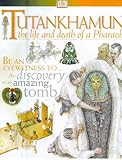
David Murdoch. Tutankhamun: The Life and Death of a Pharaoh. New York: DK Publishing, 1998. 47 pp. $14.95 (cloth), ISBN 978-0-7894-3420-3.
Reviewed by Alexandra O'Brien (University of Chicago)
Published on H-AfrTeach (July, 1999)
The story of the "Boy King," Tutankhamun, must be one of the most engaging for school children interested in the past. On his ascension to the throne of Egypt at the age of nine, he would have been the same age as many of the children who will read this book. Imagine becoming the ruler of the richest country in the world when you're only nine years old--a mind-boggling thought! In fact it is ironic that this young man, who ruled Egypt only briefly, should end up becoming the best known of the pharaohs. His fame is due to the discovery of his amazingly well preserved tomb by Howard Carter in 1922. Carter's now famous reply to Lord Carnarvon's asking if he could see anything ("Yes, wonderful things") now seems quite an understatement. I can remember the thrill I felt upon seeing Tutankhamun's treasures in the Cairo Museum for the first time; I was not disappointed! David Murdoch's book is an excellent starting point for young readers interested in ancient Egypt. The book presents in detailed yet thoroughly readable text, accompanied by a wealth of informative illustrations (both artwork and photography) of the story of Howard Carter's discovery of the tomb in 1922, as well as the life and times of the king himself.
Dorling Kindersley, the publishers of this book, seems to have come up with a winning formula for producing this kind of educational kid's material. Other examples of books from this publisher include those written by James Putnam, as well as Harriet Griffey's book in a different DK series.[1] Each is well illustrated, accurate, and informative without being a hard read, and Murdoch's book is a terrific addition to these works.
The book is divided into twenty sections which fall into four main parts: "The Discovery," "Treasures of the Tomb," and "Life and Times of Tutankhamun," followed by "Fact Finder" pages towards the end of the book. "The Discovery" includes "The Characters," "The Valley of the Kings," "The Hidden Steps," "Breaking Through," "The Antechamber," "The Burial Chamber," "The Treasury," "The Annex," and "Unwrapping the Mummy." Each succeeding section tells the story of the years and months of work that went into finding the tomb, leading up to the entrance into the pharaoh's resting place. "Treasures of the Tomb" includes "The Journey to the Tomb" (a pull-out four page spread on the final interment of the king and its attendant ceremonies) and "Wonderful Things." The final part is the "Life and Times of Tutankhamun" with sections on ancient Egyptian culture and history as well as the king himself: "The Kingdom of the Nile," "Gods and Religion," "The Pharaoh," and "Who Was Tutankhamun?" The Fact Finder pages include two double page spreads on "Mummies and Embalming" and "The Archaeologists at Work." The former is a handy breakdown of the embalming process, complete with illustrations and Herodotus' famous account, while the latter presents an overview of how Carter and his team dealt with the tomb and its artifacts, the problems of transporting these marvelously precious goods and the difficulties of preserving them. The Index on page 48 enhances the usefulness of the book.
One extremely nice touch, which also serves to knit the book together, is the inclusion of many "Eyewitness" quotes from a variety of sources penned by Carter and others (some of which come from telegrams to his supporter, Lord Carnavon, others from Carter's personal notes). This gives an air of suspense and immediacy similar, perhaps, to that felt by Carter and his team as they sought for the tomb in the Valley of Kings. It is a shame, however, that there are no suggestions for further reading or websites, a list of which should have been included.
This book is an excellent introduction to the history and culture of ancient Egypt, which uses the extremely effective hook of the "Boy Pharaoh" to attract the attention of younger readers. They will not be disappointed. The readable and accurate text as well as the thoughtful illustrations present the story of Tutankhamun, and his people, in a readily accessible form, and at $14.95 is good value. I thoroughly recommend this book.
Notes
[1.] George Hart and Peter Hayman, Ancient Egypt, Eyewitness Books (New York: Alfred A. Knopf, 1990./London: Dorling Kindersley, 1990), Harriet Griffey, Secrets of the Mummies, Eyewitness Readers (New York: DK Publishing, Inc. [Dorling Kindersley], 1998/London: Dorling Kindersley, 1998), James Putnam, Mummy, Eyewitness Books (New York: Alfred A. Knopf, 1993/London: Dorling Kindersley Limited, 1992), James Putnam, Geoff Brightling and Peter Hayman, Pyramid, Eyewitness Books (New York: Alfred A. Knopf, 1994/London: Dorling Kindersley, 1994).
Copyright (c) 1999 by H-Net, all rights reserved. This work may be copied for non-profit educational use if proper credit is given to the author and the list. For other permission, please contact H-Net@h-net.msu.edu.
If there is additional discussion of this review, you may access it through the network, at: https://networks.h-net.org/h-afrteach.
Citation:
Alexandra O'Brien. Review of Murdoch, David, Tutankhamun: The Life and Death of a Pharaoh.
H-AfrTeach, H-Net Reviews.
July, 1999.
URL: http://www.h-net.org/reviews/showrev.php?id=3218
Copyright © 1999 by H-Net, all rights reserved. H-Net permits the redistribution and reprinting of this work for nonprofit, educational purposes, with full and accurate attribution to the author, web location, date of publication, originating list, and H-Net: Humanities & Social Sciences Online. For any other proposed use, contact the Reviews editorial staff at hbooks@mail.h-net.org.

