



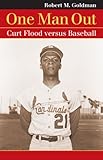
Robert Michael Goldman. One Man Out: Curt Flood versus Baseball. Landmark Law Cases and American Society. Lawrence: University Press of Kansas, 2008. vxii + 158 pp. $35.00 (cloth), ISBN 978-0-7006-1602-2; $16.95 (paper), ISBN 978-0-7006-1603-9.
Reviewed by Samuel Gale
Published on H-Law (June, 2011)
Commissioned by Christopher R. Waldrep (San Francisco State University)
Throughout the winter of 2010, baseball journalists speculated on a nearly daily basis whether or not Albert Pujols--the superstar first baseman of the St. Louis Cardinals--would sign an extension to his current contract with the club or instead opt to seek employment with one of the twenty-nine other Major League Baseball (MLB) teams at the conclusion of the 2011 season as a free agent. What the media failed to acknowledge was how Pujols would not have been able to sell his services to the highest bidder without the tremendous sacrifice made by another Cardinal--Curt Flood--forty years earlier. Indeed, a significant percentage of current MLB players and fans alike remain unaware that Flood’s legal battles with Major League Baseball from 1970 to 1972 dramatically changed the landscape of America’s pastime.
Robert M. Goldman’s One Man Out: Curt Flood versus Baseball is part of a recent explosion in scholarship examining Flood’s tireless efforts to eradicate Major League Baseball’s reserve clause system and replace it with a system of free agency that gave players greater power to choose where they would play. Unlike the other recent works that are primarily biographies, One Man Out is focused exclusively on studying the legal history surrounding this case. Overall, Goldman succeeds in providing an excellent, if thin, legal analysis of the history of baseball’s reserve clause system. Since the sport’s nascent development, MLB adopted the reserve clause system whereby the team owned the player like they would property. As a result, the player was bound to play for that team for the duration of his career unless the team traded, sold, or released him from his contract. The reserve clause system was particularly damaging to players as it gave them minimal leverage to negotiate annual contracts. The owner held the exclusive rights to the player.
Goldman frames Flood’s actions as part of a decades-long struggle between players and owners, writing that “the issues Flood would raise touched on fundamental concerns about the status and role of the professional player that were as old as professional baseball itself” (p. 30). What set Flood apart from his predecessors was that he was a star player earning one of the highest salaries in the league when he sued Major League Baseball. Flood’s large salary propelled media and owners to question Flood’s motives and they framed it as nothing more than a ploy from a well-paid player trying to demand a higher salary, to which Flood responded that, “a well-paid slave is nonetheless a slave” (p. 14). Furthermore, Flood opted to sit out an entire season in order to battle baseball owners in court over the legality of the reserve clause, a move that cost him not only a year’s salary but ultimately the skills that made him one of the better players of his generation.
The strength of Goldman’s scholarship is in his exhaustive analysis of the history of baseball in the legal system that preceded Flood v. Kuhn. Central to this was the landmark Supreme Court decision in 1922 in Federal Baseball Club of Baltimore, Inc. v. National League of Professional Baseball Clubs, where the court ruled that professional baseball was exempt from the Sherman Antitrust Act. Goldman does well in arguing that the decision seemed ripe for reexamination as the century progressed because the nature of professional baseball evolved from being a small, regional form of entertainment to becoming firmly entrenched as America’s national pastime. The author declares that this decision illustrated “the Supreme Court’s ‘astonishing inability’ to recognize baseball as a business monopoly as another ‘example of the peculiar status of baseball as an American enterprise’” (pp. 47-48).
Goldman highlights this “peculiar status” by noting how neither professional football and basketball received antitrust exemption status like baseball despite being organized in nearly identical manners. Some readers will wish that Goldman had delved further into these discrepancies, but he offers the convincing explanation that many judges reviewing these cases--most notably Judge Irving Ben Cooper in Flood v. Kuhn--were somewhat starstruck over playing a role in the national pastime and their decisions were influenced because of it (pp. 84-85).
Finally, the courts continually were hesitant to alter the precedent set in the courts, as well as those enacted by Congress throughout the first half of the twentieth century. What developed was a legacy of the courts and Congress passing the responsibility of making an authoritative decision about the sport’s antitrust exemption back and forth, with neither wanting to bear the burden. This was most evident in Chief Justice Warren E. Burger’s statement about the ruling of Flood v. Kuhn, where he argued that, although the legal precedent of Federal Baseball and Toolson v. New York Yankees was highly suspect, “the courts were not the forum ‘in which this tangled web ought to be unsnarled’” (p. 116). Consequently, the Supreme Court opted not to reverse the precedent set in earlier cases and the reserve clause system remained intact.
For Flood, the defeat in court was the beginning of a series of unfortunate events as his comeback as a baseball player ended abruptly, and he soon became mired in a myriad of personal problems that were exacerbated by this defeat. However, in the long term, Flood’s sacrifices led to profound changes to MLB’s labor system as free agency began for players beginning in the mid 1970s. Indeed, as Goldman wisely notes, the entire intent of Flood’s lawsuit had not simply been about seeking higher wages for himself and the power to choose where he would play, but rather to provide all baseball players with better legal rights as workers.
There are a number of areas where Goldman could have expanded his analysis. In particular, he frequently brushes up against the role race played in Flood’s case, particularly with how the media framed and emphasized Flood--an African-American--and his use of slave imagery. While Goldman makes it clear in the preface that his book would not be a history of African Americans in sports, he still needed to broaden his discussion to include more analysis of the role race played in the case given the escalating racial conflict prevalent throughout society in the 1960s. In fact, the role of Flood’s race in the court’s decision is even more striking when compared to the fact that the two lesser-known veteran players--Dave McNally and Andy Messersmith--who defeated MLB in arbitration and won their right to free agency were both white. Nevertheless, One Man Out is a solid contribution to the growing field of scholarship recognizing one of Major League Baseball’s most significant, yet forgotten moments in the sport’s history and the man responsible for causing such change.
If there is additional discussion of this review, you may access it through the network, at: https://networks.h-net.org/h-law.
Citation:
Samuel Gale. Review of Goldman, Robert Michael, One Man Out: Curt Flood versus Baseball.
H-Law, H-Net Reviews.
June, 2011.
URL: http://www.h-net.org/reviews/showrev.php?id=32153
 | This work is licensed under a Creative Commons Attribution-Noncommercial-No Derivative Works 3.0 United States License. |

