



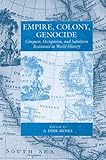
A. Dirk Moses, ed. Empire, Colony, Genocide: Conquest, Occupation, and Subaltern Resistance in World History. War and Genocide Series. Oxford: Berghahn Books, 2008. 480 pp. $95.00 (cloth), ISBN 978-1-84545-452-4.
Reviewed by Marc Becker (Truman State University)
Published on H-LatAm (October, 2012)
Commissioned by Dennis R. Hidalgo (Virginia Tech)
Genocide
“Genocide” is a relatively new term. The Polish-Jewish lawyer Raphael Lemkin coined the word in 1944 in the context of the Holocaust, and proceeded to campaign for its criminalization under international law. Lemkin conceptualized genocide as a “total social practice” that incorporated a broad range of factors that affected all aspects of human life. Writing under the context of Nazi rule, Lemkin pointed to eight different techniques that violators used to subjugate a dominated population. These ranged through political, social, cultural, economic, biological, physical, religious, and moral factors. Lemkin realized a partial success with his campaign when the United Nations passed the Convention on the Prevention and Punishment of the Crime of Genocide in 1948, but he was disappointed that the international body adopted a more narrow definition than what he would have preferred. Lemkin not only drew on the immediate context of the Second World War to understand genocide, but also framed it in the context of a long history of colonization and anticolonial writings. He spent the rest of his life working on a book exploring the historical roots of genocide, but died in 1959 without being able to publish his work.
It might seem that a book on genocide would engage in little more than setting up straw arguments to knock down, and that a book that reaches almost five hundred pages would be unnecessarily redundant. After all, where are we going to find a defender of genocide to balance out our anti-genocidal “bias” in order to assure lawmakers that both sides of every issue are fairly and objectively presented in the classroom? Nevertheless, in the preface to this collection, editor A. Dirk Moses notes that the volume’s nineteen chapters only begin to scratch the surface of genocide studies. He identifies it as a new and understudied field, and makes no claim to comprehensiveness. In fact, the 2003 conference on genocide and colonialism at the University of Sydney on which the book is based was apparently the first held on the topic.
The question of whether European colonial and imperial expansion beginning more than five hundred years ago were inherently genocidal and criminal fuel the discussions in this volume. Primarily approaching the issue from a historical perspective, the authors ask whether the term “genocide” could be used to understand the devastation of colonization. In the aftermath of the 1992 quincentennial of Christopher Columbus’s voyage across the Atlantic that notably shifted debates on the topic, this might seem to be an unnecessarily rhetorical or polemical question. At best, of course we know that Columbus (whether intentionally or not) launched one of the worst genocides in human history. At worse, these debates lead to a less than helpful discussion of guilt-ridden victimization studies. Moses’s volume Empire, Colony, Genocide does not fall into any of those traps. In fact, much of the material in this book is thoughtful and thought provoking, particularly for those with academic or political interests in imperialism and colonization.
Appropriately, the most notorious examples of genocide (the 1940s Holocaust in Germany, the killings of Armenians in Turkey earlier in the century, or Rwanda in 1994) are not a central focus of this volume. Instead, the authors seek to challenge and expand on commonly accepted notions and concepts of genocide. If the book has a particular focus, it is on settler colonialism in Australia, which is perhaps to be expected given that this is the home of the editor. Beyond that, a series of case studies draw from around the world, including historical examples from Cambodia, Canada, German-controlled Namibia and Tanzania in Africa, Russia, and Indonesia. Particularly in an introductory section of conceptual essays, the authors repeatedly turn to the Americas to understand the history of imperialism, colonialism, and genocide, and many other issues can fruitfully be applied to the study of this region of the world.
The authors in this collection debate whether genocide is a process rather than an event that can be analyzed through a comparative framework. Is genocide an aberration, or is it part of broader structural patterns? If it is an aberration, should it be judged against a normative standard of Western liberal democracies, which raises the dangers of ethnocentric interpretations? For his part, Lemkin conceptualized genocide as a two-stage process, with the first erasing the culture of a subordinate group and a second that replaced it with that of a dominate culture. Assimilation for Lemkin was not inherently genocidal, but required the use of physical or structural violence and the intent to destroy an entire culture.
In a provocative essay that presents settler colonialism as a structure rather than as an event, Patrick Wolfe draws a key distinction between genocide and mass murder. While obviously not all mass murders are genocide, Wolfe follows Lemkin’s broad definition of genocide to argue that assimilation of colonized populations into the dominate culture is a form of cultural genocide even if it does not result in murder. In contrast, Blanca Tovias examines Canadian governmental attempts to eradicate the Sun Dance from among the Blackfoot to ask whether genocide requires violence, and whether nonviolent assimilation can be justifiably interpreted as such. She cautions against applying the concept too broadly. In contrast, in an examination of German policy in Africa, Dominik Schaller unquestionably concludes that colonialism by its very nature requires physical or structural violence and is therefore inherently genocidal.
This book also raises the question of whether imperial adventures are ever justified. In Latin America, this issue is perhaps best conceptualized as part of the long-running debates over the actions of Bartolomé de las Casas. On the one hand, Las Casas did attempt to protect the survival of a threatened subaltern population. On the other, however, he remained committed to the religious conversion of the aboriginal inhabitants in the Americas. Such theological justifications for conquest would fall into Lemkin’s broad conceptualization of genocide. Nevertheless, Lemkin embraced Las Casas’s humanitarian impulses as a positive contribution that extended beyond the values of his time. Such complicated and conflictive categories are part of what makes it so difficult to reach a consensus on the meanings of genocide, with varying authors arguing for broader and narrower characterizations.
A final theme that the book raises is that of “subaltern genocide” that can result in a race war against an oppressive class, perhaps most notably as what happened in the Haitian revolution when former African slaves exterminated the French planter class. In thoughtful comments in the introduction to the volume, Moses draws on Frantz Fanon to draw a distinction between revenge killings and liberatory struggles. A danger is the emergence of a new national bourgeoisie out of a former colonial situation that exploits racial divisions to entrench their own privileged position in power. Instead, Moses points to the need to transcend race, and to recognize that a person’s racial or ethnic status does not necessarily determine a political position.
The book includes two detailed case studies of subaltern genocide, one of Eurasians in Indonesia in the 1940s and the other on the 1780 Tupac Amaru uprising. In an absolutely fascinating essay, David Cahill challenges what have become standard interpretations of the late colonial rebellion. Many scholars, on the one hand, have long argued that the pan-Andean uprising acquired characteristics of a race war when in 1781 its focus shifted southward to the Cataristas in La Paz. Cahill, on the other hand, argues for a more fundamental shift in Tupac Amaru’s strategy in the midst of the failed January 1781 siege of Cuzco. Initially the movement relied on elite creole support and resources, but a division in the troops led Tupac Amaru to turn on his former creole and mestizo allies who he now accused of treason. In what Cahill terms an abrupt and radical transformation from a multiethnic alliance to a genocidal caste war, the movement lost its earlier ideological bearings and became xenophobic, nativist, vengeful, violent, iconoclastic, and arguably genocidal. Tupac Amaru’s earlier decrees to kill all peninsular Spaniards now were extended to all creoles and mestizos--including men, women, and children--resulting in total warfare against a civilian population. While Cahill recognizes that the indiscriminate violence fed on centuries of colonial oppression that bred racial hatreds, rather than excusing the violations as regrettable excesses, he places the blame for the genocide directly on a charismatic leader who intentionally implemented a change in policy of racial revenge that drove such actions.
If Cahill is accurate in his assessment of a shift in Tupac Amaru’s policy, his arguments challenge what we think we know about the justification and legitimacy of his uprising as well as the statements and actions of his much more radical wife and second-in-command Micaela Bastidas. Even for those of us who inherently support subaltern actions can begin to recognize that the Spanish desire to halt the insurrection perhaps was motivated as much by humanitarian concerns to halt a genocide campaign as a political desire to reassert colonial hegemony. As with the Hutus and Tutsis in the 1994 Rwanda massacre, once we move beyond a class war to racial hatred, categories of who are the victims and whom we might want to support begin to blur. Such are the thought-provoking considerations that the probing contributions to Moses’s volume on genocide will raise among careful readers.
If there is additional discussion of this review, you may access it through the network, at: https://networks.h-net.org/h-latam.
Citation:
Marc Becker. Review of Moses, A. Dirk, ed., Empire, Colony, Genocide: Conquest, Occupation, and Subaltern Resistance in World History.
H-LatAm, H-Net Reviews.
October, 2012.
URL: http://www.h-net.org/reviews/showrev.php?id=32089
 | This work is licensed under a Creative Commons Attribution-Noncommercial-No Derivative Works 3.0 United States License. |

