



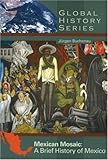
Jürgen Buchenau. Mexican Mosaic: A Brief History of Mexico. Global History Series. Wheeling: Harlan Davidson, 2008. Illustrations. 164 pp. $16.95 (paper), ISBN 978-0-88295-263-5.
Reviewed by William Suarez-Potts (Kenyon College)
Published on H-LatAm (October, 2012)
Commissioned by Dennis R. Hidalgo (Virginia Tech)
Mexican Mosaic is a brief survey text of the history of Mexico that concentrates on the period from 1821 to 2006. This national period in the country’s history is presented in ninety-four pages, with the first chapter, “The Making of Mexico,” summarizing both the pre-Columbian and colonial eras in a mere twenty-six pages. That the author, Jürgen Buchenau, is able to narrate the complex and layered history of Mexico in a meaningful and interesting way so succinctly is an accomplishment. The historian surely had to omit as much as he was able to mention, and summarize selectively the themes around which to elaborate a narrative, as he nearly acknowledges almost apologetically (p. 2). The survey’s emphasis on the political and economic developments that have contributed to the formation of modern Mexico reflects the historian’s extensive study of the country, and his experiences with it. (Buchenau has authored four books on Mexican history.) This work is presumably partly what its publisher (Harlan Davidson) and the editor of its Global History series wished: a readable, well-written text for an audience of secondary or college students. But it is also an interpretation of modern Mexican history by a scholar thoroughly grounded in the relevant historiography, whose personal experiences and links with the country add to his knowledge and consideration of it. The black-and-white photographs inserted in Mexican Mosaic, for example, include a few iconic images familiar to any student of the nation, but also many by Buchenau himself, which confirm his perception of the land and people, while enhancing the book. In this sense, an instructor assigning this text to students will be able to convey both a scholarly and a personal vision of the country’s evolution.
For Buchenau, Mexico is a mosaic composed of diverse peoples, regions, and cultures. It is an imagined national community, but, to quote, one in which, “over time, more and more Mexicans have participated” in “imagining” (pp. 6-7). Here, one can contrast Buchenau’s emphasis of the constructed nature of national ideologies in a country of distinct peoples and cultures with other surveys, which describe similar phenomena, but perhaps stress more the formation of a unified nation. Examples for contrast are Douglas Richmond’s The Mexican Nation (2002) and Alicia Hernández Chávez’s Mexico: A Brief History (2006) (at 367 pages, not including the index, not so very brief in comparison to some works). Both books, it should be noted, are cited in the helpful bibliographic essay of Mexican Mosaic. Still, regardless of possible interpretive stances, all of these surveys tend to focus, to a large degree, on the political evolution of the country. In Mexican Mosaic, the chapter titles suggest major political and economic trends over two hundred years. Thus, chapter 2, “Independence and Upheaval,” is self-explanatory; chapter 3, “Liberal Modernization,” covers the period of the Restored Republic and the Porfirian regime (and quite effectively as a single unit); chapter 4 is centered on the Mexican Revolution (1910-46); and chapter 5 recounts the years since World War II, concluding with the inauguration of President Felipe Calderón. Timelines on the inside covers of the book span from 200 BCE to 2000 CE. Besides the up-to-date bibliographic essay, there is a glossary of terms and a useful index.
Mexican Mosaic has two major themes, according to its author: “Mexico in the global community and the negotiation of power” (p. 2). The first appears to be one largely prescribed by the publisher of the series. Indisputably, Mexican history has become interrelated with that of the United States; and, just as indisputably, first, as a colony of silver mining, and, more recently, as a cultural center in the Hispanic world, Mexico has contributed to global developments. But these connections are difficult to detail or even outline within the parameters of a brief survey. Thus, Buchenau notes twice (pp. 6, 70) that the country’s silver reached India and China, but he cannot discuss fully Mexico’s integration into global commercial networks as early as in the sixteenth and seventeenth centuries; nor, to cite another example, can he extend his notation of José Vasconcelos’s “the cosmic race” to a discussion of its probable influences on the genesis of Víctor Raúl Haya de la Torre’s thought while the Peruvian political leader was in exile in Mexico, or, more generally, to the cultural and social implications of the Mexican Revolution for Latin America and elsewhere (p. 9).
The accounts of political contests (reflecting the second organizational theme of the book) reflect better the author’s thoughtfulness in explaining Mexico’s trajectory since independence. Thus a section entitled “The Search for Stability, 1821-1854” vividly narrates in about ten pages the period from Agustín Iturbide’s coronation to the Plan of Ayutla. It not only touches on the distinctions between centralists and federalists and conservatives and liberals, but also comments on a different kind of clientelist politics, while defining the terms “caudillo” and “cacique” (and perhaps mistakenly attributing the latter to a Nahuatl root?) (p. 48). This is impressive: this period in particular is difficult to present in a meaningful way to students.
Buchenau begins his history of Mexico with a vignette of a peddler setting down her (Asian) wares on an opulent boulevard in Mexico City, the Paseo de la Reforma, “in front of a bank building” the day after the passionately contested presidential election of 2006. Very effectively he draws from this scene a historical context juxtaposing her social position and that of some of the passers-by in “expensive suits” (pp. 1-2). The author returns to the same scene in his conclusion to underscore the fact that despite political leaders’ projects--or dreams--to create “a strong, unified country bound together by a clear sense of national identity,” the peddler and “tens of millions of Mexicans” like her remain marginal to such projects (p. 129). It is an eloquent end to a history that could have been a dry, formulaic textbook. Definitely, the author’s interpretation of Mexico has produced something else: in many ways a perceptive, historical essay that still addresses a student audience and satisfies the pedagogical requirements of an accessible, introductory survey. For, ultimately, it is a Mexicanist (and scholar) fully dedicated to his subject who has written Mexican Mosaic.
If there is additional discussion of this review, you may access it through the network, at: https://networks.h-net.org/h-latam.
Citation:
William Suarez-Potts. Review of Buchenau, Jürgen, Mexican Mosaic: A Brief History of Mexico.
H-LatAm, H-Net Reviews.
October, 2012.
URL: http://www.h-net.org/reviews/showrev.php?id=32053
 | This work is licensed under a Creative Commons Attribution-Noncommercial-No Derivative Works 3.0 United States License. |

