



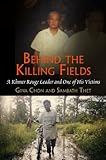
Gina Chon, Sambath Thet. Behind the Killing Fields: A Khmer Rouge Leader and One of His Victims. Philadelphia: University of Pennsylvania Press, 2010. Illustrations. 178 pp. $49.95 (cloth), ISBN 978-0-8122-4245-4.
Reviewed by Douglas Irvin (Rutgers University, Center for the Study of Genocide, Conflict Resolution, and Human Rights)
Published on H-Human-Rights (June, 2011)
Commissioned by Rebecca K. Root (Ramapo College of New Jersey)
Brother No. 2 and the Order of the Madness: Behind the Khmer Rouge Killing Fields
More than three decades after Phnom Penh fell in April 17, 1975, and the Khmer Rouge took power of the country, four surviving leaders of the brutal regime stand trial in a United Nations-backed court in Cambodia on charges of genocide, war crimes, and crimes against humanity. Foreign Minister Ieng Sary; his wife, Minister of Social Welfare Ieng Thirith; Head of State Khieu Samphan; and Noun Chea, the second in command to Pol Pot are all charged with the deaths of at least 1.7 million people between 1975 and 1979, during their attempt to manufacture an ideal agrarian society free of corrupting imperial forces and capitalist tendencies. Legal justice may have been a long time in the works, but historical truth seems to have concluded that Noun Chea, with the three other defendants and Pol Pot, who died in 1998, are guilty of genocide.[1] Yet, as Noun Chea awaits his trial, he remains defiant of the historians' verdict.
"What is the real truth and how do you find it out?" Noun Chea asks Gina Chon and Sambath Thet, authors of Behind the Killing Fields, a biographic history based on more than one thousand hours and six years worth of interviews with the elusive and secretive leader. "What is hiding inside the events?" Noun Chea continues: "The husband beats the wife and the wife beats the husband, so the violence is in the family and outsiders cannot understand" (p. 7). Noun Chea's question and analogy frame much of the book's inquiry, which traces the historical development of Khmer Rouge ideology and power by balancing standard historical accounts of the genocide against the personal stories of the Khmer Rouge's second most powerful leader and the stories of a victim and survivor, coauthor Sambath Thet. What emerges is not a history textbook, but rather a window into the psyche of the Khmer Rouge regime's most senior surviving leader.
The second in command to Pol Pot, Noun Chea is known as Brother Number Two. The intellectual architect of the regime's utopian ideals, he remains a loyal adherent to the Khmer Rouge's revolutionary cause to end poverty and purify Cambodian society. He justifies the deaths of so many as the necessary price of progress, and blames the Khmer Rouge's failure on the weak spirit of Cambodians who had been corrupted by the forces of modernity and foreign domination. At times, he seems oblivious to the regime's direct contribution to the lasting poverty of the country. A loving grandfather and loyal husband, an idealist, a reflective intellectual, Noun Chea is characterized by his devotion to self-discipline and his abstention from indulgence. The most searing criticisms of those who fell victim to his wrath are reserved for those he accuses of betraying the Khmer Rouge party through immorality--drinking too much alcohol or using their political power for sexual exploits. These "worms of the flesh" were enemies of the state because they could have "struggled" to improve Cambodia with the Khmer Rouge through hard work and devotion to revolutionary ideology (p. 5). The statement is absurd given that the Khmer Rouge turned the country into a "prison without walls," as Cambodians commonly refer to the time period, and forced people into village-sized work camps where nearly one-quarter of the country's population died from over work and starvation.
Chon and Thet, journalists for the Wall Street Journal and the Phnom Penh Post respectively, present the story of Noun Chea evenhandedly, allowing his statements to speak for themselves. This produces a curious set of incongruities as Noun Chea's account and interpretation diverge from that of historians and survivors. For instance, he says that the decision to evacuate Phnom Penh's residents to countryside work camps was pragmatic, not ideological. It was not that the Khmer Rouge were attempting to cleanse the country of corrupt urbanites and city life; rather, he claims, the city was emptied because there was not sufficient rice, oil, and food. Besides, "Phnom Penh was in disorder and confused and Lon Nol soldiers had weapons. Who would protect their safety?" (p. 15). In addition to presenting himself as the guarantor of human security (a paradox in and of itself), Noun Chea goes on to repeatedly present himself as the defender of the people and morality, bizarrely recounting how he instructed the starving to plant more vegetables for their health and "smashed" the perpetrators who raped girls and orchestrated state marriages to hide the pregnancies.
Noun Chea is no Adolf Eichmann, an unthinking traveling salesman who is swept up into the tide of Nazi history and comes to command the rail system that ships its human cargo toward ghastly doom, in Hannah Arendt's classic account Eichmann in Jerusalem: A Report on the Banality of Evil (1965). Critical, scholarly, and astute, the banality of Noun Chea's evil is not that he lost his faculties of moral judgment, but that he thought of the Khmer Rouge policies as fundamental good. This is in keeping with the most daring aspect of Arendt's thesis on the inversion of moral systems during genocides and mass atrocities. Neither is Noun Chea a Franz Stangl, the commandant of the Treblinka extermination camp who adamantly told his interviewer Gitta Sereny that he had no hate in his heart when he sent hundreds of thousands to their deaths (Into That Darkness: An Examination of Conscience [1983]). To the contrary, Noun Chea's account is filled with rage that emerges from the historical context of his youth.
In the psyche of Noun Chea, we find that the violence of the Khmer Rouge genocide has its antecedents in the colonial past, in economic exploitation following World War II, and in the indiscriminate U.S. bombing of the Ho Chi Minh Trail. In his memories, he rails against the brutality of French colonial rule; the Cambodian people who supported the French system; and systems of state torture under the Sihanouk and Lon Nol regimes during the 1950s and 60s that left his party members and friends paralyzed, blind, or dead.
Regardless of the validity of Noun Chea's self-constructed mythic origins as an anticolonial leader, this account allows us to further understand that genocidal violence is neither meaningless nor ahistorical.[2] As in his analogy of violence within a family that can never be understood from outside of the family, Noun Chea traces his desires to radically and violently realign Cambodian society to the political oppression under successive generations of Cambodian governments. He presents the Cambodian regimes between 1930 and 1975 as little more than the willing colonial clients of the patron states of France, China, Japan, and the United States. His heroes are the students shot down by U.S. troops at Kent State University and George Washington, whose biography left a strong impression on him when he studied it as a young man. These details, coming from a savvy political actor, feel like calculated attempts to garner sympathy from an American audience. And he clearly is attempting to cast himself as a liberation leader in just rebellion against oppression, and not as a genocidaire.
The history presented in this book is known to historians. Chon and Thet's greatest contribution to our understanding of this dark chapter in Cambodian history is that they allow a rare glimpse into the order of the madness of genocide. When Noun Chea tells us of how he would stand on the roofs of cars in Bangkok in the 1930s, speaking to crowds about "how the Cambodian people were slaves to France," we are reminded that solidarity and conviction, no matter how dark, are political variables of the heart that are not easily measured (p. 25). Against Noun Chea's persistent conviction in the righteousness of the Khmer Rouge cause, Chon and Thet present the brutal historical actuality of the genocide he is accused of leading with Pol Pot. The story is adorned with Thet's memories, a victim and survivor of the genocide, presenting the consequences of Noun Chea's policies in human terms. There are also the subtle symbols that serve to remind the reader of the nature of Noun Chea's utopian dream to "free" Cambodia: a bottle of ginger wine offered to the authors, a prized gift from North Korean president Kim Il Sung, whose state still serves as a model of strength and prosperity for Noun Chea. And there is his corroded, rusting pistol, "a relic from his glory days as Pol Pot's most senior lieutenant in charge of Cambodia," which remained by the side during the interview sessions "just in case" (p. 1).
This book serves as an important reminder that the coldest of despots remain human beings, filled with love and hate in what only appears to be a paradoxical capacity toward both compassion and vengeance.
Notes
[1]. On the Khmer Rouge regime as genocide, see Ben Kiernan, Genocide and Democracy in Cambodia: The Khmer Rouge, the United Nations, and the International Community (New Haven: Yale University Press, 1993); and Ben Kiernan, The Pol Pot Regime: Race, Power, and Genocide in Cambodia under the Khmer Rouge, 1975-79 (New Haven: Yale University Press, 1996).
[2]. See Alexander Laban Hinton, Why Did They Kill? Cambodia in the Shadow of Genocide (Berkeley: University of California Press, 2005). And, for a political history of the Khmer Rouge, see David P. Chandler, The Tragedy of Cambodian History: Politics, War, and Revolution since 1945 (Chiang Mai: Silkworm Books, 1993).
If there is additional discussion of this review, you may access it through the network, at: https://networks.h-net.org/h-human-rights.
Citation:
Douglas Irvin. Review of Chon, Gina; Thet, Sambath, Behind the Killing Fields: A Khmer Rouge Leader and One of His Victims.
H-Human-Rights, H-Net Reviews.
June, 2011.
URL: http://www.h-net.org/reviews/showrev.php?id=31980
 | This work is licensed under a Creative Commons Attribution-Noncommercial-No Derivative Works 3.0 United States License. |

