



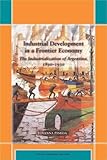
Yovanna Pineda. Industrial Development in a Frontier Economy: The Industrialization of Argentina, 1890-1930. Social Science History Series. Stanford: Stanford University Press, 2009. Tables, graphs. xiii + 209 pp. $55.00 (cloth), ISBN 978-0-8047-5983-0.
Reviewed by Vera Blinn Reber (Shippensburg University)
Published on H-LatAm (February, 2014)
Commissioned by Dennis R. Hidalgo (Virginia Tech)
Argentine Industries Failed to Surpass Agricultural Sector Growth
Yovanna Pineda brings new analysis and a deeper understanding to the question that has plagued Argentine economic history. Using new data sets and statistical analysis, the author explains why Argentina failed to create a sustainable manufacturing sector, which would surpass the importance of the agricultural sector. Although her focus is on the years between 1890 and 1930, her analysis of company data and decision-making policy provides a basis for understanding the economic challenges that Argentina faced in both the first part of the nineteenth century and later in the twentieth century.
Pineda begins Industrial Development in a Frontier Economy by noting the obstacles Argentina faced in seeking to industrialize. The country had a viable railroad network, a growing consumer market, expanding capital markets, and the necessary legal institutions. Nevertheless, industrial growth was hampered by unpredictable economic cycles; limited bank lending practices; inappropriate tariffs; low labor productivity; high costs of machinery, raw materials, and fuel; and failure to obtain economies of scale because of slow adaptations to new technology. The four schools of thought that have examined Argentina’s industrial sector in the twentieth century are dependency studies, entrepreneurship studies, studies focusing on failures of leadership of the landholding class, and “old” and “new” economic studies. The author views her work as part of the economic studies school because of the questions she asks and her use of statistical and econometric evidence.
In chapter 2, “Manufacturing Productivity and Concentration, 1895-1935,” the author provides four tables that deal with labor productivity, child and female workers, sector productivity, and economies of scale. The evidence supports the conclusion that Argentine industry from its beginning was inefficient, labor intensive, and incapable of filling domestic demands. Two major tables and one graph support the argument that although companies mechanized, owners failed to import new machinery in a timely fashion, to make innovations, or to take necessary risks.
Because Argentine banks limited credit, merchant finance groups had to obtain capital through their own businesses. This required the creation of alliances. Pineda creates a new data set of company directors and major shareholders from fifty-nine companies from brewing through tobacco. From this data, the author creates a table of five finance groups: Bemberg, Devoto, Paper, Soulas, and Tounquist. For each group, she lists their major investments and companies. As the table illustrates, inefficient capital markets did not prevent industrialization. However, because industries had to self-finance, those who had the best alliances could expand while companies with few networks remained small and noncompetitive.
Pineda supports her discussion of manufacturing profits and strategies with four tables and four graphs. Of particular interest is her table on industrial sector returns, which show double digit average return on stockholder equity for all sectors except paper, soap, and textiles. Given the steady profits and the inadequate banking and stock market, it is not surprising that Argentine-manufacturing companies failed to take additional investment risks and focused on the short run. The author explains her methods of calculating Argentine machine investments and profits in the appendices.
The author further argues that tariff policies from 1900 to 1930 failed to support greater industrialization and led to the national industrial structure of a few modern large firms and the existence of many small inefficient firms, which served the domestic market. In effect, the tariff structure protected domestic manufacturers from competing imports and led to the production of lower quality goods. By the 1920s, government leaders assumed that the best way for government to promote industrialization was to provide more protection to domestic industries, yet congressional legislation remained primarily short term and political in orientation. Congress failed to consider long-term consequences and to adapt a forward-looking industrial plan. This pattern continued through the 1980s.
Pineda concludes that Argentine industries grew significantly from 1869 to 1930 but remained second to agriculture. Argentine manufacturers were never able to surpass the economic significance of agriculture because manufacturers were unwilling to pay for expensive technology or innovations and the government failed to support the availability of credit, capital, and long-term planning. Leading manufacturers responded rationally to steady profits but failed to address long-term challenges of quality and foreign competition. In fact it appears that the Argentine businessmen’s decision-making process, the significance of family alliances, and the problems of capital and credit did not radically change from the challenges that mercantile houses faced at the beginning of the nineteenth century.
I have two basic criticisms of Industrial Development in a Frontier Economy. First is Pineda’s use of the phrase “frontier economy” in the title of her book. My initial reaction was that the author was going to examine industries in the northern Argentine provinces. This was a false assumption because the author focuses on the province of Buenos Aires. Since the author never specifically discusses her exact meaning of “frontier,” the reader is left with several possible interpretations. Argentine industry may be viewed as on the edge of world industrial development or perhaps Argentine industry was poorly developed. Second, it would have been helpful if the author had included a chapter comparing the economic growth of agriculture and industry. Pineda states that “agricultural productivity increased over time because of technical advancements in agricultural machinery, cattle breeding, and seeding methods” (p. 128). Although the statement is probably true, the author provides little evidence. Moreover, why was the agricultural sector more willing to take risks and to innovate? This question is of particular interest since in many cases the same families were involved in both agriculture and industry.
Industrial Development in a Frontier Economy displays outstanding scholarship. The number of tables and the statistical evidence is impressive. The author is clear and concise and has provided significant evidence to support her thesis. Although her arguments are too sophisticated for most undergraduates, this work will introduce graduate students to an important issue of Argentine history and provide an example of the new approaches that economic historians use. Any future discussions of Argentine economic growth will most certainly need to consider the conclusions that Pineda reaches on the issues surrounding Argentina’s failure to maintain sustainable industrial growth and manufacturing’s inability to surpass agricultural sector growth.
If there is additional discussion of this review, you may access it through the network, at: https://networks.h-net.org/h-latam.
Citation:
Vera Blinn Reber. Review of Pineda, Yovanna, Industrial Development in a Frontier Economy: The Industrialization of Argentina, 1890-1930.
H-LatAm, H-Net Reviews.
February, 2014.
URL: http://www.h-net.org/reviews/showrev.php?id=31870
 | This work is licensed under a Creative Commons Attribution-Noncommercial-No Derivative Works 3.0 United States License. |

