

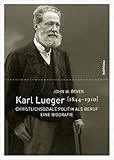
John W. Boyer. Karl Lueger (1844-1910): Christlichsoziale Politik als Beruf. Eine Biographie. Vienna: Böhlau Verlag, 2009. 595 pp. $50.00 (cloth), ISBN 978-3-205-78366-4.
Reviewed by Lothar Hoebelt (University of Vienna)
Published on HABSBURG (January, 2012)
Commissioned by Jonathan Kwan (University of Nottingham)
The Strange Death of Liberal Vienna
John W. Boyer’s two magisterial volumes on the rise of the Christian Social movement (Political Radicalism in Late Imperial Vienna: Origins of the Christian Social Movement in Vienna, 1848-1897 [1981] and Culture and Political Crisis in Vienna: Christian Socialism in Power, 1897-1918 [1995]) have long since become the standard work on Karl Lueger’s party. They do not just offer an interpretation, a fresh outsider’s view of a controversial local figure, but provide the reader with the results of detailed research that for all the fascination of the subject, Austrians never really bothered to do themselves. Part of the problem has always been that while there are beautifully preserved aristocratic archives for the turn of the century and while some bourgeois politicians like Karel Kramář or Joseph Maria Baernreither have bequeathed dozens of boxes of papers to posterity, there is no cache of Lueger papers--and the same holds true for his closest collaborators. Rather than write many letters, Vienna politicians, one must assume, met in the proverbial “smoke-filled rooms.”
Now, of course, everyone in present-day academe is supposed to read English. But if students read anything at all, one still wonders whether they will read 1,200 pages in a foreign language. This is why a German version of Boyer’s magnum opus has long since been a desideratum. For the centenary of Lueger’s death in 1910, Böhlau has now finally produced an attractive one-volume version of Boyer’s findings in German (albeit with a slightly awkward subtitle). With less than six hundred pages, the German version is only about half as long as Boyer’s original two volumes. Thus, some parts had to be left out, for example, the chapter “White Collar Radicalism and the Elections of 1891,” or the chapters dealing mainly with imperial politics or relations with Franz Ferdinand from volume 2. However, despite the biographical approach, the story does not end with Lueger’s death. In fact, about a third of the book is devoted to Lueger’s political heirs and to his political legacy, including an essay on Ignaz Seipel, the equally controversial mastermind of the First Austrian Republic; and a new summary that explicitly draws parallels between machine politics in Vienna and Chicago. Boyer has also incorporated a lot of new source material about Catholic approaches to social policy into his first chapters.
Today’s Austrians have usually forgotten that there was a Catholic and conservative tradition, a cleavage between clericals and anticlericals, long before Lueger’s rise to power. Lueger was neither the founding father of Catholic politics (nor, for all that, of anti-Semitism) nor was he a simple convert to the cause. His Christian Social Party was a creature sui generis. It did not merge with rural conservatives until 1907 and did not really become all that Catholic until a few years later. Lueger did not only come from a (left) liberal background, he appropriated and continued many of their traditions. At the time, Lueger was seen as the proponent of a catchall (or almost all) party, a “Wurstkesselpartei” that included all sorts of ingredients. True, as a speaker at a recent book presentation pointed out, nothing has damaged Lueger’s reputation abroad as much as the few lines of praise showered on him--against the wishes of people on both sides of the divide--in Adolf Hitler’s Mein Kampf. Yet no one has better summed up the context of Lueger’s brand of anti-Semitism than Boyer when he writes about the gradual transformation of Lueger’s protest alliance into the Christian Social Party at a time when clericalism was a far bigger taboo in polite circles than anti-Semitism: “He could not afford clericalism without anti-Semitism, and he could not accept anti-Semitism without clericalism” (p. 95).
Above all, Lueger did so in the context of a big city. One of the many strengths of Boyer’s book is his genuine interest in the running of such a big city and of the workings of its administration. Lueger did create machine politics; that in itself was hardly a liberal policy. But it did serve liberal ends, as Boyer makes clear. It enabled the city self-government to stand up to the imperial bureaucracy or at least to cooperate with it at eye level, thus giving lie to the old lament about “the weakness and passivity of Central European ‘Bürgertum.’” Boyer continues: “Nationalism that underpinned much of the vitality of the movement, but never dominated it exclusively, was not only a destructive centrifugal process but at the same time an emancipatory centripetal process that enabled citizens to have a say in shaping their lives” (p. 450).
Boyer has been one of the first to point out that as such political parties and their machines gained in influence when they started to divide the ex-imperial bureaucracy among themselves after 1918. Yet he concludes his book with the following lines: “Lueger actually ran Vienna the way the monarch ran his Empire. Thus it is difficult to imagine how he could have survived in the thinner and more egalitarian air of the First Republic” (p. 456). In a way it is rather fitting that these days, in Vienna, some people with little power and a surfeit of ideology are every now and then lobbying for the renaming of the square named after Lueger, the mayor who enjoyed wielding power and had a fairly instrumental view of any –isms.
If there is additional discussion of this review, you may access it through the network, at: https://networks.h-net.org/habsburg.
Citation:
Lothar Hoebelt. Review of Boyer, John W., Karl Lueger (1844-1910): Christlichsoziale Politik als Beruf. Eine Biographie.
HABSBURG, H-Net Reviews.
January, 2012.
URL: http://www.h-net.org/reviews/showrev.php?id=31821
 | This work is licensed under a Creative Commons Attribution-Noncommercial-No Derivative Works 3.0 United States License. |

