



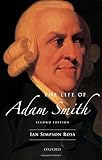
Ian Simpson Ross. The Life of Adam Smith. Oxford: Oxford University Press, 2009. 500 pp. $45.00 (cloth), ISBN 978-0-19-955003-6.
Reviewed by Maureen Harkin (Reed College)
Published on H-Albion (October, 2011)
Commissioned by Jeffrey R. Wigelsworth (Red Deer Polytechnic)
Harkin on Ross's The Life of Adam Smith
When Ian Simpson Ross published the first edition of his Life of Adam Smith in 1995 it had been many years since the last full-scale biography of his subject. Despite the status of The Wealth of Nations (1776) and to a lesser extent, The Theory of Moral Sentiments (1759), Smith had not, until quite recently, attracted much specifically biographical investigation. Before 1995 the most recent major biography had been W. R. Scott’s in 1937, preceded by John Rae’s in 1895 and the foundational text of all Smith biographies, Dugald Stewart’s short biographical sketch of 1795.[1] For all the intimate knowledge Stewart had of Smith’s life and circle, his short narrative concluded with a note of disappointment, the suggestion being that the biographer’s task was, in the case of Smith, rendered extraordinarily difficult by the subject’s life being so “barren of incident.”[2]
The relative paucity of biographical commentary on Smith before Simpson Ross would appear to be testament to the kind of challenge Stewart noted, rather than to a lack of interest in Smith’s work and influence. Adding to the problem of lack of incident, there is a further obstacle to writing any life of Smith: the lack of any substantial record left by Smith in correspondence or journals. Smith appears--perhaps even more notably to readers accustomed to the constant flow of twenty-first-century electronic communications--to have been constitutionally disinclined to commit himself in writing, with the exception of course being his magisterial treatises. Smith famously had most of his surviving incomplete manuscripts burnt by his executors in a deathbed bonfire a few days before his demise in July 1790; Stewart commented on Smith’s unusually strong dislike of students taking any notes at all on his lectures; and, as the editors of Smith’s correspondence in the Glasgow edition of his works noted in 1977, in the golden age of letter-writing, Smith produced a remarkably small body of correspondence.[3] The total of surviving letters over a fifty-year period from 1740 to 1790 is well under two hundred, with only a few dozen more known to have existed. Such a record was reason both for friends like David Hume to complain of neglect to Smith, and for biographers to hesitate.
The co-editor of the 1977 volume of correspondence, part of the six-volume Glasgow edition of Smith’s works published between 1976 and 1987, was, of course, Ian Simpson Ross, and the meticulous reconstruction of the material circumstances of Smith’s life in the annotations to these letters formed the foundation for the extraordinary detail of his 1995 biography. Now within the same year, 2010, we have not only another major new biography of Adam Smith from Nicholas Phillipson, but a second edition of Ian Simpson Ross’s book.[4] That Smith is now attracting this level of biographical investigation is not the product of the discovery of any major new letters, documents, or facts, but of the dramatic surge of interest in Smith and the reevaluation of the significance of his work across a range of disciplines over the last three or so decades--an interest that the Glasgow edition has itself helped to foster.
Simpson Ross’s biography was acclaimed on its first publication for its command of every material detail of Smith’s daily life in Glasgow and Edinburgh. In its twenty-four chapters it followed the major stages of his personal and professional life, his writing of The Wealth of Nations and the Theory, including his numerous revisions, and other projects. Part of the achievement of Simpson Ross’s book is precisely in its accretion of the details of daily life and the implicit challenge this posed to the traditional image of Smith as unsociable, traditional since Stewart’s first sketch of Smith as awkward in company. Simpson Ross’s portrait stressed instead the range and depth of Smith’s social and familial relationships. Smith’s actual responses to particular situations, however--bringing back the body after the death of the younger brother in his charge, the Duke of Buccleugh, to the family home, for example (p. 234)--remain necessarily somewhat conjectural in light of the absence of Smith’s direct commentary: “It seems ... ”; “It is likely …”; and so on.
The new edition updates the text in incorporating references, albeit necessarily rather brief ones, to the abundant important work on Smith since 1995 (Samuel Fleischacker, Ryan Patrick Hanley, Emma Rothschild et al.) in the text and notes. As in the 1995 edition, Simpson Ross’s focus is on establishing contexts and connections rather than on reinterpreting Smith’s texts. The overall structure of the book is little changed, though Simpson Ross provides a reorganized and expanded account of the social and intellectual context in which Smith turned, in late 1766, from his travels abroad to the composition of The Wealth of Nations. Simpson Ross marks this shift by the interpolation of the chapter entitled “Transition,” a move that effectively pauses the narrative sequence to linger a little longer on the debates and personalities shaping the moment in which Smith wrote and his sense of their local and global consequence. As Simpson Ross suggests in the preface to the second edition, this is in part a response to scholarship of the last fifteen or twenty years on colonialism and postcolonialism, which has rendered more visible Smith’s concerns with the forms and reach of the late eighteenth-century British Empire in his work.
Two hundred and twenty years after his death, we now have two impressive and complementary recent biographies of Smith: Simpson Ross’s reconstruction of Smith’s society, daily life, writing habits, and relationships, and Phillipson’s tracking of the development of Smith’s ideas and intellectual character through his texts. While Simpson Ross’s study refrains from interweaving biography with a reinterpretation of Smith’s texts his work lays the strongest foundation for such interpretative work. His account will be mined for many years to come.
Notes
[1]. W. R Scott, Adam Smith as Student and Professor (Glasgow: Jackson, Son and Co., 1937); John Rae, Life of Adam Smith (London: Macmillan,1895); and Dugald Stewart, “Account of the Life and Writings of Adam Smith,” in Essays on Philosophical Subjects, ed. W. P. D. Wightman and J. C. Bryce, vol. 3 of Glasgow Edition of the Works and Correspondence of Adam Smith (Oxford: Oxford University Press, 1977).
[2]. Stewart, “Account of the Life,” 329.
[3]. Ernest Campbell Mossner and Ian Simpson. Ross, eds., Correspondence of Adam Smith, vol. 6 of Glasgow Edition of the Works and Correspondence of Adam Smith, revised edition (New York: Oxford University Press, 1987), vii.
[4]. Nicholas Phillipson, Adam Smith: An Enlightened Life (New Haven: Yale University Press, 2010).
If there is additional discussion of this review, you may access it through the network, at: https://networks.h-net.org/h-albion.
Citation:
Maureen Harkin. Review of Ross, Ian Simpson, The Life of Adam Smith.
H-Albion, H-Net Reviews.
October, 2011.
URL: http://www.h-net.org/reviews/showrev.php?id=31774
 | This work is licensed under a Creative Commons Attribution-Noncommercial-No Derivative Works 3.0 United States License. |

