



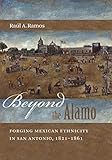
Raúl A. Ramos. Beyond the Alamo: Forging Mexican Ethnicity in San Antonio, 1821-1861. Chapel Hill: University of North Carolina Press, 2008. 204 pp. $35.00 (cloth), ISBN 978-0-8078-3207-3.
Reviewed by Matthew K. Saionz (Virginia Tech)
Published on H-LatAm (February, 2012)
Commissioned by Dennis R. Hidalgo (Virginia Tech)
Class and the Perseverance of Tejano Elites
Change and continuity within the Tejano community during the first half of the nineteenth century take center stage in Beyond the Alamo. Raúl A. Ramos traces these changes through an examination of Bexareño identity, the inhabitants of San Antonio de Bexar. His analysis involves multiple categories, including ethnicity, national identity, and class. Ramos explains how certain components of Bexareño identity became more significant than others at particular points in the narrative. National identity and ethnicity, which receive the most of Ramos’s attention, constantly shifted in importance in nineteenth-century Bexar. However, perhaps the most significant aspect of social identity in Ramos’s narrative is class. The elites in Bexareño society negotiated for prominent roles in the borderlands, either as liaisons to empresarios or as ambassadors to the Mexican government. The elite status of nineteenth-century Tejanos, thus, allowed for cooperative links between the wealthy in both the United States and Mexico in Ramos’s story.
Along with the continuous importance of elite status in the Southwest, Ramos considers how ethnicity and national identity saw constant shifts in their significance between 1800 and 1860. During the insurgency movements of the 1810s, for example, a distinct Mexican national identity formed and manifested even on Mexico’s northern frontier. Once independence from Spain was finally achieved in 1821, Ramos argues that Bexareños found themselves at the top of an ethnically diverse frontier society that included Mexicans, Europeans, Anglo-Americans, and indigenous peoples. Ramos attempts to illustrate the importance of ethnic identity in Bexar during the early 1820s through a revealing diagram. Using concentric circles, he places ethnic Mexicans at the center, followed by “mission Indians” (those deemed worth saving), American migrants, and indios barbaros (barbarous Indians) (p. 57). Although these distinctions were fluid, Ramos shows that Bexareño society operated through a deeply complex ethnic framework. However, during the period of Anglo colonization in the 1820s, the ambiguous national identity of Bexareños and their ability to act as middlemen between Anglo immigrants and Mexican officials kept them in a powerful place (p. 83). With the huge influx of Anglo migration, national identity pushed ethnic identity into a position of secondary importance in Texas. In contrast, once Texas separated from Mexico, Tejanos were obligated to operate within a new ethnic framework that placed non-Anglos in a subordinate social location (pp. 164-165). Ultimately, Tejano elites continued to negotiate for a prominent social space, even amidst unfavorable political dynamics and a social landscape that never ceased in its transformation.
The period between the independence of Texas and the U.S.-Mexican War proved to be extremely difficult for Tejanos. Ramos describes newly independent Texas as a place where Tejanos were considered a “suspect class” (p. 167). Their ethnic, social, and economic links to Mexico made Tejanos untrustworthy in the eyes of their Anglo neighbors, especially in the immediate wake of the violent Texan War for Independence. Ramos argues that annexation and eventual incorporation into the United States further confirmed that Bexareños and Tejanos in general would have to operate within an entirely new ethnic and racial structure--one that placed them near the bottom of the social hierarchy (pp. 203-204). Ethnicity, thus, constituted the focal point of identity in mid-nineteenth-century Texas, a transition that had undesirable consequences for the Tejano population. As Ramos so eloquently puts it, even while living in Texas, “Tejanos felt alienated from their homeland” (p. 204).
While Ramos acknowledges the crucial element of class in this story, even he falls short of fully grasping its paramount significance. As Bexareño society ebbed and flowed with the shifting tides of national and ethnic identity, the power of elite Tejanos persisted throughout the nineteenth century. It was the Bexareño elites who organized insurgency movements during the struggle for Mexican independence, just as it was the Tejano wealthy who mediated the negotiations between the first empresarios and the Mexican government. Similarly, Bexareño elites cleverly maneuvered the political channels to ensure that their communities were kept safe from the brunt of Anglo discrimination. In short, the Tejanos about whom Ramos writes belonged to the wealthy, upper echelon of Tejano society. They are at the center of his analysis for two reasons. First, they battled under all circumstances for the survival of Tejano power. Second, Bexareños left a visible and bountiful paper trail, which the lower classes did not. In other words, Ramos’s focus on Bexareño elites is just as much an issue of methodology as it is one of argument. While certainly Tejano elites did much for their communities in the nineteenth century, it would be difficult to prove otherwise.
Ramos’s account of Bexareño society fits well with recent movements in historiography. For example, in an essay about the scholarship of U.S.-Mexico borderlands, James Crisp argues for the need to both uncover and bring to the forefront the historical voices of Tejanos. Their stories, according to Crisp, are often lost “in the misrepresentation of their actual lives (usually through the omission of convenient facts) and in the co-option of their voices within the familiar linear narrative of Anglo-dominated progress.”[1] Beyond the Alamo goes a long way in heeding Crisp’s call. Looking beyond the veil of the Anglo metanarrative, Ramos not only analyzes the Bexareño elite through their own lenses, but also places them within the histories of both the United States and Mexico. Further, much like Andres Resendez does in Changing National Identities, Ramos offers a borderlands not of rigid boundaries, but rather one of constant transformation and contested identities.[2]
Where the classroom is concerned, Beyond the Alamo can help graduate and undergraduate students understand numerous historical topics and nuances of life in between two nations: the borderlands. Ramos reconnects the events of Mexico’s northern frontier to the general history of the nation. While always ambiguously “Mexican,” Bexareños celebrated Mexican independence and maintained political and economic ties with Mexico-even after formal separation in 1836. In addition, the story of Bexareños in the early nineteenth century lends much to the history of the United States. Ramos paints a landscape in which many of the same cultural and social issues that permeated the heart of the United States also manifested in Texas and other parts of the would-be American Southwest. For the borderlands themselves, Ramos shows how issues of identity become truly complicated when boundaries are blurred and governments are obligated to manage their national extremities from a considerable distance.
Ultimately, Beyond the Alamo reminds us that Tejanos (mostly elites) played vital roles in Mexican, independent, and U.S. Texas.
Notes
[1]. James E. Crisp, “¡Mucho Cuidado! Silencing, Selectivity, and Sensibility in the Utilization of Tejano Voices by Texas Historians,” in Recovering the Hispanic History of Texas, ed. Monica Perales and Raul A. Ramos (Houston: Arte Publico Press, 2010), 117.
[2]. Andres Resendez, Changing National Identities at the Frontier: Texas and New Mexico, 1800-1850 (New York: Cambridge University Press, 2005).
If there is additional discussion of this review, you may access it through the network, at: https://networks.h-net.org/h-latam.
Citation:
Matthew K. Saionz. Review of Ramos, Raúl A., Beyond the Alamo: Forging Mexican Ethnicity in San Antonio, 1821-1861.
H-LatAm, H-Net Reviews.
February, 2012.
URL: http://www.h-net.org/reviews/showrev.php?id=31735
 | This work is licensed under a Creative Commons Attribution-Noncommercial-No Derivative Works 3.0 United States License. |

