



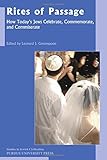
Leonard J. Greenspoon, ed. Rites of Passage: How Today's Jews Celebrate, Commemorate, and Commiserate. West Lafayette: Purdue University Press, 2010. 197 pp. $35.00 (paper), ISBN 978-1-55753-577-1.
Reviewed by Einat Ramon (Schechter Institute of Jewish Studies)
Published on H-Judaic (January, 2012)
Commissioned by Jason Kalman (Hebrew Union College - Jewish Institute of Religion)
The Many Faces of Jewish Ritual
Leonard J. Greenspoon has added a thought-provoking anthology to our bookshelves in which the many faces of Jewish rituals (mainly in the United States, England, and Israel) are celebrated. While Jewish feminists, like Debra Orenstein (Lifecycles Anthology [1994]), paved the way for the revival of interest in Jewish ritual, other anthropological studies and contemporary perspectives on Jewish life evolved into rich anthologies, such as Harvey Goldberg's The Life of Judaism (2001). Jews' interest and creativity in the area of ritual is, as I have suggested elsewhere, an inherent part and extension of the halakhic paradigm in Judaism, which translates theology into action in the material world. Yet it is unfortunate that a number of essays here, on such topics as egalitarian weddings and rituals celebrated with autistic children, overlook discussions of similar topics previously addressed in other anthologies on Jewish ritual. Steven Puzarne’s contribution on rites of passage for children with autism, for example, would have benefited from discussing Miri Lawrence's essay exploring the Passover Seder and Jewish education through the lens of her autistic child, an essay that could be useful to any (Jewish) educator anywhere in the world.[1] The absence of this encounter with other research is unfortunate because rather than continue to develop discussions on these topics, the essays offer as new conclusions perspectives reached by earlier scholarship.
Although the subtitle of Greenspoon's book makes explicit reference to the celebrations of "Today's Jews," what I find refreshing in this volume is the addition of historical dimensions to ritual usually missing in similar anthologies. Of special interest to me were Daniel Lasker's essay "Karaism: An Alternate Form of Jewish Celebration," which adds a medieval approach to the question of Jewish pluralism and diversity in ritual as it lays out the main features of the Karaite calendar, Karaite slaughter and Kashrut observance, and their stricter forbidden kin relations. It raises the question of whether modern pluralism differs from ancient splits and debates in the Jewish world, as well as the question of boundaries: where and when does a group deviate or not deviate from Judaism? Another piece of history of ritual, previously unknown to me because of geographic distance, I found in Rachel Kranson's essay on the extravagance of Bar Mitzvah receptions in post-Holocaust Jewish America. She examines American-Jewish laypeople's attraction to these receptions and rabbis' anxieties regarding this social phenomenon.
From the perspective of ritual theory, Vanessa Ochs's "Perspectives on Evaluating New Jewish Rituals" is a fascinating contribution. With the immense richness of new (particularly feminist Jewish) rituals, the question of how we "measure" their sociological-religious importance or contribution to the Jewish world is a valid one. Ochs correctly points out that many of the most traditional customs in Jewish rituals were new at some point and were probably regarded as "inauthentic" at the time; new rituals feel authentic only after applying them over time, linking the ritual to traditional texts and engaging the Hebrew language. In this context, it would have been interesting to consider which rituals introduced over the ages did not endure and to think further why certain ritual--or ritual symbols--have remained part and parcel of Jewish lives (e.g., breaking the glass at a wedding, Bar Mitzvah, and Tashlich [symbolically casting away sins at the New Year]). To explore this and perhaps predict what will remain of all of the new feminist rituals introduced primarily in America today, one must ask where and in what ways the existential concerns of that community were embedded?
Despite Ori Z. Soltes's fascinating piece on art and Jewish ritual objects, I am not sure that ritual necessarily functions as art, that is, as an expression of individuals' creativity; neither am I certain that the function of ritual is merely ethical in that it is established to express new moral sensitivities. Perhaps as an Israeli Jew I am prejudiced to view ritual as an expression of the community's (or the individual's) deepest anxieties, mostly regarding illness and death, and perhaps also regarding sex or sexual transitions as an expression of our anxieties about death. While the anthology too easily assumes that rituals demonstrate ethical transitions, I remain with the question of American Jewry's contemporary existential concerns and how these new rituals respond to these concerns. Unless the new rituals, such as using the Mikveh (ritual immersion) for pre-Bat Mitzvah ceremonies as portrayed in the very first essay of the anthology, respond to some deep cultural-emotional anxieties (about Jewish continuity? about too early or too promiscuous expressions of adult sexuality?), I doubt that these rituals will remain. Rituals marking menstruation prevailed in the premodern world because that bodily transition marked the end of childhood and the dramatic transition to sexual and familial adulthood. In the modern world, I am not sure that this is the case; I have yet to see a teenager in our day and age who wishes to celebrate her onset of maturation publicly or even among women close to her family. In the next anthology to be compiled on contemporary rituals, I suggest that these existential questions be addressed since they are the key to an in-depth understanding of modern Jews who generally live in an overly rationalistic, anti-ritualistic culture, yet who crave, like their ancestors, to express their yearning for meaning through symbolic acts, namely, rituals.
Note
[1]. Miri Lawrence, "The Little Boy Who Did Not Know How to Ask," in Taking Up the Timbrel: The Challenge of Creating Ritual for Jewish Women Today, ed. Sylvia Rothchild and Sybil Sheridan (London: SCM Press, 2000), 40-51.
If there is additional discussion of this review, you may access it through the network, at: https://networks.h-net.org/h-judaic.
Citation:
Einat Ramon. Review of Greenspoon, Leonard J., ed., Rites of Passage: How Today's Jews Celebrate, Commemorate, and Commiserate.
H-Judaic, H-Net Reviews.
January, 2012.
URL: http://www.h-net.org/reviews/showrev.php?id=31678
 | This work is licensed under a Creative Commons Attribution-Noncommercial-No Derivative Works 3.0 United States License. |

